
About Gisbert Combaz
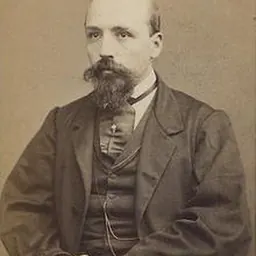
Lived 1869 – 1941 (aged 71). Gisbert Combaz was a Belgian painter, art educator, pedagogue, sinologist, lawyer and lithographer.
Gisbert Combaz, or Ghisbert Combaz (23 September 1869 – 18 January 1941), was a Belgian painter, lithographer, illustrator, poster artist, furniture designer, sculptor, art educator, art historian and lawyer. He originally trained and practised as a lawyer, but gave up his legal career to dedicate himself to art education and art. He was one of the leading Belgian Art Nouveau artists. Despite his talents as a painter, he is now mainly known for his poster designs and postcards as well as his First World War drawings expressing his hatred for the German occupiers. His work showed a strong influence of his in-depth study of Japanese and Chinese art.
Life
Gisbert Combaz was born in Antwerp as the son of engineering major Paul Combaz and Marie-Amélie Vanden Eynde.
From 1898 to 1940, he taught decorative arts at the École des arts industriels et décoratifs (School of Industrial and Decorative Arts) of Ixelles. He was appointed professor of art history at the Université Nouvelle (New University, later renamed 'Institut des Hautes Études de Belgique' (Institute of High Studies of Belgium)) in 1905 where he replaced Paul Janson as member of the Steering Committee. On 1 October 1912 he was appointed professor of ornamental composition at the Académie Royale des Beaux-Arts of Brussels. One of his students was René Magritte.
He was influenced by the work of the Belgian artistic and literary group known as Les XX, one of Europe's most prominent avant-garde circles and a catalyst for the development of Symbolism and Art Nouveau. Combaz exhibited with the group's successor, La Libre Esthétique starting from 1897 and designed many of the exhibition posters of the group. He also participated in group exhibitions of L'Estampe, an artists' association founded at the end of 1906 in Brussels. It brought together graphic artists with the intention of promoting the print medium through exhibitions. Its members included Fernand Khnopff, Auguste Danse, Richard Heinz, Auguste Oleffe, Henry De Groux, Marie Danse, Louise Danse, Georges Lemmen, Richard Baseleer, Willy Finch, Victor Mignot, Gustave-Max Stevens en Henri Meunier. Combaz never did a solo show during his career, and only one brief article about his work was published during his lifetime.
Combaz was very effective in transposing the Japanese wood block print style known as ukiyo-e to the medium of posters. In his Poster for the 1895 Expositions Peinture, Sculpture, Architecture, Arts Appliques at La Maison d’art, Brussels, Combaz succeeded like the Japanese masters to express the maximum with a minimum of resources. With the motif of the sailboat treated in a single flat color, his poster gains a great expressiveness equal to that of Japanese prints. Combaz wrote in the journal L'Art moderne that the quality of the Japanese landscapes is their chromatic unity: in each print there is a dominant palette which, by simplifying the impression, makes it strong and confers to these pictures a character of powerful homogeneity. These characteristics were clearly transposed by Combaz to his posters.
Combaz' work further shows the influence of contemporary movements such as cloisonnism and pointillism.
Combaz further designed book covers and postcards. Particularly well known are his postcards with designs of the four elements, scenes of the ocean and fishermen, expressions and proverbs. He further created a number of drawings that expressed the horror of the Belgians at the atrocities committed by the German occupiers during the First World War. One of his drawings called Louvain shows the terror of the citizens of Louvain at the burning down of their town by German soldiers on 25 August 1914. Combaz depicted in very graphic detail the horrified people fleeing the town with flames visible in the background of the drawing. La peinture chinoise vue par un peintre occidental, Introduction à l'histoire de la peinture chinoise, Extrait des Mélanges chinois et bouddhiques, publiés par L'Institut belge des Hautes Études Chinoises, vol. VI. Imprimerie Sainte Catherine, Bruges, 1939
Don’t just read it —
keep it.
Full-length biographies made to live with: read them, listen on the way to work, watch them tonight.
- E-book
- Audio
- Video
Instant download · yours to keep · every purchase keeps this site free
Important facts
Family & relationships
People in Gisbert Combaz's life
Named in this biography and alive at the same time



Related people
Same field, nearest in time



Contemporaries
People whose lives overlapped Gisbert Combaz's



Frequently asked questions
Who was Gisbert Combaz?
Belgian artist (1869–1941)
When was Gisbert Combaz born?
Gisbert Combaz was born on 23 September 1869 in Antwerp.
When did Gisbert Combaz die?
Gisbert Combaz died on 18 January 1941 in Saint-Gilles, Belgium.
What was Gisbert Combaz's occupation?
Gisbert Combaz was a painter, art educator, pedagogue, sinologist, lawyer and lithographer.
What nationality was Gisbert Combaz?
Gisbert Combaz was Belgian.
Sources & further reading
Cite this page
APA: Biography.guide. (2026). Gisbert Combaz. https://biography.guide/gisbert-combaz/
MLA: "Gisbert Combaz." Biography.guide, https://biography.guide/gisbert-combaz/.
Chicago: "Gisbert Combaz." Biography.guide. https://biography.guide/gisbert-combaz/.
Data last updated: 2026-09-20 · Spot an error? Report a correction.
Page generated 2026-09-27 05:30 UTC