
About Giovanni Villani
Lived 1280 – 1348 (aged 67–68). Giovanni Villani was an Italian diplomat, chronicler, historian, banker and writer.
Giovanni Villani (; 1276 or 1280 – 1348) His Cronica is viewed as the first introduction of statistics as a positive element in history. However, historian Kenneth R. Bartlett notes that, in contrast to his Renaissance-era successors, "his reliance on such elements as divine providence links Villani closely with the medieval vernacular chronicle tradition." In recurring themes made implicit through significant events described in his Cronica, Villani also emphasized three assumptions about the relationship of sin and morality to historical events, these being that excess brings disaster, that forces of right and wrong are in constant struggle, and that events are directly influenced by the will of God.
Villani was inspired to write his Cronica after attending the jubilee celebration in Rome in 1300 and noting the venerable history of that city. He outlined the events in his Cronica year for year, following a strictly linear narrative format. He provided intricate details on many important historical events of the city of Florence and the wider region of Tuscany, such as construction projects, floods, fires, famines, and plagues.
While continuing work on the Cronica and detailing the enormous loss of life during the Black Death in 1348, Villani died of the same illness. Traveling abroad as a factor for the company, Villani was paid a regular salary in addition to his shareholding profits. On May 15, 1306, one of the first exchange contracts (cambium) to mention the city of Bruges involved two parties: Giovanni Villani, representing the Peruzzi Company, granting a loan to Tommaso Fini, representing the Gallerani Company of Siena. Villani and his brother Matteo transferred most of their economic activities to the Buonaccorsi firm by 1322. Giovanni Villani was a co-director of Buonaccorsi in 1324. He went with the Florentine army to fight against Castruccio Castracani, lord of Lucca, and was present at Altopascio during Florence's defeat. In his Cronica, he gave a detailed account of why Florence was unable to acquire Lucca after the death of Castruccio Castracani.
Villani was the superintendent of the construction of Andrea Pisano's bronze doors for the Florence Baptistry.
Villani was sent on another diplomatic mission in 1329, this time to Bologna to meet Cardinal Bertrand de Pouget. He was also sent with others as a hostage to Ferrara, to ensure that Florence made good on a debt; he resided there for some months in 1341.
Villani often expressed an optimistic viewpoint in his writing; this changed with the short-lived regime of Walter VI of Brienne, a despot invited to Florence and granted signoria. In fact, after experiencing his own financial troubles, a terminated career, and the failure of Florence in international affairs, and witnessing a host of different natural calamities and the onset of the Black Death in Europe, he became convinced that the apocalypse and final judgement was near. Other banking companies also went bankrupt, such as the Peruzzi in 1343 and the Compagnia dei Bardi in 1346 (they were allied in a joint venture by 1336); Villani calculated that before their bankruptcy the Peruzzi had lost some 600,000 florins and the Bardi had lost some 900,000 florins. Although Villani attributed the losses to the companies' massive monetary loans to Edward III of England which were never repaid, historian Edwin S. Hunt suggests that the firms simply lacked the resources to have made such loans, which in all probability were much smaller and were not the key reasons for the companies' failures. The Bardi and Peruzzi were just two of many European banks that Edward III accepted loans from, prominent members of the Bardi and other Florentine families were owed only 63,000 Florins by Edward in 1348, and even a mass of small lenders and investors in Florence could not have made the necessary loan to England. The figure Villani asserted of 400,000 Florins owed to the Peruzzi by Edward alone equalled Villani's estimate for the entire payroll of 30,000 workers of the Florentine cloth industry in 1338. Hunt asserts that the failures of the Florentine banks seems closely tied to the expansionist policy of Florence in Tuscany, hoping that newly conquered territory would yield greater security for their trade with northern Europe, but instead resulted in costly campaigns and little profit. In addition to the questionable figures Villani posed for the Peruzzi and Bardi companies, it is also known that several events described in his Cronica surrounding the Buonaccorsi's bankruptcy were written to deliberately obscure the truth about the company's fraudulent behavior; Miller writes that "this is one of the most convincing conclusions" of historian Michele Luzzati's Giovanni Villani e la Compagnia dei Buonaccorsi (1971).
Villani and the Buonaccorsi had gained an unsavory reputation as early as 1331, when Villani was tried (and cleared) for barratry for his part in building the new third circuit of walls around Florence. Like other Florentine bankers and companies having difficulty with bankruptcy at the time, in September 1342 they supported the move to invite Walter VI of Brienne to become the next signor of Florence. Walter later suspended all legal actions taken against the Buonaccorsi and other company partners for nearly a year. After the overthrow of the Brienne regime and a subsequent but short-lived aristocratic signoria, the novi cives or new families—some even from the lesser guilds—rose up in late September 1343 and established a government that provided them with much greater representation in officialdom. Villani and other chroniclers disdained these rustic non-aristocrats who suddenly rose to power, considering them brazen upstarts incapable of governance. Yet by the 1350s the general attitude towards the novi cives had changed much, as even Villani's brother Matteo depicted them in a heroic light for being united in a coalition with the merchants and artisans to curb oligarchic power. Villani was also a staunch supporter of what he deemed the liberties of the Church, while criticizing the new popular government of the novi cives since they protested against the many legal exemptions the Church enjoyed. However, he did find civic pride in that the whole city—including the novi cives—had joined together in an uprising against Walter VI, whose sins of imposing tyranny were, to Villani, sufficient justification for the violence needed to overthrow him.
Nuova Cronica
The Battle of Crécy in 1346, from Froissart's Chronicles; Giovanni Villani wrote an accurate description of the battle and other events. Villani's work is an Italian chronicle written from the perspective of the political class of Florence just as the city rose to a rich and powerful position. Only scanty and partly legendary records had preceded his work, and there is little known of events before the death of Countess Matilda in 1115. In contrast, Rubinstein states Villani provided "a mature expression" of Florentine history. Villani states that the idea of writing the Cronica was suggested to him during the jubilee of Rome in 1300, Historian J. K. Hyde writes that the idea of Florence being the daughter of Rome would have given the Florentines a sense of destiny, while the second founding by Charlemagne provided historical context for alliance with France, which Hyde calls "the touchstone of Guelphism". Villani's reasoning for Rome's decline was the schisms of the Church and rebellion against the papal institution, while the ascension of Otto I, Holy Roman Emperor (r. 962–973) allowed for the conditions of Florence's rise against enemies of papal authority, such as Florentine-conquered Fiesole. Villani was certain that the Republic of Florence had experienced a great setback on its path to glory with the defeat of the Guelphs by the Ghibellines at the Battle of Montaperti in 1260. Despite this, Villani states that the paramount prosperity and tranquility of the city by 1293 was evidenced by the fact that its gates were no longer locked at night and that indirect taxes such as the gate fee (common in times of war) were not levied. Historian Felicity Ratté states that the validity of this comment should be heavily scrutinized considering the Florence statutes of 1290 that designated employment for individuals in charge of locking the city gates.
Villani wrote that the small cog type vessel with single mast, square sail, and stern-post rudder was introduced to the Genoese and Venetians in 1304 by pirates from Bayonne. In 1300 or shortly after, Villani began working on the Cronica, which was divided into twelve books; the first six deal with the largely legendary history of Florence, starting at conventionally biblical times with the story of the Tower of Babel up to the year 1264. The second phase, in six books, covered the history from 1264 until his own time, all the way up to 1346. He wrote his Cronica in the vernacular language rather than Latin, the language of the educated elite.
Despite numerous mistakes, Villani often displayed an insider's knowledge on many subjects, as a result of his extensive travels and access to both official and private documents. While describing detailed events unfolding within the city, Villani would name every individual street, square, bridge, family, and person involved, assuming his readers would have the same intimate knowledge of Florence as he did. For example, he recorded that in Florence there were 80 banks, 146 bakeries, 80 members in an association of city judges with 600 notaries, 60 physicians and surgical doctors, 100 shops and dealers of spices, 8,000 to 10,000 children attending primary school each year, 550 to 600 students attending 4 different schools for Scholastic knowledge, 13,200 bushels of grain consumed weekly by the city, and 70,000 to 80,000 pieces of cloth produced in the workshops of the Arte della Lana each year, the latter having a total value of .
Villani was a Guelph, However, Villani admitted in his writing that republicanism bred factional strife, that benevolent rulers like Robert of Naples were sometimes needed to keep order, and republicanism could become tyrannical if it came to represent only one class (such as exclusive favoring of aristocrats, merchants, or artisans). Villani's Cronica also provides the first known biography of Dante Alighieri (1265–1321), author of the Divine Comedy, who Villani described as haughty, disdainful, and reserved. In his revised Cronica of 1322, Villani shortened Dante's biography and the amount of quotations taken from his Divine Comedy. which shaped the organization of the work, "[channeling] events into recurring patterns of significance." Green writes that this story in the Cronica bears a resemblance to the ancient Greek story of Polycrates and his ring in the work of Herodotus. However, Green notes that Villani's "cautionary tales" disembarked from the Classical Greek tradition of the arrogant and haughty rich falling from fortune due to the Greek belief in equalizing forces determining one's unavoidable fate, which Green calls "excessive good fortune having to be balanced by an appropriate measure of sorrow." Villani wrote:
it seems that it happens in the lordships and states of earthly dignitaries, that as they are at their highest peak, so presently does their decline and ruin follow, and not without the providence of divine justice, in order to punish sins and so that no one should place his trust in fallacious good fortune. The interests of these two powers represent, as Green states, "the kingpin of Villani's scheme of historical interpretation." He believed that certain events were really omens of what was to come. For instance, when a lion was sent to Florence as a gift by Boniface VIII, a donkey purportedly killed the lion. However, he noted that the movement of the heavens would not always predetermine the actions of men and did not trump the divine plan of God. In the original account by the Ghent monk Jean de Thilrode in 1294, the Jew was compelled to convert to Christianity, but Villani's account followed that of the later Chronicles of Saint-Denis (1285–1328) which told that the Jew was burned to death for his crime. St. Antoninus, archbishop of Florence, repeated the story of Villani in his Latin Chronicles, while Villani's illustrated Cronica featured a scene of this French Jew that later appeared in a painting by Paolo Uccello.
Death and continuation of Villani's work
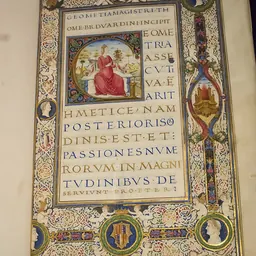
By the 16th century, more than one edition of the Cronica was available in printed form. There was also an abundance of handwritten illuminated manuscripts, including one from Venice by Bartholomeo Zanetti Casterzagense in 1537 and one from Florence by Lorenzo Torrentino in 1554. The Cronica is also an incredibly rich historical record; its greatest value to modern historians is its descriptions of the people, data, and events experienced by Villani during his lifetime. Historian Mark Phillips states that all subsequent Florentine accounts of the tyrannical regime of Walter VI of Brienne—including those by Leonardo Bruni and Niccolò Machiavelli—were based upon the primary source of Villani's Cronica. The reprinting of new editions of Villani's work in the early 20th century provided material for a resurgence in the study of Dante. However, Villani's descriptions of events which preceded him by centuries are riddled with inaccurate traditional accounts, popular legend, and hearsay. However, the early 20th-century historian Philip Wicksteed stated of Villani, "When dealing with his own times, and with events immediately connected with Florence, he is a trustworthy witness, but minute accuracy is never his strong point; and in dealing with distant times and places he is hopelessly unreliable." On Villani's estimation that a third of Antwerp's population died off during the Great Famine of 1315-1317, the early 20th-century historian Henry S. Lucas wrote, "not much faith can be placed in such statistics which are little better than guesses." Louis Green notes Villani's limitation as a chronicler and not a full-fledged historian:
Recording as he did incidents in the order of their occurrence without any of the historian's pretensions to a thematic organization of his material, he could not feed back the lessons of a changing present into a reinterpreted past. Nor did his devotion to the justification and glorification of Florence permit him to see in the altered fortunes of his city a repetition of the pattern of decline he had illustrated in the histories of the great dynasties of his age.
Louis Green asserts that Giovanni's Cronica expressed the outlook of the merchant community in Florence at the time, but also provided valuable indications of "how that outlook was modified in a direction away from characteristically medieval to embryonically modern attitudes." Green writes that Villani's Cronica was one of three types of chronicles found in the 14th century, the type which was largely a universal history.
Editions Pietro Massai (ed.). Istorie fiorentine di Giovanni Villani, cittadino fiorentino, fino all'anno MCCCXLVIII. 8 Volumes. Societè tipografica de' classici italiani, Milan 1802–1803 : Vol. 1 (primo), 1802; Vol. 2 (secondo); Vol. 3 (terzo); Vol. 4 (quattro); Vol. 5 (quinto); Vol. 6 (sesto), 1803; Vol. 7 (settimo); Vol. 8 (ottavo). Achille Mauri (ed.). Istorie fiorentine di Giovanni Villani. Nicolò Bettoni, Mailand 1834, Digitalisat . Giovanni Porta (ed.). Giovanni Villani: Nuova Cronica. 3 Volumes. Fondazione Pietro Bembo/Guanda, Parma, 1991, it.Wikisource . [Vol. I: books 1–8, Vol. II: books 9–11, Vol. III: books 12 and 13.] Philip H. Wicksteed (ed.). Villani's Chronicle. Selections from the First Nine Books of the Croniche Fiorentine of Giovanni Villani. Translated by Rose E. Selfe. Archibald Constable, London 1906, revised 2nd edition . Online at Project Gutenberg (2010).
Don’t just read it —
keep it.
Full-length biographies made to live with: read them, listen on the way to work, watch them tonight.
- E-book
- Audio
- Video
Instant download · yours to keep · every purchase keeps this site free
Important facts
People in Giovanni Villani's life
Named in this biography and alive at the same time




Related people
Same field, nearest in time





Contemporaries
People whose lives overlapped Giovanni Villani's



Frequently asked questions
Who was Giovanni Villani?
Italian merchant and historical writer (1280-1348)
When was Giovanni Villani born?
Giovanni Villani was born in 1280 in Florence.
When did Giovanni Villani die?
Giovanni Villani died in 1348 in Florence.
What was Giovanni Villani's occupation?
Giovanni Villani was a diplomat, chronicler, historian, banker and writer.
What nationality was Giovanni Villani?
Giovanni Villani was Italian.
Sources & further reading
Cite this page
APA: Biography.guide. (2026). Giovanni Villani. https://biography.guide/giovanni-villani-diplomat/
MLA: "Giovanni Villani." Biography.guide, https://biography.guide/giovanni-villani-diplomat/.
Chicago: "Giovanni Villani." Biography.guide. https://biography.guide/giovanni-villani-diplomat/.
Data last updated: 2026-09-22 · Spot an error? Report a correction.
Page generated 2026-09-27 05:20 UTC