About Giovanni da Cascia
Lived 1340 – 1350 (aged 9–10). Giovanni da Cascia was a composer.
Giovanni da Cascia, also Jovannes de Cascia, Johannes de Florentia, Maestro Giovanni da Firenze, was an Italian composer of the medieval era, active in the middle of the fourteenth century.
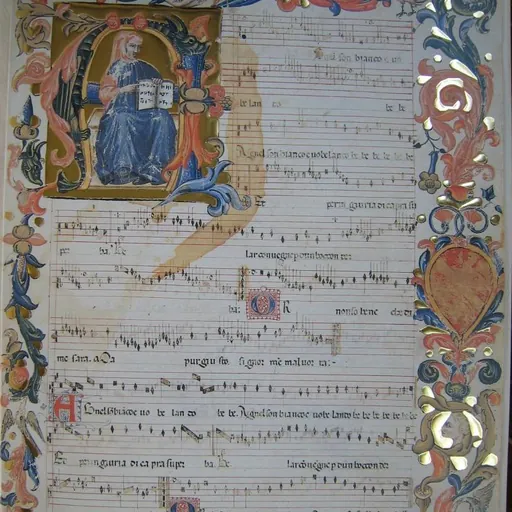
Life and career Virtually nothing is known about Giovanni's life. From his surname it is presumed that he was born in the village of Cascia, near Florence. It was once thought that he held a post at Florence Cathedral, but this is no longer accepted. A Florentine chronicle states that Giovanni and Jacopo da Bologna competed at Mastino II of Scala's court; Mastino died in 1351. The metaphors used in his works are consistent with prevailing idioms of the mid-14th century. His portrait in the Squarcialupi Codex shows him without priestly garments.
Music Nineteen of Giovanni's compositions survive, scattered in nine manuscripts. Sixteen of these are madrigals, and three of them are cacce. He is thought to have written some of his own texts. Musically, Giovanni's madrigals are of importance in the development of the style of the 14th-century madrigal. He tends to use extended melismas on the first and penultimate syllables of a poetic line, and sometimes introduces hockets at these points. The middles of the lines are generally syllabic. Many of his works are very similar in style to the anonymous works preserved in the Rossi Codex.
Several of his works survive in quite different versions; this is evidence that improvisation was still an important aspect of musical performance up to this time. Giovanni's works tend not to be tonally unified; they begin and end on different notes, and in some cases, such as Nascoso el viso, each poetic line begins and ends on different notes. Occasional imitation is found in his work.
Works Madrigals (all for two voices) Agnel son bianco Appress’un fiume chiaro Deh, come dolcemente Donna già fu’ Fra mille corvi In su la ripa La bella stella Nascoso el viso Nel meço a sei paon O perlaro gentil O tu, cara sciença Per ridda andando ratto Più non mi curo Quando la stella Sedendo all’ombra Togliendo l’una a l’altra
Cacce (all for three voices) Con brachi assai Nel bosco sença foglie Per larghi prati
Doubtful De soto ’l verde (2 voices)
Lost Soni multi et ballate (1 voice)
Editions Editions of all of Giovanni's works have been completed by W. Thomas Marrocco and Nino Pirrotta in the twentieth century.
Don’t just read it —
keep it.
Full-length biographies made to live with: read them, listen on the way to work, watch them tonight.
- E-book
- Audio
- Video
Instant download · yours to keep · every purchase keeps this site free
Important facts
Related people
Same field, nearest in time




Frequently asked questions
Who was Giovanni da Cascia?
Italian composer
When was Giovanni da Cascia born?
Giovanni da Cascia was born in 1340.
When did Giovanni da Cascia die?
Giovanni da Cascia died in 1350.
What was Giovanni da Cascia's occupation?
Giovanni da Cascia was a composer.
Sources & further reading
· Wikipedia: Giovanni da Cascia
Cite this page
APA: Biography.guide. (2026). Giovanni da Cascia. https://biography.guide/giovanni-da-cascia/
MLA: "Giovanni da Cascia." Biography.guide, https://biography.guide/giovanni-da-cascia/.
Chicago: "Giovanni da Cascia." Biography.guide. https://biography.guide/giovanni-da-cascia/.
Data last updated: 2026-09-22 · Spot an error? Report a correction.
Portrait: Wikimedia Commons · author & licence
Page generated 2026-09-27 05:03 UTC