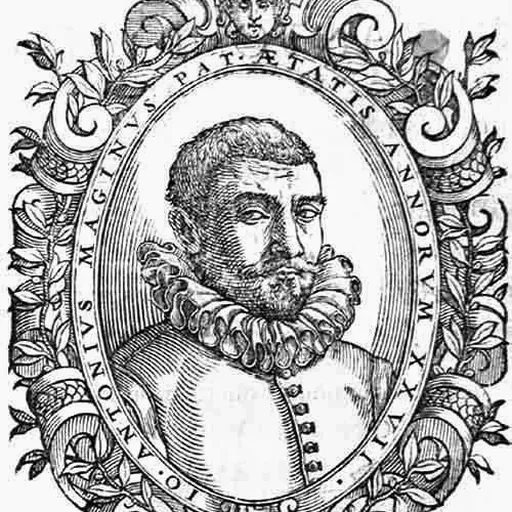
Giovanni Antonio Magini
Italian mathematician, cartographer and astronomer
About Giovanni Antonio Magini
Lived 1555 – 1617 (aged 61). Giovanni Antonio Magini was an Italian astronomer, mathematician, astrologer, cartographer and philosopher.
Giovanni Antonio Magini (in Latin, Maginus) (13 June 1555 – 11 February 1617) was an Italian astronomer, astrologer, cartographer, and mathematician.
His Life He was born in Padua, and completed studies in philosophy in Bologna in 1579. His father was Pasquale Magini, a citizen of Padua. Dedicating himself to astronomy, in 1582 he wrote Ephemerides coelestium motuum, translated into Italian the following year.
In 1588 he was chosen over Galileo Galilei to occupy the chair of mathematics at the University of Bologna after the death of Egnatio Danti. He died in Bologna on 11 February 1617.
His work
Magini supported a geocentric system of the world, in preference to Copernicus's heliocentric system. Magini devised his own planetary theory, in preference to other existing ones. The Maginian System consisted of eleven rotating spheres, which he described in his Novæ cœlestium orbium theoricæ congruentes cum observationibus N. Copernici (Venice, 1589).
In his De Planis Triangulis (1592), he described the use of quadrants in surveying and astronomy. In 1592 Magini published Tabula tetragonica, and in 1606 devised extremely accurate trigonometric tables. He also worked on the geometry of the sphere and applications of trigonometry, for which he invented calculating devices. He also worked on the problem of mirrors and published on the theory of concave spherical mirrors.
He also published a commentary on Ptolemy’s Geographia (Venice, 1596).
As a cartographer, his life's work was the preparation of Italia or the Atlante geografico d'Italia (Geographic Atlas of Italy), printed posthumously by Magini's son in 1620. This was intended to include maps of every Italian region with exact nomenclature and historical notes. A major project, its production (begun in 1594) proved expensive and Magini assumed various additional posts in order to fund it, including becoming tutor in mathematics to the sons of Vincenzo I of Gonzaga, Duke of Mantua, a major patron of the arts and sciences. He also served as court astrologer. The Duke of Mantua, to whom the atlas is dedicated, assisted him with this project and allowed for maps of the various states of Italy to be brought to Magini. The governments of Messina and Genoa also assisted Magini financially in this project. Magini did not do any of the mapping himself.
A strong supporter of astrology, he defended its use in medicine in his De astrologica ratione (Venice, 1607). Magini collaborated closely with Valentine Naibod, and in this book he published De annui temporis mensura in Directionibus and De Directionibus from Naibod's unfinished manuscript Claudii Ptolemaei Quadripartitae Constructionis Apotelesmata Commentarius novus et Eiusdem Conversio nova. He was also interested in metoposcopy.
He corresponded with Tycho Brahe, Clavius, Abraham Ortelius, and Johann Kepler. His correspondence was edited in 1886 by Antonio Favaro. Magini was an early critic of Galileo's 1610 identification of the Galilean moons of Jupiter and lunar mountains. Magini's one-time secretary, Martin Horký, published an aggressively anti-Galilean pamphlet in 1610, though Magini cut ties with Horký shortly before it was published. published in Italian as "Geografia cioe Descrittione Universale della Terra" 1596 Venice. Latin text. Printer Heredes Simoni Galignani. 64 copper-plate maps. 1597 Cologne. Latin text. Printer Petrus Keschedt. 64 copper-plate maps. 1598 Venice. Italian text. Printer Gio. Battista & Giorgio Galignani Fratelli. Artist Girolamo Porro. 64 copper-plate maps. 1608 Cologne. Latin text. Printer Antonius Becker. 63 copper-plate maps. 1617 Arnheim. Latin text. Printer Ioannes Ianssonius. 64 copper-plate maps. 1621 Padua. Italian text. Printer Paolo and Francesco Galignani. 64 copper-plate maps.
Gallery
Don’t just read it —
keep it.
Full-length biographies made to live with: read them, listen on the way to work, watch them tonight.
- E-book
- Audio
- Video
Instant download · yours to keep · every purchase keeps this site free
Important facts
People in Giovanni Antonio Magini's life
Named in this biography and alive at the same time



Related people
Same field, nearest in time

Contemporaries
People whose lives overlapped Giovanni Antonio Magini's



Frequently asked questions
Who was Giovanni Antonio Magini?
Italian mathematician, cartographer and astronomer (1555–1617)
When was Giovanni Antonio Magini born?
Giovanni Antonio Magini was born on 13 June 1555 in Padua.
When did Giovanni Antonio Magini die?
Giovanni Antonio Magini died on 11 February 1617 in Bologna.
What was Giovanni Antonio Magini's occupation?
Giovanni Antonio Magini was an astronomer, mathematician, astrologer, cartographer and philosopher.
What nationality was Giovanni Antonio Magini?
Giovanni Antonio Magini was Italian.
Sources & further reading
· Wikipedia: Giovanni Antonio Magini
· DBpedia: Giovanni Antonio Magini
Cite this page
APA: Biography.guide. (2026). Giovanni Antonio Magini. https://biography.guide/giovanni-antonio-magini/
MLA: "Giovanni Antonio Magini." Biography.guide, https://biography.guide/giovanni-antonio-magini/.
Chicago: "Giovanni Antonio Magini." Biography.guide. https://biography.guide/giovanni-antonio-magini/.
Data last updated: 2026-09-21 · Spot an error? Report a correction.
Portrait: Wikimedia Commons · author & licence
Page generated 2026-09-27 05:01 UTC