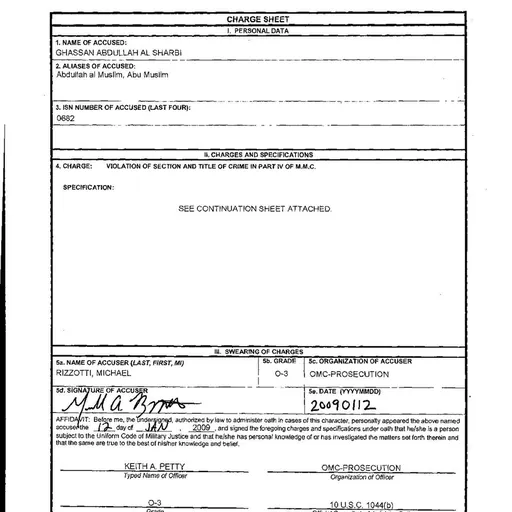
Ghassan al-Sharbi
Saudi Arabian Guantanamo Bay detainee
About Ghassan al-Sharbi
Born 1974. Ghassan al-Sharbi is a Saudi.
Ghassan Abdallah Ghazi al-Sharbi (born 28 December 1974) is a Saudi citizen who was held in extrajudicial detention in the United States Guantanamo Bay detention camps, in Cuba. His Guantanamo Internment Serial Number was 682.
Captured in Faisalabad, Pakistan in March 2002, al-Sharbi was transferred to Guantanamo Bay later that year. In 2006, al-Sharbi told a military commission that he was a member of al-Qaeda and proud of his actions against the United States. Serious war crimes charges were dropped against him in October 2008, as it had been found they were based on evidence gained through torture of Abu Zubaydah. Al-Sharbi had a habeas corpus petition which his father had initiated on his behalf; when it reached the court in March 2009, al-Sharbi requested that it be dismissed. He did not want to pursue it.
Al-Sharbi was held at Guantanamo for twenty years.
Early life and education The US Department of Defense reports that Ghassan al-Sharbi was born on December 28, 1974, in Jeddah, Saudi Arabia. He was sent to the United States for high school and later graduated from Embry-Riddle Aeronautical University in Prescott, Arizona with a degree in electrical engineering. thumb The Bush administration developed a $12 million tent city to hold up to 80 military commissions under a 2006 law.
Afghanistan Al-Sharbi left the United States for Afghanistan in 2000, leaving his wife and daughter behind. He offered the names, addresses and phone numbers of several American classmates, professors and landlords who he said would vouch for his having done nothing wrong. He also stated that he was glad to see the Taliban ruling Afghanistan, quoting statistics that showed a dramatic decrease in crime rates and an increase in new schools built under their government. In 2006, his pro bono attorney, Bob Rachlin, was trying to arrange for al-Sharbi to talk by phone with his parents, hoping they would persuade him to accept Rachlin's legal assistance, which his father had initiated.
On October 21, 2008, Susan J. Crawford, the official in charge of the Office of Military Commissions, announced that charges were dropped against al-Sharbi and four other detainees: Jabran al Qahtani, Sufyian Barhoumi, Binyam Mohamed, and Noor Uthman Muhammed. Carol J. Williams, writing in the Los Angeles Times, reported that all five men had been connected to Abu Zubaydah by his testimony. The CIA has acknowledged that Zubaydah is one of three high-value detainees who were interrogated at length under the technique known as "waterboarding", generally considered a form of torture, before the CIA transferred them to military custody in September 2006 at Guantanamo Bay. Evidence which Zubaydah gave under such coercive interrogation could not be used in court against other suspects. The report stated al-Sharbi was subjected to the "frequent flyer" program from November 2003 to February 2004. It also said that such sleep deprivation was applied widely against numerous detainees, and guards had continued to use it for months after it was banned. Sullivan dismissed the petition at Al Sharbi's request. The petition had been initiated by his father, who had worked with the Center for Constitutional Rights to gain legal assistance in the United States prior to the appointment of military defense counsels. Al Sharbi's lawyer Robert Rachlin confirmed that Al Sharbi had consistently declined all legal assistance. He said the detainee had often expressed disdain for the United States process and was "an aspiring martyr". He promised the use of torture would cease at the camp. He promised to institute a new review system. That new review system was composed of officials from six departments, where the OARDEC reviews were conducted entirely by the Department of Defense. When it reported back, a year later, the Joint Review Task Force classified some individuals as too dangerous to be transferred from Guantanamo, even though there was no evidence to justify laying charges against them. On April 9, 2013, that document was made public after a Freedom of Information Act request. Ghassan Abdallah Ghazi al-Sharbi was one of the 71 individuals deemed too innocent to charge, but too dangerous to release. Although Obama promised that those deemed too innocent to charge, but too dangerous to release would start to receive reviews from a Periodic Review Board, less than a quarter of men have received a review. Al-Sharbi was approved for transfer on February 4, 2022.
Release Al-Sharbi was transferred to Saudi Arabia on March 8, 2023.
Don’t just read it —
keep it.
Full-length biographies made to live with: read them, listen on the way to work, watch them tonight.
- E-book
- Audio
- Video
Instant download · yours to keep · every purchase keeps this site free
Important facts
People in Ghassan al-Sharbi's life
Named in this biography and alive at the same time



Contemporaries
People whose lives overlapped Ghassan al-Sharbi's





Frequently asked questions
Who is Ghassan al-Sharbi?
Saudi Arabian Guantanamo Bay detainee
When was Ghassan al-Sharbi born?
Ghassan al-Sharbi was born on 28 December 1974 in Jeddah.
What nationality is Ghassan al-Sharbi?
Ghassan al-Sharbi is Saudi.
Sources & further reading
· Wikipedia: Ghassan al-Sharbi
Cite this page
APA: Biography.guide. (2026). Ghassan al-Sharbi. https://biography.guide/ghassan-al-sharbi/
MLA: "Ghassan al-Sharbi." Biography.guide, https://biography.guide/ghassan-al-sharbi/.
Chicago: "Ghassan al-Sharbi." Biography.guide. https://biography.guide/ghassan-al-sharbi/.
Data last updated: 2026-09-21 · Spot an error? Report a correction.
Portrait: Wikimedia Commons · author & licence
Page generated 2026-09-27 05:00 UTC