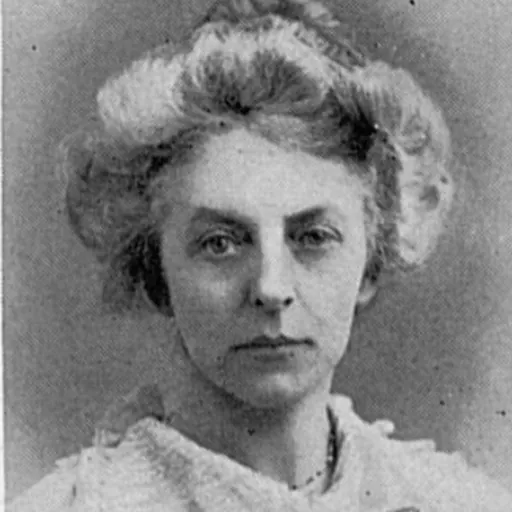
About Gertrude Baillie Weaver
Lived 1855 – 1926 (aged 71). Gertrude Baillie Weaver was a British writer, suffragist and activist.
Gertrude Baillie-Weaver (née Renton; 8 June 1855 – 26 November 1926) was an English suffragette, Theosophist, Freemason and writer who published as Gertrude Colmore. She co-founded the National Council for Animals' Welfare and wrote in support of animal welfare and human rights. Her books about Suffragette Sally and Emily Wilding Davison were republished in the 1980s.
Personal life Gertrude Renton was born on 8 June 1855 in Kensington, London. Her parents were Elizabeth (née Leishman) and John Thomas Renton, a stockbroker. She had five older sisters.
In 1882, she married lawyer Henry Arthur Colmore Dunn, who died in 1896. In 1901, when she was in her forties, she married the barrister and theosophist Harold Baillie-Weaver, an advocate of animal welfare. Baillie-Weaver joined the London branch of the Theosophical Society in 1906. As with many British Theosophists of the time, she was also a Freemason in what was then called the Universal Order of Co-Masonry, which she found a source of order in a chaotic world.
Activism and writing Baillie-Weaver wrote under the pseudonyms Gertrude Colmore, Gertrude Renton Weaver and Mrs Gertrude Dunn. She was chairman of the National Council for Animals' Welfare Week which urged colleges, schools, churches and local committees to teach kindness to animals for a week.
In 1907 she published The Angel and the Outcast, a melodramatic novel regarding a Deptford slaughterhouse. The following year she published Priests of Progress, an anti-vivisection novel that was condemned by vivisectionists from the Research Defence Society. She served on the committee that managed Battersea General Hospital which was notably opposed to any experimentation using either animals or humans.
She supported women's suffrage by writing short stories for Votes for Women and The Suffragette newspapers. She chaired the suffrage group in Saffron Waldon. She was an early member of the Women's Freedom League and her husband spoke for the Men's League for Women's Suffrage. In 1911, as the campaign for women's suffrage became increasingly militant, she published Suffragette Sally, a fictional account that included references to real people. Emily Wilding Davison was a militant suffragette who died in 1913 when she was run over by the King's racehorse during a protest at Epsom. Baillie-Weaver wrote a long obituary. It was later published as The Life of Emily Davison. The following year her work Mr Jones and the Governess was published by the Women's Freedom League. thumb In 1926 she published A Brother of the Shadow which returned to the themes of The Angel and the Outcast and Priests of Progress. The villain is a professor of physiology who uses mind-control to make people kill themselves.
Baillie-Weaver and her husband were commemorated with a statue in St John's Lodge public gardens in Regent's Park, London erected in 1931. The statue by Charles Leonard Hartwell celebrates their work and the National Council for Animals' Welfare which they founded. It shows a woman "Protecting the Defenceless" and is known as The Shepherdess, or The Goatherd's Daughter.
Selected publications
Concerning Oliver Knox (1888) Poems of Love and Life (1896) Priests of Progress (1908) Mr. Jones and the Governess (1913) The Life of Emily Davison (1913) Ethics of Education (with Beatrice de Normann, 1918) A Brother of the Shadow (1926)
Don’t just read it —
keep it.
Full-length biographies made to live with: read them, listen on the way to work, watch them tonight.
- E-book
- Audio
- Video
Instant download · yours to keep · every purchase keeps this site free
Important facts
Family & relationships
People in Gertrude Baillie Weaver's life
Named in this biography and alive at the same time



Related people
Same field, nearest in time



Contemporaries
People whose lives overlapped Gertrude Baillie Weaver's




Frequently asked questions
Who was Gertrude Baillie Weaver?
British writer and suffragist (1855–1926)
When was Gertrude Baillie Weaver born?
Gertrude Baillie Weaver was born on 8 June 1855 in Kensington.
When did Gertrude Baillie Weaver die?
Gertrude Baillie Weaver died on 26 November 1926 in Wimbledon.
What was Gertrude Baillie Weaver's occupation?
Gertrude Baillie Weaver was a writer, suffragist and activist.
What nationality was Gertrude Baillie Weaver?
Gertrude Baillie Weaver was British.
Sources & further reading
· Wikipedia: Gertrude Baillie Weaver
· DBpedia: Gertrude Baillie-Weaver
Cite this page
APA: Biography.guide. (2026). Gertrude Baillie Weaver. https://biography.guide/gertrude-baillie-weaver/
MLA: "Gertrude Baillie Weaver." Biography.guide, https://biography.guide/gertrude-baillie-weaver/.
Chicago: "Gertrude Baillie Weaver." Biography.guide. https://biography.guide/gertrude-baillie-weaver/.
Data last updated: 2026-09-23 · Spot an error? Report a correction.
Portrait: Wikimedia Commons · author & licence
Page generated 2026-09-27 05:07 UTC