
About Gerhardt Katsch
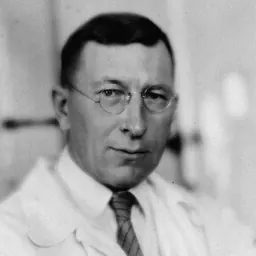
Lived 1887 – 1961 (aged 73). Gerhardt Katsch was a German internist, university teacher, physician and rector (academia).
Life Provenance and early years The eldest of his parents' four recorded children, Gerhardt Alexander Ferdinand Katsch was born in Berlin. His mother, born Elisabeth Beutner (1864–1908), was an opera-dramaturge.
Through his paternal grandmother, born Caroline Helene Antoinette Auguste Andrée (1832-1916), Katsch had a family connection with Nîmes: he attended the francophone "French school" in Berlin. When he received his "school [graduation] certificate" on 30 August 1905 it came with a rare "höchstem Prädikat" commendation. That same year he enrolled at the Sorbonne university in Paris where he studied Biology, Physics and Philosophy. In the ensuing months relevant learned journals contained a number of follow-up specialist articles, authored jointly by Bickel and Katsch, in which the authors elucidated further the research methods and findings applied by Katsch in undertaking his doctorate. By this time Katsch had moved to Hamburg where in February 1912 he accepted a position as a doctor's assistant and then as a junior doctor in the medical department at the Altona City Hospital ("Stadtkrankenhaus Altona"). Here he worked with the internist Gustav von Bergmann, who would later recall Katsch as his "best colleague" and "most impressive student". During 1913 he volunteered for a year of military service, undertaken with Infantry Regiment 91. In 1926/27, von Bergmann moved on again, this time to the Charité in Berlin. But this time, Katsch stayed behind, taking on the role of Chief physician at the Clinic for Internal Medicine at the venerable Holy Ghost Hospital. It was the first time he had been given charge of his own department. Just one year after the discovery of insulin by the Canadians Frederick Banting and Charles Best in 1921, Katsch began his investigations into the clinical use of insulin for treating diabetics. He was also an enthusiastic backer of the establishment of the German Diabetic Association, with occurred less than a year later. On 1 September 1930, five months after the opening of the "Arndt-Stiftung Garz – Diabetikerheim", the first facility for the socio-medical treatment of diabetics anywhere in Europe was opened at the same premises. It became a template for other similar institutions elsewhere, for instance when a similar facility opened in Copenhagen. In 1937 Katsch published the "Garzer Thesen", one of his best known and most important pieces of writing. In it he set out, for the first time, his principles for the treatment of Diabetes mellitus. He postulated and outlined his principle of "produktive Fürsorge" (loosely, "constructive care") of Diabetes patients, and robustly rejected the general view within the medical establishment that diabetics were "unheilbare Stoffwechselkrüppel" ("incurable metabolic cripples"), substituting a more encouraging concept of "bedingt Gesundheit" ("conditional health"). He identified an optimal Diabetes Therapy, combining diet, insulin injections, physical exercise and appropriate education. Taken together in an appropriate balance, these should enable patients to enjoy a full working life. At the urging of the new government, the Stahlhelm were merged into the party's own paramilitary organisation, the so-called Sturmabteilung (SA) in January 1934. Katsch, having just entered his sixth decade, thereby became an SA member, appointed to the rank of "Oberscharführer" (loosely, "senior squadron leader") in the "SA-Reserve" during 1934. (In 1956 Burchard returned to Germany, married Anna-Elisabeth Brandt in 1958, and then, between 1959 and 1964, produced three recorded grandchildren. ) He joined the government backed “Nationalsozialistische Lehrerbund” (party teachers’ association) but managed to avoid having to become a member of the “Nationalsozialistische Deutschen Ärztebund” (party physicians’ association). In political terms he successfully resisted government efforts to impose "racial purity" dogmas on Diabetes patients. During the war years he was for some time “consultant internist” with the Military Health Service for Army District II (Stettin): responsibility for all the army hospitals in and around Greifswald was added to his consultancy portfolio in 1940/41. Katsch himself served on the frontline, presumably as an army doctor, in the Balkans between the end of November 1941 and March 1942, and then again in Ukraine between May 1943 and November 1943. His diary entries from this period were subsequently published. They may have been written with half an eye on future publication or at least on the possibility that they might fall into the hands of the German authorities, since they scrupulously avoid personal judgements. This makes the coldly factual assessment that he recorded - for instance in his diary entry for 9 July 1943 - the catastrophic "nutritional status" of German war prisoners all the more chilling.
After the Second World War At the instigation of Rudolf Petershagen, the local military commander, during the night of 29/30 April 1945 Gerhardt Katsch, as head of the University Clinic and senior medical officer at Greifswald, together with the University Rector Carl Engel and Colonel Max Otto Wurmbach (1885-1946), the deputy military commander responsible for Greifswald, were part of a small group of city representatives mandated to deliver a surrender offer to leaders of the advancing Soviet army. Acceptance of the offer brought about the hand-over of the city of Greifswald without fighting. Had Germany not formally capitulated a few days later, involvement in this breach of Adolf Hitler's instruction that Germans should “fight to the death” would have had seriously personal consequences for Katsch, one of the least of which would be the conclusion that he had, by his actions, voluntarily resigned his party membership. It was a point that Katsch felt the need to emphasize after the war when trying to explain his party membership between 1937 and 1945 to influential members of another post-democratic ruling party after 1946. The "Arndt-Stiftung Garz – Diabetikerheim", which had been opened on the Island of Rügen in 1930, was by this time far too small, but it continued to operate as a satellite facility. Its coastal location made it particularly well suited, during the summer months, for use as a vacation center for diabetic children. In 1950 the main Institute at Karlsburg was renamed as the, "Institut für Diabetes-Forschung und Behandlung" ("Diabetes Research and Treatment institute"). Two years later two substantial houses in the castle grounds were given over to experimental Diabetes research. At Sellin on shoreline beyond Garz on the Island of Rügen the first special school in the world designed for and dedicated to diabetic children was opened in 1955. An accompanying holiday camp was opened on the same site a year later. Further expansion and development at Karlsburg and on the island sites followed.
In the German Democratic Republic (1949-1989) Katsch became one of the best known and most influential physicians and medical researchers of the time. After the foundation of the rival West and East German states, the eastern party leadership were conscious that he was one of very few German physicians of international repute who had not chosen to pursue his professional career in the west. In 1950, in recognition of his reputation and contributions, he was granted, through a resolution of the ministerial council dated 12 October 1950, what was termed an "Einzelvertrag" (loosely, "unique deal") which gave him far reaching competences and privileges, including a teaching salary which he would continue to receive after reaching the state retirement age, and the opportunity to continue serving as director of the Institute at Karlsburg for life. The package included more than mere monetary rewards. His son, who till 1956 still lived in Mexico was able to travel into and out of East Germany with few of the usual bureaucratic hurdles. The professor himself was permitted both to own a private motor car and to drive it, without hindrance, to his private holiday home, built in 1938 at Hochweiler (Sonthofen) in the Allgäu, far beyond the "wrong side" of the Inner German border which, for most of his fellow citizens, became progressively more impenetrable through the 1950s. Since Katsch died on 7 March 1961 it must remain a matter for speculation how far his remarkable travel privileges would have been restricted by the appearance in August 1961 of the Berlin Wall which, for all but the most privileged of citizens, put an end to foreign travel to the west. Despite his privileges he was able to sustain a certain level of political independence, and never became a party member. His term of office coincided with the university's 500th anniversary celebrations, in which he participated some effect, notably in using the event as an opportunity to submit two letters to President Pieck (who at the time, despite his advancing years, was still formally head of state in the German Democratic Republic). The letters consisted of appeals for clemency on behalf of Greifswald students who had been convicted, following some form of student unrest, on political grounds. The outcome of Katsch's intervention is not known. He continued in post throughout the rest of his life as Director of the institute at Karlsburg, which had become the leading institution for the medical treatment of diabetic patients in East Germany, and one of the leading research institutes in the country.
His physical remains ended up in a family grave in Berlin.
Academic and clinical-medical contributions
This bust of the diabetologist Gerhardt Katsch (1887-1961) by Irmfried Garbe is a permanent feature of Lecture Hall 2 at the Greifswald University Clinic. Those unable or unwilling to access the lecture hall can find identical castings out of doors in the park surrounding the former "Schloss" at Karlsburg or in front of Katsch's former holiday home at Hochweiler (Sonthofen) in the mountains south of Kempten and west of Garmisch During the course of his career Gerhardt Katsch published approximately 220 academic contributions. He supervised more than 300 doctoral students and 14 habilitation students, most of whom were subsequently appointed to professorial chairs in internal medicine ort other influential positions in medicine. That made him one of the most important internists of his generation in Germany. His specialities were Gastroenterology, diseases of the Pancreas and, in particular Diabetes mellitus. In the case of diabetes research, alongside clinical issues such as the relative effectiveness of different insulin preparations and the effects of muscle contractions, his principal concern was with metabolic aspects, such as diabetic disruption of lipid metabolism. In terms of subsequent developments it nevertheless begged some important questions: one which stirred significant controversy through the 1940s, 50s and 60s, concerned the need to find an optimal balance between insulin dosages and nutrition. The pediatrician Karl Stolte (1881-1951), who had been director of the children's clinic at the University of Breslau before 1945, found it necessary to add a refinement to Katsch's theses. Based on his own experience of treating adults, Katsch had assumed that dietary choices should be significantly restricted in order to align with fixed insulin dosages. Stolte advocated a more variable diet - identified (if simplistically) in sources as a "free diet" - based on his own treatment of diabetic patients of all ages since 1929. Where menues were varied from meal to meal, a corresponding element of flexibility should be applied to insulin dosages. Patients were expected to monitor their urine and ensure that it remained free of glucose. They were to inject an insulin dose before each meal, variable according to the size and nutritional balance of the meal. Provided urine remained sugar-free, the insulin dosages applied were sufficient. At a time when insulin was relatively expensive and health insurance was far from universal, most patients had good economic motives for not overdosing on insulin. The Stolte approach did imply a level of confidence in the ability and willingness of patients to take responsibility for varying their own medication, however. According to detractors, trusting patients to the extent necessary would never have been deemed appropriate by Gerhardt Katsch. By the time the controversy became heated, Germany was at war, and there were no opportunities available to develop and undertake appropriate experimentation, which under other circumstances might have resolved the issues arising. During the 1970s, by which time suitable analytical tools had become more widely available, mainstream medical opinion was tending to line up behind Stolte's approach. By that time the main protagonists of the controversy were both dead, however. During the 1950s and 1960s, as the controversy refused to be stilled, it was Katsch's characteristically rigid approach that retained traction with medical establishments.
Recognition and celebration The work of Gerhardt Katsch was widely acknowledged and celebrated, especially in the German Democratic Republic (East Germany). In 1953, he became an ordinary (i.e. full) member of the (East) German Academy of Sciences and Humanities in Berlin. In 1955 he also accepted membership of the Halle-based Leopoldina Academy. In 1952 he chaired the German Association for Gastroenterology and Diseases of the Digestive and Metabolic Systems, and in 1953 of the German Association for Internal Medicine. That same year an equivalent honour was bestowed on him at the congress of the International Diabetes Federation, held that year in, Düsseldorf (West Germany). The lecture in question was delivered under the title "Zur bedingten Gesundheit des Diabetikers" ("On the conditional health of the diabetic"). In Greifswald, where he made his home between 1928 and his death in 1961, the city awarded him "Ehrenbürgerschaft" (loosely, "Honorary citizenship") in 1952. The next year, the University of Greifswald made him an honorary senator. That was followed four years later with an honorary doctorate accompanied by a golden chain of honour. There are streets named after Gerhardt Katsch in Greifswald and Wiesbaden. Since 1979, the German Diabetes Association has awarded the "Gerhardt Katsch Medal" annually to people "who have made a special contribution to the well-being of diabetics".
Burial The mortal remains of Gerhardt Katsch were buried in a little family grave plot at the "Alter St.-Matthäus-Kirchhof" (cemetery) in central Berlin. The plot had originally been acquired by hos grandmother in 1873 and is decorated with a figure by the sculptor Rudolf Pohle. The plot also accommodates the bodies of his wife, of the businessman Carl. W. Katsch (1813–1873), the artist Hermann Katsch (1853–1924), the sculptor Arnold Katsch (1861–1928) and a woman identified as Antoinette Katsch (1832–1916) .
Output (selection) Charles Darwin. Reihe: Hillgers illustrierte Volksbücher. Band 125. Hillger, Berlin and Leipzig 1909 Garzer Thesen. Zur Ernährungsführung der Zuckerkranken. In: Klinische Wochenschrift. 16/1937. pp. 399–403 Die Arbeitstherapie der Zuckerkranken. T. Steinkopff, Darmstadt 1939 Das Leib-Seele-Problem in medizinischer Sicht. Wichern-Verlag, Berlin 1951 Über die vitale Tendenz zu reaktiven Überleistungen. Akademie-Verlag, Berlin 1954 Der therapeutische Imperativ des Arztes. JF Lehmanns, München 1958 Kurzgefasste Diagnostik der Pankreaskrankheiten. Enke, Stuttgart 1958 Betrachtung über die Funktion der Keimblätter. Akademie-Verlag, Berlin 1959 Aceton bis Zucker. Nachschlagebuch für Zuckerkranke. Sechste Auflage. VEB Georg Thieme, Leipzig 1970 (as co-compiler)
Don’t just read it —
keep it.
Full-length biographies made to live with: read them, listen on the way to work, watch them tonight.
- E-book
- Audio
- Video
Instant download · yours to keep · every purchase keeps this site free
Important facts
People in Gerhardt Katsch's life
Named in this biography and alive at the same time


Related people
Same field, nearest in time





Contemporaries
People whose lives overlapped Gerhardt Katsch's





Frequently asked questions
Who was Gerhardt Katsch?
German physician (1887-1961)
When was Gerhardt Katsch born?
Gerhardt Katsch was born on 14 May 1887 in Berlin.
When did Gerhardt Katsch die?
Gerhardt Katsch died on 7 March 1961 in Greifswald.
What was Gerhardt Katsch's occupation?
Gerhardt Katsch was an internist, university teacher, physician and rector (academia).
What nationality was Gerhardt Katsch?
Gerhardt Katsch was German.
Sources & further reading
Cite this page
APA: Biography.guide. (2026). Gerhardt Katsch. https://biography.guide/gerhardt-katsch/
MLA: "Gerhardt Katsch." Biography.guide, https://biography.guide/gerhardt-katsch/.
Chicago: "Gerhardt Katsch." Biography.guide. https://biography.guide/gerhardt-katsch/.
Data last updated: 2026-09-25 · Spot an error? Report a correction.
Page generated 2026-09-27 05:13 UTC