
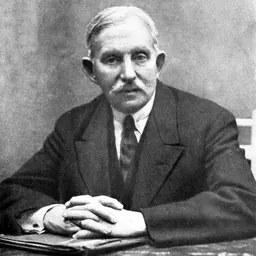
Gerald Warner Brace
Novelist, writer, educator, sailor, boat builder
About Gerald Warner Brace
Lived 1901 – 1978 (aged 76). Gerald Warner Brace was an American writer, university teacher, pedagogue and boat building.
Gerald Warner Brace (September 24, 1901 – July 20, 1978) was an American novelist, writer, educator, sailor and boat builder. His work frequently employed settings from rural life in New England.
Biography
Early life and ancestors He was born on September 24, 1901, in Islip, Long Island, Suffolk County, New York, and died on July 20, 1978, at Blue Hill, Maine.
Gerald W. Brace was a son of Charles Loring Brace Jr., who was an 1874 graduate of Phillips Academy in Andover, Massachusetts, and a graduate of Yale College class of 1876 with a degree in Civil Engineering. C. L. Brace was a Mugwump in politics. He was employed as Superintendent and Engineer of Construction with the Minneapolis and St. Louis Railway at Minneapolis. When his father, CLB Sr., died in 1890, he was invited by the trustees of the New York Children's Aid Society to take up as Secretary and chief executive officer of that society.
Gerald Brace's mother was Louise Tillman Warner, the daughter of Dr. Lewis Tillman Warner and Elizabeth Williams Gray. Elizabeth was the daughter of Elizabeth Williams Hull, a daughter of Dr. Amos Gift Hull, a well known surgeon of New York, and a sister of Dr. Amos Gerald Hull (1810–1859), an 1832 graduate of Rutgers Medical College and an influential Homeopathic Physician.
Elizabeth Williams Gray was also the daughter was Dr. John Franklin Gray (1804–1882), an 1826 graduate of the Columbia University College of Physicians and Surgeons and the first practitioner of homeopathy in the United States. He is buried in Green-Wood Cemetery in Brooklyn, New York. He was a grandson of the Rev. Mr. Blackleach Burritt and a descendant of Governor Thomas Welles.
Dr. Warner's second wife was Sarah Loring MacKaye, Yale College 1846, who was a contributing philanthropist in the field of social reform. He is considered a father of the modern foster care movement and was most renowned for starting the Orphan Train movement of the mid-19th century, and for founding The Children's Aid Society in 1853.
He is a great-grandson of John Pierce Brace, an 1812 graduate of Williams College who was head teacher at Litchfield Female Academy. The academy was founded in 1792 by his aunt, Sarah Pierce (1767–1852) and was one of the earliest schools for girls in the United States.
J. P. Brace left Litchfield Female Academy in 1833 and moved on to a position at Catharine Beecher's Hartford Female Seminary. He was also editor of the Hartford Courant. His wife was Lucy Porter, the sister-in-law of Lyman Beecher, Yale College, 1797 and a descendant of politician, and diplomat Rufus King, who was one of the signers of the United States Constitution.
Gerald W. Brace had a typical upper-middle class Victorian upbringing. He always looked back with nostalgia on the moral certainties and romantic visions of that age. on Fifty-sixth Street, between Park Avenue and Madison Avenue in New York City. In 1913, he began attending The Gunnery and graduated from Loomis Chaffee School in 1918. He received his Bachelor of Arts degree in English from Amherst College in 1922. He received both his Master of Arts and Ph.D. degrees from Harvard University.
When he entered Amherst College he first became acquainted with and studied under the poet Robert Frost. In later years, when both he and Frost lived in the Boston area, Frost would often join them for dinner and fascinated Brace's children by his speculative nonstop monologue.
It was also during his college years that he began taking long hikes in The Berkshires and then into the mountains of Vermont.
He became acquainted with the harsh life of the rural people who lived on the back country roads, subconsciously gathering subject matter for his novels. Many of his books dealt with a way of life that was already disappearing, however, his plots and writing style continued to evolve.
Hoping to learn more about boat design, Gerald entered a graduate program in Architecture at Harvard, but he soon realized that he was in the wrong field. He really wanted to write, and he was allowed to transfer to English and take a seminar in Creative Writing. ) Huldah Potter Laird, born on November 12, 1902, at Boston, Suffolk County, Massachusetts, and died in August 1986 in Belmont, Massachusetts. She was the daughter of Raymond Gilchrist Laird and Huldah Blanche Potter. She taught biology at Lasell College (formerly known as Lasell Seminary) prior to her marriage to Brace.
Gerald and Huldah were the parents of three children:
C. Loring Brace, (1930–2019) is an anthropologist at the University of Michigan. Gerald Warner Brace Jr. (1931–2003) Barbara Brace Seeley (1934–2003)
Career He began his career as an instructor and professor of English and of creative writing teaching briefly at Williams College, and later at Dartmouth College and Mount Holyoke College. he died in Blue Hill Maine on July 20, 1978, at 76.
Reputation
Brace, like C. P. Snow, greatly admired Anthony Trollope above all of the English novelists and wrote an introduction to The Last Chronicle of Barset. Reviewers of his novel, The Department, inevitably compared him to C. P. Snow. One reviewer called his novel The Department the American equivalent of The Masters, which was awarded the James Tait Black Memorial Prize in 1954, in its witty and basically good-humored anatomy of every English department there ever was.
From his first book through of his succeeding books, it is dominated by scene. He has few equals in New England landscapes and perhaps none in describing her coastline, especially the jagged rock and spruce covered coast of Maine. It was also said of all of his novels that the quality of his "prose style so perfected and shaped that it is difficult to find anywhere a poorly written sentence."
What follows is a brief description of his works.
The Garretson Chronicle In his novel, The Garretson Chronicle, depicting three generations of a Massachusetts family, he deals with satirizing the decline of Emersonain New England, and the battle with the mountain (a modern version of Moby Dick). The narrator-hero of the novel is a young boy who has never been content with his job as the village carpenter and is always searching for roots and a sense of accomplishment. This novel was promoted for the Pulitzer Prize in 1948.
The Wayward Pilgrims The Wayward Pilgrims is a novel about a young university instructor, traveling around the state of Vermont, who meets an older woman, at a train depot, who teaches him about her experiences in life.
The Department The narrator of the novel is Robert "Sandy" Sanderling, a professor of American literature with a degree from Harvard, who is planning his retirement speech. Looking back over his life, he feels that he has accomplished very little and his one novel, Aftermath was not the book he had hoped it would be; his marriage was a disaster; he has no real friends in his department, and the profession of teaching and the field of scholarship have changed and left him behind.
It is also one of the first novels portraying the institutional and personal responses to political influences on college campuses during the 1960s.
List of works He wrote eleven novels and, in addition, literary works such as The Age of the Novel (1957) and The Stuff of Fiction (1969). In 1976 he published his autobiography, Days That Were, which included his own illustrations.
Most of Brace's novels are set in New England. They include: The Islands (1936), set in Maine The Wayward Pilgrims (1938), set in a Vermont train depot Light on a Mountain (1941) The Garretson Chronicle (1947) A Summer's Tale (1949) The Spire (1952 Bell's Landing (1955) The World of Carrick's Cove (1957), a nominee for the 1958 National Book Award for Fiction Winter Solstice (1960) The Wind's Will (1964) The Department (1968/1983), which was translated and published in Bengali in 1970
Students Philip R. Craig (1933–2007) was a writer known for his Martha's Vineyard mysteries.
Awards He was a 1958 National Book Award nominee for fiction. In 1967 he won the Shell Award for Distinguished Writing from Boston University.
Don’t just read it —
keep it.
Full-length biographies made to live with: read them, listen on the way to work, watch them tonight.
- E-book
- Audio
- Video
Instant download · yours to keep · every purchase keeps this site free
Important facts
People in Gerald Warner Brace's life
Named in this biography and alive at the same time







Related people
Same field, nearest in time




Contemporaries
People whose lives overlapped Gerald Warner Brace's

Frequently asked questions
Who was Gerald Warner Brace?
Novelist, writer, educator, sailor, boat builder (1901–1978)
When was Gerald Warner Brace born?
Gerald Warner Brace was born on 24 September 1901 in Islip.
When did Gerald Warner Brace die?
Gerald Warner Brace died on 20 July 1978 in Blue Hill.
What was Gerald Warner Brace's occupation?
Gerald Warner Brace was a writer, university teacher, pedagogue and boat building.
What nationality was Gerald Warner Brace?
Gerald Warner Brace was American.
Sources & further reading
· Wikipedia: Gerald Warner Brace
· DBpedia: Gerald Warner Brace
Cite this page
APA: Biography.guide. (2026). Gerald Warner Brace. https://biography.guide/gerald-warner-brace/
MLA: "Gerald Warner Brace." Biography.guide, https://biography.guide/gerald-warner-brace/.
Chicago: "Gerald Warner Brace." Biography.guide. https://biography.guide/gerald-warner-brace/.
Data last updated: 2026-09-20 · Spot an error? Report a correction.
Page generated 2026-09-27 05:02 UTC