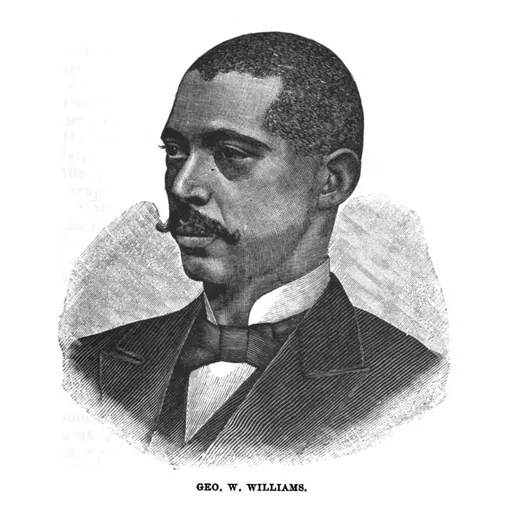
About George Washington Williams
Lived 1849 – 1891 (aged 41). George Washington Williams was an American soldier, historian, diplomat, writer, christian minister and politician.
George Washington Williams (October 16, 1849 – August 2, 1891) was a soldier in the American Civil War and in Mexico before becoming a Baptist minister, politician, lawyer, journalist, and writer on African-American history. He served in the Ohio House of Representatives.
In the late 1880s, Williams turned his interest to Europe and Africa. After having been impressed by meeting King Leopold II of Belgium, he traveled in 1890 to the Congo Free State (then owned by the king) to see its development. Shocked by the widespread brutal abuses and slavery imposed on the Congolese, he wrote an open letter to Leopold in 1890 about the suffering of the region's native inhabitants at the hands of the king's agents. This letter, which subsequently popularized the term "crimes against humanity", was a catalyst for an international outcry against the regime running the Congo, which had caused millions of deaths.
Early life
Williams was born free in 1849 in Bedford Springs, Pennsylvania, to two African Americans, Thomas, a laborer, and Ellen Rouse Williams. He was the oldest of four children; his brothers were John, Thomas and Harry Lawsom Williams. The boys had a limited education. For a time, Williams lived in a "house of refuge", where he learned barbering, considered a skilled and advantageous trade at the time. During the American Civil War, Williams ran away to enlist at the age of 14 in the Union Army under an assumed name; he fought during the final battles.
Education After returning to civilian life, the young veteran decided to attend college. He was accepted at Howard University, a historically black college in Washington, DC, but did not stay long. In 1870, Williams began studies at the Newton Theological Institution near Boston, Massachusetts. In 1874, Williams became the first African American to graduate from Newton.
Marriage and family He met Sarah A. Sterrett during a visit to Chicago in 1873. They were married the following spring when he graduated from Newton Theological. They had one son together.
Religious and political career After graduation, Williams was ordained as a Baptist minister. He held several pastorates, including the historic Twelfth Baptist Church of Boston. Williams served a pastorate in Washington, DC. While there, with support from many of the leaders of his time, such as Frederick Douglass and William Lloyd Garrison, Williams founded The Commoner, a weekly journal. (This had no relation to William Jennings Bryan's later publication of the same title). Williams published eight issues.
Williams moved with his family to Cincinnati, Ohio, where he continued as a preacher. In addition, he studied law under Alphonso Taft (father of President William Howard Taft), reading the law with an established firm. He passed the bar.
He became the first African American elected to the Ohio state legislature, serving one term from Cincinnati for 1880 to 1881. According to his biographer, historian John Hope Franklin, he offended his constituents by offering a bill that "threatened to deny members of a local African Methodist church the right to bury their dead in what was becoming an exclusive suburb" of the river city. Although the bill died in committee, Williams was not re-elected and his state political career abruptly ended. He turned to practicing law. Franklin noted Williams' ability to persist and pick up new endeavors after he had closed off some fields. Thompson was confirmed by the Senate.
In 1887, Williams was given an honorary doctorate of law by Simmons College of Kentucky, a historically black college, where he spoke at a commencement ceremony.
In 1888, Thompson was a delegate to the World's Conference of Foreign Missions at London. Although he failed to gain entry as a delegate to an anti-slave trade conference in Brussels in the spring of 1890, he made other arrangements to visit the city and the continent. (See below)
Historian Williams' most substantial achievement was as a historian. He wrote groundbreaking histories about African Americans in the United States: The History of the Negro Race in America 1619–1880 was published in 1882. It is considered to be the first overall history of African Americans, showing their participation and contributions from the earliest days of the colonies. In addition, he wrote a history of the United States Colored Troops and African-American participation in the American Civil War, A History of Negro Troops in the War of Rebellion (1887). In this letter, he condemned the brutal and inhuman treatment of the Congolese at the hands of Europeans and Africans supervising them for the Congo Free State. He mentioned the role played by Henry M. Stanley, sent to the Congo by the King, in deceiving and mistreating local Congolese. Williams reminded the King that the crimes committed were all committed in his name, making him as guilty as the perpetrators. He appealed to the international community of the day to "call and create an International Commission to investigate the charges herein preferred in the name of Humanity ...". The Ohio legislature commissioned a video documentary of Williams: George Washington Williams: A Portrait of Faith, Courage and Wisdom (2002; run time = 26m29s). No longer available online, obtainable via interlibrary loan. Samuel L. Jackson played a fictionalized version of Williams in the Congo in the 2016 film The Legend of Tarzan. Jackson was in his late 60s during filming, an age which the real Williams never reached.
Books History of the Negro Race in America From 1619 to 1800 (vol 1) and 1800–1880 (vol 2): Negroes As Slaves, As Soldiers, and As Citizens (1882) full text at Internet Archive A History of the Negro Troops in the War of the Rebellion, 1861–1865 (1888) full text at Internet Archive
Don’t just read it —
keep it.
Full-length biographies made to live with: read them, listen on the way to work, watch them tonight.
- E-book
- Audio
- Video
Instant download · yours to keep · every purchase keeps this site free
Important facts
People in George Washington Williams's life
Named in this biography and alive at the same time




Related people
Same field, nearest in time


Contemporaries
People whose lives overlapped George Washington Williams's




Frequently asked questions
Who was George Washington Williams?
American Civil War soldier, Christian minister, Ohio politician, lawyer, journalist, and writer
When was George Washington Williams born?
George Washington Williams was born on 16 October 1849 in Bedford.
When did George Washington Williams die?
George Washington Williams died on 2 August 1891 in Blackpool.
What was George Washington Williams's occupation?
George Washington Williams was a soldier, historian, diplomat, writer, christian minister and politician.
What nationality was George Washington Williams?
George Washington Williams was American.
Sources & further reading
· Wikipedia: George Washington Williams
· DBpedia: George Washington Williams
Cite this page
APA: Biography.guide. (2026). George Washington Williams. https://biography.guide/george-washington-williams/
MLA: "George Washington Williams." Biography.guide, https://biography.guide/george-washington-williams/.
Chicago: "George Washington Williams." Biography.guide. https://biography.guide/george-washington-williams/.
Data last updated: 2026-09-20 · Spot an error? Report a correction.
Portrait: Wikimedia Commons · author & licence
Page generated 2026-09-27 04:57 UTC