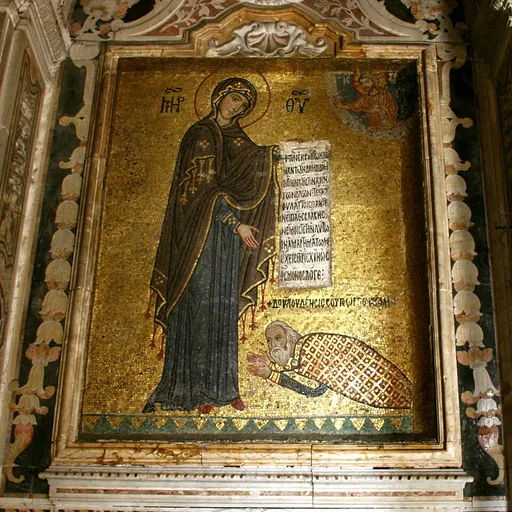
About George of Antioch
Lived 1100 – 1151. George of Antioch was an Italian and Byzantine soldier.
George of Antioch (Greek: Γεώργιος ό Άντιοχεύς; 1080 – 1151 or 1152 ) was a court official and military officer in the Norman Kingdom of Sicily that played a significant role in the transformation of Norman Sicily into a multicultural society and naval power. He did so as chiefly as an advisor to Roger II of Sicily. He was a Greek Eastern Orthodox Christian from the Byzantine Empire. After the death of George's brother at the hands of Tamim's successor, Yahya, George fled the court and found refuge in Norman Sicily.
Early life and career The interior of the church of Santa Maria dell'Ammiraglio in Palermo, founded by George of Antioch. The exact location of George of Antioch's birth is uncertain, but many place it at Antioch, where it is certain that he spent a portion of his younger life. It is again unclear when he left the city, but Sarah Davis-Secord places it sometime around the Seljuk conquest of the city in 1084, whereupon George likely migrated through various other Greek cities in the Byzantine Empire before finding employment with Emperor Alexios Komnenos. His many administrative and linguistic skills facilitated his rise within the Norman court. Much like in Ifriqiya, George was placed in charge of administrating the district of Iato in Sicily, and was given the position as an ambassador to the Fatimids of Egypt. Many of these positions were granted in subordination to Christodulus, who served as a mentor to George. When George took this position in 1126, he assumed all of the powers that his former mentor had possessed and served in this position until his death in either 1151 or 1152. It seems likely that the lack of George, who served as a bridge between the Greeks, Normans, and Arabs of Sicily, contributed to the decline in diverse cultural influences seen after his death in 1151 or 1152. Joshua Birk makes the case that the Arabic character of the Norman court was ostracized almost immediately after George's death. Birk demonstrates this with the trial of George's successor, Philip of Mahdia, who was sentenced to death after rumors of "unfaithfulness" that were likely a result of his leniency toward his fellow Berbers in North Africa (which were harsher than the terms George had put them to). However, Arabic and Muslim influences still persisted for many years, at least until the reign of King William II of Sicily, when the Muslim scholar and writer Ibn Jubayr recorded the significant Arabic presence and influence within the royal court.
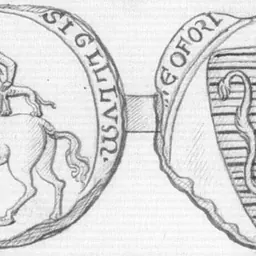
Admiral of Sicily Seal of George of Antioch, bearing the titles of his offices (archōn archontōn and amēras) in Greek. George of Antioch's military career started soon after his migration to Sicily. He was initially a commander under Christodulus, with one of their first joint ventures being the 1123 attack on Mahdia, the seat of the Zirid emirs. The attack started out successfully with the seizure of the fortress of ad-Dimas near Mahdia, but the two admirals were soon defeated at the hands of the Zirids, and lost 200 of the 300 ships they had sailed from Sicily with.
The next phases of George's military career took place in Africa and Greece. Starting in 1140, George began raiding the city of Mahdia on a regular basis, on King Roger II's orders. The attack on Mahdia was part of a larger invasion of Muslim Ifriqiya by the Normans. This is shown by the subsequent attacks on North African cities such as Sousse, Sfax, and George's final attack on Mahdia in 1148, where he returned with 300 ships, taking the city for the last time. Roger II took that fight to Byzantium proper through raids on Greece starting in 1147. These attacks are recorded by Greek historian Nicetas Choniates, who portrays George, his fellow Greek, as a pillager only motivated by greed. George's attacks began with the island of Corfu, which he was able to bribe due to the excessive tax burden placed on the island by the Byzantines. George then sailed into the Saronic Gulf between Athens and the Peloponnese peninsula, raiding towns such as Monemvasia. George then sailed back around the Peloponnese and into the Gulf of Corinth, where he and his troops set out onto the land, attacking Thebes, sacking and looting the city, and absconding with great wealth. George then made his way to the city of Corinth, which was lightly defended, and did much the same as he did in Thebes and returned to Sicily with his spoils in late 1147. George would return in 1148, but not before he was defeated by a coalition of Venetian and Byzantine ships. In 1149, George then managed to sail through the Aegean and harass the defenses of Constantinople. An example of these connections that still remains today is the church he sponsored in Palermo, the Santa Maria dell'Ammiraglio, or the Church of Saint Mary of the Admiral. It also later came to be known as the Martorana. George sponsored the construction in 1143. The Martorana is a prime example of Arab-Norman-Byzantine culture, combining aspects of the various cultures within Norman Sicily. This can be seen in the distinctly Greek mosaics and artworks along with various Arabic writings and inscriptions within the church. Upon his death, George was buried in the church. In 2015, the Martorana was made part of the UNESCO World Heritage Site of Arab-Norman Palermo and the Cathedral Churches of Monreale and Cefalu.
Don’t just read it —
keep it.
Full-length biographies made to live with: read them, listen on the way to work, watch them tonight.
- E-book
- Audio
- Video
Instant download · yours to keep · every purchase keeps this site free
Important facts
People in George of Antioch's life
Named in this biography and alive at the same time


Related people
Same field, nearest in time




Contemporaries
People whose lives overlapped George of Antioch's



Frequently asked questions
Who was George of Antioch?
Italian admiral
When was George of Antioch born?
George of Antioch was born in 1100 in Antioch.
When did George of Antioch die?
George of Antioch died in 1151 in Palermo.
What was George of Antioch's occupation?
George of Antioch was a soldier.
What nationality was George of Antioch?
George of Antioch was Italian and Byzantine.
Sources & further reading
· Wikipedia: George of Antioch
Cite this page
APA: Biography.guide. (2026). George of Antioch. https://biography.guide/george-of-antioch/
MLA: "George of Antioch." Biography.guide, https://biography.guide/george-of-antioch/.
Chicago: "George of Antioch." Biography.guide. https://biography.guide/george-of-antioch/.
Data last updated: 2026-09-21 · Spot an error? Report a correction.
Portrait: Wikimedia Commons · author & licence
Page generated 2026-09-27 04:59 UTC