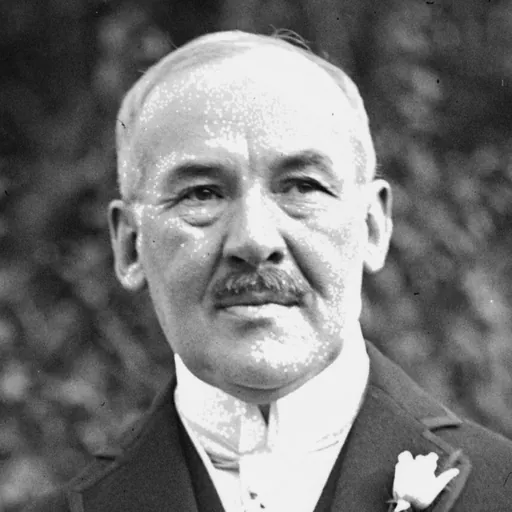
About George Oakley Totten, Jr.
Lived 1866 – 1939 (aged 72–73). George Oakley Totten, Jr. was an American architect.
Edward H. Everett House, now the Turkish ambassador's residence. George Oakley Totten Jr. (December 5, 1866 – February 1, 1939) was an American architect who was one of the most prolific architects in the Gilded Age in Washington D.C. He designed many mansions that were located primarily on or near Dupont, Sheridan (including Embassy Row), and Kalorama circles and along 16th Street, N.W., near Meridian Hill. Most now serve as embassies, chanceries, or offices for national or international organizations.
Biography Totten rescued H. H. Richardson's Warder Mansion from demolition. Totten was born in New York City on December 5, 1866, a son of George Oakley and Mary Elizabeth (Styles) Totten and a descendant of John Totten, from whom Tottenville, Staten Island, was named. After receiving his early education at public schools in Newark, New Jersey and the Newark Technical School, he graduated from Columbia University with a Ph.B in 1891 and an A.M. in 1892. He was awarded Columbia's McKim travelling fellowship in 1893, and for the next two years studied at the Ecole des Beaux Arts and Atelier Daumet-Esquie. He returned to the United States and in 1896, was appointed chief designer in the Office of the Supervising Architect, Department of the Treasury. He continued in that position until 1898, when he established an independent architectural practice in Washington D.C., which he continued until his death.
He was the architect for many public buildings in that city and drew plans for ten legations and embassy buildings, including the Turkish, Polish, Belgian, Norwegian, Spanish, Swedish, and Danish legations, and the former French embassy. He was an advisor when the U.S. Capitol Building was remodelled. He also designed many private city and country dwellings in Washington, including a group of houses in the 2600 block of 16th Street, N.W., representing several styles of architecture. He also designed homes in Vermont and New Jersey. He was architect for a number of government buildings including the post office at Waterbury, Connecticut and the $3 million post office and federal court building at Newark, New Jersey, that opened in 1934.thumb
In 1923, he rescued architect H. H. Richardson's Warder Mansion (1885–88), at 1515 K Street NW, from demolition. He had the stonework and some of the interiors dissassembled, transported them about from downtown to Meridian Hill, and re-erected the building alongside his house for use as apartments. The Warder Mansion is the only surviving building by Richardson in Washington, D.C.
He was active in professional architectural associations. From 1897 to 1939, he served as secretary and vice president of the American section of the permanent committee of the International Congress of Architects. During World War I, he served as a major with the Army Corps of Engineers. In 1926, he authored Maya Architecture.
On August 22, 1921, he married noted sculptor and artist Vicken von Post-Börjesson of Sweden. They had two sons: George Oakley Totten III, Distinguished Professor Emeritus of Political Science from the University of Southern California, and Gilbert von Post Totten. Totten died at Washington, D.C., on February 1, 1939.
Selected works
Washington, D.C.1906House built for Franklin MacVeagh. Now the Inter-American Defense Board headquarters.
Washington, D.C.1908Previous Embassy of Pakistan building, vacant since the early 2000s.
Washington, D.C.1909House built for Senator John B. Henderson and Mary Foote Henderson. Now the Embassy of Lithuania. Washington, D.C.1910House built for the Hendersons. Now the Embassy of Lithuania. The OrchardsBennington, Vermont1911Mansion built for Edward Hamlin Everett. Was Southern Vermont College until 2019. On the NRHP (No. 00000384). Washington, D.C.1914Built for Edward Hamlin Everett. Now the Residence of the Ambassador of Turkey.
Washington, D.C.1923Building commissioned by Mary Foote Henderson. Now the Art of Living Foundation D.C. headquarters. On the NRHP (No. 90002147). Langley Park, Maryland1924Now the CASA of Maryland multicultural services building. On the NRHP (No. 08000809). Washington, D.C.1927Built for Mary Foote Henderson. Now the Josephine Butler Parks Center. On the NRHP (No. 88000171). Washington, D.C.1928Commissioned by Mary Foote Henderson. On the NRHP (No. 86003023).
Don’t just read it —
keep it.
Full-length biographies made to live with: read them, listen on the way to work, watch them tonight.
- E-book
- Audio
- Video
Instant download · yours to keep · every purchase keeps this site free
Important facts
People in George Oakley Totten, Jr.'s life
Named in this biography and alive at the same time





Related people
Same field, nearest in time


Contemporaries
People whose lives overlapped George Oakley Totten, Jr.'s



Frequently asked questions
Who was George Oakley Totten, Jr.?
American architect
When was George Oakley Totten, Jr. born?
George Oakley Totten, Jr. was born on 5 December 1866.
When did George Oakley Totten, Jr. die?
George Oakley Totten, Jr. died in 1939.
What was George Oakley Totten, Jr.'s occupation?
George Oakley Totten, Jr. was an architect.
What nationality was George Oakley Totten, Jr.?
George Oakley Totten, Jr. was American.
Sources & further reading
· Wikipedia: George Oakley Totten, Jr.
· DBpedia: George Oakley Totten Jr.
Cite this page
APA: Biography.guide. (2026). George Oakley Totten, Jr.. https://biography.guide/george-oakley-totten-jr/
MLA: "George Oakley Totten, Jr.." Biography.guide, https://biography.guide/george-oakley-totten-jr/.
Chicago: "George Oakley Totten, Jr.." Biography.guide. https://biography.guide/george-oakley-totten-jr/.
Data last updated: 2026-09-24 · Spot an error? Report a correction.
Portrait: Wikimedia Commons · author & licence
Page generated 2026-09-27 05:09 UTC