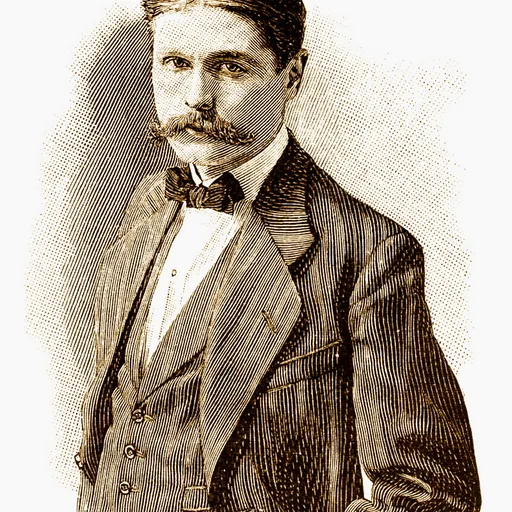
George Groslier
French writer, art historian and archaeologist
About George Groslier
Lived 1887 – 1945 (aged 58). George Groslier was a French writer, art historian, archaeologist, photographer, painter and ethnographer.
George Groslier (; February 4, 1887 – June 18, 1945) was a French polymath who – through his work as a painter, writer, historian, archaeologist, ethnologist, architect, photographer and curator – studied, described, popularized and worked to preserve the arts, culture and history of the Khmer Empire of Cambodia. Born in Phnom Penh to a French civil servant – he was the first French child ever born in Cambodia – Groslier was taken by his mother to France at the age of two and grew up in Marseille. Aspiring to become a painter, he tried but failed to win the prestigious Prix de Rome. Shortly afterwards, he returned to Cambodia, on a mission from the Ministry of Education. There he met and befriended a number of French scholars of traditional Cambodian culture. Under their influence, he wrote and published, in France in 1913, his initial book on this subject: Danseuses Cambodgiennes – Anciennes et Modernes (Cambodian Dancers – Ancient and Modern). It was the very first scholarly work ever published in any language on Cambodian dance. He then returned to Cambodia, traveling the length and breadth of the country to examine its ancient monuments and architecture. From this experience came his book A l'ombre d 'Angkor; notes et impressions sur les temples inconnus de l'ancien Cambodge (In the Shadow of Angkor: Notes and Impressions on the Unknown Temples of Ancient Cambodia). In June 1914, Groslier enlisted in the French army and was employed as a balloonist in the early part of World War I. It was during this time that he met and married sportswoman Suzanne Cecile Poujade; they eventually had three children.
He was ultimately reassigned to French Indochina because of his knowledge of the Khmer language. Upon his arrival in Phnom Penh in May 1917, he was charged with a new mission: to found a new Cambodian art museum and organize a school of Cambodian arts. From 1917 to his retirement in 1942, Groslier changed the focus of his work from that of merely describing Cambodian culture for a European audience to what he called a "rescue mission" to save the indigenous national art forms of Cambodia from destruction. His vision for the museum was to build collections from the full range of Cambodia's traditional works of art. At the art school, Groslier did not try to make the native culture adapt to that of the colonizing power; on the contrary, he insisted that the school be run by Cambodians for Cambodians and that no European influence be allowed. He was also intolerant of any attempts by Europeans to loot or damage native art. In 1923, the 22-year-old writer André Malraux, later to become world-famous, removed some bas-relief statues from a 10th Century temple, Banteay Srei, with the intention of selling them to an art museum. Although Malraux claimed that he was acting within the law, Groslier immediately had him arrested, scarring the former's reputation in Indochina. Groslier would later contemptuously refer to Malraux as "le petit voleur" ("the little thief").
Between 1920 and 1939, Groslier's family frequently traveled between France and Cambodia so that the three children could attend schools in France. In 1939, however, events leading up to the Second World War made such travel increasingly dangerous, and Suzanne was forced to remain in France with their two sons, while Nicole, their daughter, stayed with her father in Cambodia. When the Japanese military occupied Cambodia, because French colonies were then administered by the pro-Axis Vichy regime, violence was initially avoided. But in March 1945, as the Allies made further advances in Asia, the Japanese relieved French officials of their authority, rounded up all foreign nationals, and placed them under guard in concentration camps. Because of his known enthusiasm for shortwave radio, Groslier was suspected by the Japanese of being part of the anti-Japanese resistance. On June 18, 1945, in Phnom Penh, while imprisoned by the Kempeitai, Groslier died under torture. He was later officially recognized as Mort pour la France ("Died in the service of France").
All Groslier's major work was inspired by his profound love and respect for the Cambodian people and their culture. Referring to his numerous talents, literary scholar Henri Copin has written: In addition to his extensive body of scholarly writings on the art, archaeology and history of the Khmer people of Cambodia, Groslier's books include detailed travelogues as well as works of fiction – such as the novel Retour à l'Argile (Return to Clay (1928)), which won Le prix de littérature colonial (Grand Prize of Colonial Literature) in 1929 – describing his impressions of, and interactions with, Cambodians. Both institutions he founded, the National Museum of Cambodia The Protectorate was established when King Norodom of Cambodia signed a treaty with France to protect his country from incursions by neighboring Siam (present-day Thailand) and Annam (present-day Vietnam). In 1889, his mother became pregnant with a second child, but due to the primitive medical situation in Cambodia, she was forced to travel to Saigon for the delivery. She gave birth to a daughter, who immediately died, so Angélina decided to return to her family home in France to protect two-year-old George from the harsh climate and dangers of colonial life.
Groslier began his education in Marseille and discovered his talents for writing and painting. At the age of seven, he attended the Universal Exposition in Lyon, which featured exhibits on French Indochina, including Cambodia. He grew up with an awareness of and interest in the land in which he had been born, but no great desire to return there. In 1904, at the age of 17, George published his first book, a self-published poetry collection entitled La Chanson d'un Jeune (Song of a Youth). Beginning about 1905, Groslier attended the prestigious École nationale supérieure des Beaux-Arts, studying under classical painter Albert Maignan, who was then in his sixties. (Groslier would dedicate his first book about Cambodia to the older painter.) However, this setback turned out to be a fortunate one, as it created the opportunity for his future career in Cambodia.
First project in Cambodia (1910–12) In 1910, the Ministry of Public Education, whose head, Albert Sarraut, the future Prime Minister of France, would become his lifelong mentor and friend, commissioned Groslier to carry out an educational assignment in Cambodia. Upon his return to his birthplace, Groslier was soon working with prominent leaders in the field of Khmer archaeology, including Jean Commaille, Henri Parmentier and Henri Marchal. By all accounts, he was awed by his first glimpse of the ancient temples of Angkor Wat. As one scholar has said, "This vision of the grand Angkorean past was the wellspring of his love for Cambodia and its culture." Although he witnessed just three evening performances for King Sisowath's birthday, and three additional "supplications" in the throne room, Groslier, with the special help of Gravelle, gained access to royal dancers and teachers connected to the king's court. He assembled hundreds of original sketches, numerous paintings and detailed written information, which he brought back with him to France.
Funded by a subscription from the Minister of Colonies and the "High Patronage of His Majesty Sisowath, King of Cambodia," Groslier published Danseuses Cambodgiennes – Anciennes et Modernes (Cambodian Dancers – Ancient and Modern) in Paris in 1913. On April 1, 1913, George returned to Cambodia with new assignments.
Over the remainder of 1913, he traveled the length and breadth of the country documenting the most remote Khmer monuments and recording his impressions and adventures. Groslier traveled on his own, isolated in remote jungles, rivers and mountains in primitive and demanding conditions, assisted only by native helpers.
In the Shadow of Angkor He published his experiences in his second book, A l'ombre d 'Angkor; notes et impressions sur les temples inconnus de l'ancien Cambodge (In the Shadow of Angkor: Notes and Impressions on the Unknown Temples of Ancient Cambodia), penning lively accounts that blended his subjective impressions with objective details. As Maxime Prodromidès observes, what set George Groslier apart from other authors was his close contact with the Khmer people, with his passion split between the art and life of the country: Publication of the book was, however, delayed until 1916 due to the outbreak of the First World War.
World War I service In June 1914, Groslier returned to France to enlist in the French army; the war began only weeks later. In 1915, Groslier was assigned to serve as a balloonist at Versailles Aerostation. Observation balloons were vital to the war effort as a means of aerial reconnaissance, and as these vehicles, for that reason, were favored targets for enemy fire, it was dangerous work. The French media at that time were encouraging French women to become pen pals with soldiers as a way of boosting morale. A relationship developed between Groslier and a pen pal named Suzanne Cecile Poujade, resulting in their marriage in Paris on May 27, 1916. Although she was not authorized to accompany him, Suzanne made her way to the town to join him, using documents issued under her maiden name to avoid detection. On the long, circuitous trip, his ship was falsely reported sunk, causing great sorrow to everyone but his wife, who was certain he was alive. By the time he arrived safe and sound in Bucharest, he had been promoted to corporal. After completing his duties, George went to Liverpool and then to Paris to be reunited with his wife.
Albert Sarraut was then charged with assembling an Air Force team in the Far East and, knowing Groslier was familiar with Cambodia and was fluent in the Khmer language, Sarraut had him reassigned to this mission in April 1917. Groslier headed back to French Indochina, accompanied by Suzanne. He charged him with two new missions: to found a museum of Cambodian art and to organize a school of Cambodian arts. Sarraut believed that the future of colonial rule lay not in assimilating cultures but, in his words, in "understanding [them] so that they may evolve, under our tutelage, in the framework of their civilization."
In the words of one scholar: "From 1917 to 1942, Groslier had shaped his career as a rescue mission and established institutions, principally an art school and museum, which he described as a life raft to save Cambodia's national arts from vanishing... Those arts he had only years ago described as 'immortal' now seemed to Groslier to be on the verge of vanishing." (From this point to the end of his life, Groslier continually resided in Cambodia, returning to Europe only for brief vacations or for educational initiatives on behalf of his professional mission, e.g., the 1931 Paris International Exposition (see below).)
Groslier proved brilliant at the public relations challenge of rallying French colonial public opinion (and the administration) to the cause of saving Cambodian art. and bemoaned the fact that "everything here that has withstood time, wars, and religions has now succumbed to civilization... Our steamships and automobiles generate a smoke in which champa flowers wither..." In the summer of 1917, Groslier initiated a national survey to quantify the state of traditional arts, and produced a report that predictably painted a very pessimistic picture of its present condition.
Founding of the Museum of Cambodia alt=A building in traditional Cambodian style, in front of which is a path and garden. Groslier drafted the architectural plans for the Museum of Cambodia (Musée du Cambodge), known from 1920 as the Albert Sarraut Museum, which opened its doors to the public during the Cambodia New Year on April 13, 1920. (It continues to operate today as the National Museum of Cambodia.) Simultaneously he enlisted Cambodians in preserving their own heritage by providing an organization to catalog the nation's historical resources "to give all Khmers a stake in that past."
Though the two institutions were administered by Frenchmen (including of course, Groslier), he pursued his own agenda by transferring true control of both to Cambodians. In 1917, he installed the former royal architect Tep Nimit Mak as an administrator of the school, and later assembled, with great difficulty, Cambodian master artists to teach. As the institution grew, Groslier maintained his hands-off approach. As Ingrid Muan describes:
In 1923, a visiting French journalist, François de Tessan, arrived at the school and came away with a very favorable impression of both the school and Groslier, who proudly described to de Tessan its dedicated masters and students: "As you can see," [Groslier] told me, "we have settled in and are well equipped. But for two years, at its very beginnings, the School of Arts was functioning in a dark, nondescript warehouse a third the size of what was needed... Every night during the rainy season we had to remove every piece of silk from the looms, because of leaks in our worm-eaten roof. It was a tedious task for masters and students alike. We had recruited a handful of professors and artisans to get the classes going. Not one failed to show up. Not one quit their job. Not a one. In fact, these educators were so enthusiastic that they refused their vacations. Outside its walls, all of them promoted the school, recruited students and sought ancient and rare objects." The article revealed the site as neglected and overgrown with vegetation. Apparently, Malraux, before he left France, made a detailed study of the applicable laws and determined (at least to his own satisfaction) that the site was abandoned property to which no one could stake legal claim.
In the summer of 1923, at the age of 22, he set out for Indochina with his wife, Clara, and a colleague, Louis Chevasson. The party concealed their true purpose – to take priceless traditional art objects and sell them to a European art museum – by pretending to be mere sightseeing tourists and scholars. Malraux had even received special permission from the authorities to explore the Banteay Srei site. However, upon meeting Groslier, Malraux inadvertently aroused the former's suspicions by referring repeatedly to the "commercial value" of the pieces in the Sarraut Museum.
The incident created an enormous scandal in both colonial Indochina and France itself, despite the fact that Malraux was, at that time, virtually unknown outside French literary circles. As Copin puts it, "the controversial court cases that ensued shook the colonial administration from Indochina to Paris." However, there were many irregularities in the conduct of the case by the prosecution. It created a "secret dossier," withheld from the defense, with which it sought to demonize Malraux and Chevasson by their association with left-wing bohemians, whom it called "Bolsheviks," and by the fact of Clara's Jewish origins.
Furthermore, the basic legal case against Malraux was very questionable. It was true that the Governor General of Indochina had designated EFEO as the protector of Indochinese archeological sites and forbade anyone except members of EFEO from taking any artifacts out of the country. However, Banteay Srei had never been officially designated as a protected site. In the words of scholar Lindsay French, "Malraux, furious that EFEO should have such a monopoly over the temples, argued that since Banteay Srei had never been specifically 'classified' as a monument to be preserved, the stones were not legal artifacts and [therefore] there was no [legal] basis for his arrest."
The incident had two repercussions. It prompted the colonial administration to belatedly begin a serious restoration of the decrepit Banteay Srei site, headed by Groslier's friend Parmentier, whose earlier article had brought the site to Malraux' attention in the first place.
Scholarly and literary work Groslier was a very prolific writer throughout his career, but the period between the mid-1920s through the early-1930s was particularly productive for him. In the second half of 1924, he published Angkor, and in 1925, he published two books: La Sculpture khmère ancienne (Ancient Khmer Sculpture) and a massive two-volume work, Arts et Archéologie Khmers (Khmer Arts and Archeology). Copin offers a highly laudatory description of the book's approach:
It was also during this period that he added another title to his long list of accomplishments: novelist. In 1926, he published his first novel, La Route du plus fort (The Road of the Strongest), an overview of colonialism more critical than he could ever have made in his scholarly works. Two years later, he published his most acclaimed work of fiction Le Retour à l'argile (Return to Clay).
The book received the Grand Prize of Colonial Literature (Le prix de littérature coloniale) in 1929, but afterwards fell into obscurity, until its re-release in modern French and English editions.
1931 International Exposition in Paris Groslier played a major role in preparing the Cambodian exhibitions for the Colonial Exposition that opened in Vincennes, just outside Paris, on May 6, 1931. The event was designed to be the most spectacular colonial show in history. Groslier, however, who saw the exposition as an opportunity to open world markets to Cambodian art,
The focal point of the exhibition was a full-sized reproduction of the top level of Angkor Wat, reconstructed in the center of Paris, as well as a Cambodian pavilion that was
Suzanne Groslier's notes confirm that preparations for the exhibition began a year in advance of the official opening, so that the Cambodian exhibition was ready before those of any of the other participants. In fact, such a demand for indigenous Cambodian crafts was created that a permanent sales office for such items was opened in Paris.
Marriage and family life Suzanne Poujade, Groslier's wife, was born in Paris in 1893. (By a strange coincidence, Albert Sarraut, Groslier's future mentor and employer, was a friend of the Poujade family.) She had been very thin as a child and a doctor had recommended sports as therapy. As a result, in her teens she trained in both ice skating and tennis and became a champion at both. With her skating partner, a man named Pigueron, she won five gold medals at the national championships and several medals at the Paris city championships. In tennis, she competed in the world championships in 1914, and won three gold medals.
At the outbreak of the war, Suzanne headed for Lavaur in southwest France, where some of her father's family lived and where she worked as a nurse for the war effort. It was while staying in the area, both to pass the time and to do something novel for their country, that she and some friends decided to participate in the marraine de guerre (War Godmother) program, in which civilian women established pen pal relationships with soldiers at the front. After Suzanne's friends had chosen their pen pals, Suzanne took a letter from balloonist George Groslier and began a correspondence with him. As noted above, Suzanne and George fell in love and were married in May 1916. This was not unusual: many pen pal relationships begun by the War Godmother program ended in marriage.
The couple had three children, all of whom were born in Cambodia like their father: Nicole, born June 15, 1918 (godfather: Albert Sarraut) Gilbert, born September 8, 1922 Bernard-Philippe, born May 10, 1926.
The last child, , would follow in his father's footsteps and become a renowned archaeologist and curator of the National Museum of Cambodia.
During the children's youth, they spent much time in France at the family home there and attending school. In June 1939, just before the outbreak of a new war, Suzanne traveled to France with young Bernard (Gilbert had already been in the country for several years as a high school student), while Nicole remained behind with her father. In June 1940, the Nazis invaded France, and Suzanne and her sons eventually took refuge in unoccupied (Vichy) southern France, whose administration still controlled the French colonies, including Cambodia. However, because of the war, sea travel between France and Southeast Asia was disrupted, and neither Suzanne, Gilbert, nor Bernard would ever see Groslier again.
Japanese occupation and death alt=A mid-length portrait of a man of about 30 in a conservative suit and wearing a moustache, facing the camera. In July 1940, the Vichy government appointed Admiral Jean Decoux as Governor-General of Indochina. On September 22, under heavy pressure from Germany, Decoux signed a treaty giving Japanese forces free movement through the area, effectively ending resistance against them. Although the Vichy regime continued to administer Indochina, the Japanese, which stationed a garrison of 8,000 troops in Cambodia, were the true masters of the region.
However, because France was officially, at that time, an ally of Japan, Cambodia temporarily avoided the violence and disorder that was tearing apart so much of the rest of the world, and the life of the French colonists, although more isolated from the outside world, went on more or less as before. It was during this period that Groslier, who was still in his fifties, retired. At this time, also, the Japanese became increasingly interested in Cambodian culture, particularly Angkor. A translation of Groslier's 1924 book on the subject, Angkor, was published by a Japanese press in Tokyo under the title Ankōru no iseki (Ruins of Angkor).
The political situation changed drastically in August 1944, when Paris was liberated by Allied forces. The Vichy government shortly afterwards collapsed. (Groslier's son, Bernard, participated actively in the French Resistance.) In Asia, too, the Allies were encroaching upon the increasingly desperate Japanese. On March 9, 1945, Japanese authorities, promising autonomy to the local population, overthrew the French colonial regime, and four days later King Sihanouk declared Cambodia's independence from France and its alliance with the crumbling Japanese Empire.
The Japanese proceeded to round up all foreign nationals in the country, including Groslier and his daughter, and place them in concentration camps. As Nicole Groslier describes it:
Since at least the 1930s, Groslier had been a passionate shortwave radio enthusiast. (A photo dating from 1933 reveals his rather sophisticated system, and it may have become more elaborate in the intervening years.) This fact aroused the suspicions of the Japanese authorities, who feared that Groslier might be using his radio to help anti-occupation forces within the country. Nicole later insisted that her father used his radio solely to listen to music. However, Copin remarks that he "apparently supported local resistance efforts," and Davis concedes that this was at least possible, though not proven. Eyewitnesses in the camp report that the Japanese military police, the Kempeitai, interrogated Groslier, tortured him, and returned him to his cell dead or dying on the morning of June 18, 1945.
Nicole, who had not been notified of her father's fate, was called into the office of the camp commander. Without a word, the man gestured in the direction of a nearby table. On or near the table were her father's last remains: his eyeglasses, a pair of shoes and his ashes in a box. She retrieved the objects and left. "My God," she later wrote, "I was frightened and lonely that day." After Indochina was re-occupied by the French (with Bernard as part of this invading force), Groslier's ashes were sent to France, where they are now interred.
Legacy alt=A cast-iron statue of a man in a suit with a hat in his lap, seated upon a chair also of cast iron; the wall and roof of a building is visible in the background. On October 4, 1946, Governor Penn Nouth of Phnom Penh honored Groslier by inaugurating rue Groslier ("Groslier Street") in front of the National Museum, saying Historian Penny Edwards observes that, though there is no longer a rue Groslier, "the palace and the arts school still grace the skyline." However, in 2019 an initiative was started to rename this street in memory of Georges Groslier, with various expressions of support or objection.
On May 5, 1947, the French government officially recognized Groslier as "Mort pour la France," a term traditionally used for military personnel and civilians, killed during a period of French military conflict, who are considered to have died in service to their country.
In 2008, DatAsia Press editor Kent Davis began working with Nicole Groslier and her family, documenting her father's life, translating a number of his books to English, and restoring them to print, as listed in the bibliography below.
In October 2015, the Royal University of Fine Arts in Phnom Penh honored Groslier with a statue next to H. M. Sisowath on the school grounds.
Awards and honors During his lifetime, Groslier won many awards and honors from many different counties. Davis quotes historian Joel Montague as saying that Groslier was "a bit of an oddity" in that he won his awards not over a short span of time, but throughout his life, from his teens to his fifties, as well as in the fact that he was given them for widely divergent activities and services: for painting, for writing, for museum work, for charity, and from the governments of France, Cambodia, Laos and Annam (Vietnam). Davis points out yet another interesting fact: in the more than 100 surviving photos of Groslier, he never appears wearing any of his many decorations. The list of awards follows:
Works The following is a list of published work by George Groslier in French and English.
Nonfiction books
Novels
Graphic work
Miscellaneous French language publications
Archaeological publications (selected)
Publications on indigenous arts of Cambodia (selected)
Miscellaneous English language publications
Narratives
Modern Editions
French
English
Don’t just read it —
keep it.
Full-length biographies made to live with: read them, listen on the way to work, watch them tonight.
- E-book
- Audio
- Video
Instant download · yours to keep · every purchase keeps this site free
Important facts
People in George Groslier's life
Named in this biography and alive at the same time





Related people
Same field, nearest in time


Contemporaries
People whose lives overlapped George Groslier's




Frequently asked questions
Who was George Groslier?
French writer, art historian and archaeologist (1887-1945)
When was George Groslier born?
George Groslier was born on 4 February 1887 in Phnom Penh.
When did George Groslier die?
George Groslier died on 18 June 1945 in Phnom Penh.
What was George Groslier's occupation?
George Groslier was a writer, art historian, archaeologist, photographer, painter and ethnographer.
What nationality was George Groslier?
George Groslier was French.
Sources & further reading
Cite this page
APA: Biography.guide. (2026). George Groslier. https://biography.guide/george-groslier/
MLA: "George Groslier." Biography.guide, https://biography.guide/george-groslier/.
Chicago: "George Groslier." Biography.guide. https://biography.guide/george-groslier/.
Data last updated: 2026-09-22 · Spot an error? Report a correction.
Portrait: Wikimedia Commons · author & licence
Page generated 2026-09-27 05:03 UTC