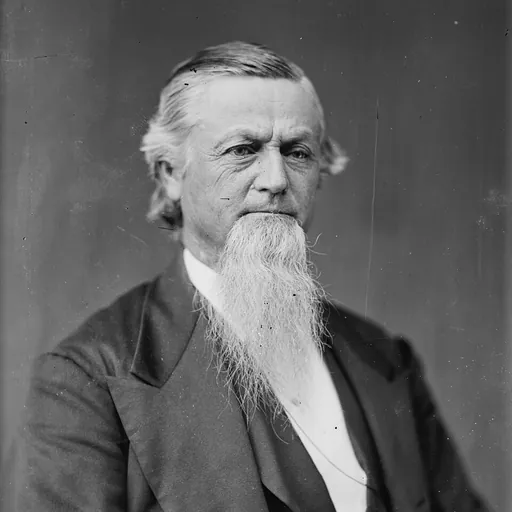
About George Gibbs Dibrell
Lived 1822 – 1888 (aged 66). George Gibbs Dibrell was an American politician and lawyer.
George Gibbs Dibrell (April 12, 1822 – May 9, 1888) was an American lawyer and a five-term member of the United States House of Representatives from the 3rd Congressional District of Tennessee. He also served as a general in the Confederate States Army during the American Civil War and as a railroad executive.
Biography Dibrell was born in Sparta, Tennessee, on 12 April 1822. His ancestors were Huguenot refugees from France who settled in Virginia in 1700. His grandfather fought as a Patriot in the American Revolution and married into a branch of the Lee family in Virginia. His father, Anthony Dibrell, arrived in White County, Tennessee, in 1811, where he served as a circuit court clerk, state legislator, was once a Whig candidate for Congress, and eventually the State Treasurer of Tennessee.
Dibrell worked on his father's farm during the summer, and at the age of 15 he travelled alone to Virginia and Mississippi with droves of livestock. What little formal education Dibrell received came at the local schools during the winter months, followed by one session at the University of Tennessee at Knoxville at age 16. Ten years later in 1860, the total value of Dibrell's personal estate had increased to $27,000, making him one of the top five wealthiest landowners in the county.
The 1850 United States Census, Slave Schedule, for White County, indicates that Dibrell owned four mulatto slaves: a woman of 45 years, a girl of 12, and two boys of four and two years. The 1860 census record lists Dibrell as owning 16 slaves, ranging in age from 1–50 years in age. From the end of his time as clerk at the Bank of Tennessee until the beginning of the War, Dibrell carried on in commerce, his occupation in the 1850 census indicating "merchant."
Promoted to brigadier general in early 1865, Dibrell commanded a division under Wheeler during the Carolinas campaign and its climactic Battle of Bentonville. He accompanied the flight of the Confederate government following the evacuation and fall of Richmond in April 1865, having charge of protecting the national archives of the Confederacy and escorting President Jefferson Davis from Greensboro, North Carolina, into Georgia. He was finally captured and paroled near Washington, Georgia, on May 9, 1865.
1861–1862 As the secession movement swept the South, Dibrell was elected as a Union delegate to the Tennessee State Constitutional Convention in July 1861, which would debate the prospect of secession, but it was voted against and never met. Dibrell was also elected to represent White County in the 1861 Tennessee State Legislature, where he served but several weeks before joining the Confederate States Army. At Livingston he was elected Lieutenant Colonel of the regiment. After three months’ drilling, the 25th marched as part of a larger force under Brigadier General Zollicoffer to Camp Beech Grove, just across the Cumberland River from Mill Springs, Kentucky, in advance of a threatened Federal invasion from nearby Somerset or Colombia to the west, and to break up Kentuckian Federal home guard units.
This immediately preceded the Battle of Fishings Creek (more generally known as the Battle of Mill Springs or Logan's Crossroads) on 19 January 1862, one of the first significant Union victories of the Civil War, which helped break the Confederate defensive line. Zollicoffer fell during the battle, at which point the Confederate forces were outflanked and retreated in disorder. Dibrell and the 25th Tennessee formed the Confederate left flank which was turned by the Union commander. The Confederates fell back that night across the Cumberland River, leaving behind their artillery, wagons, horses, and all of their supplies and ammunition. Confederate loss totaled about 400 killed, wounded, and captured. after which he returned home to Sparta. There he organized an independent force of cavalry as partisan rangers. This regiment, which entered service as the 8th Tennessee Cavalry (sometimes called the 13th), was organized at Yankeetown, a short distance from downtown Sparta, on 4 September 1862, and totaled 920 men in twelve companies. George Dibrell was elected Colonel.
Politics Dibrell was a delegate to the Tennessee state constitutional convention in 1870. Elected as a Democrat to the Forty-fourth and the four succeeding Congresses, Dibrell served from March 4, 1875, to March 3, 1885. He was not a candidate for renomination in 1884 and resumed agriculture and business pursuits, including the development of several coal mines.
Post-war Pursuits
Overview Owner of over fifteen thousand acres in White County, Dibrell established the Bon Air Coal & Coke Company, which became one of the county's leading industries and largest employers. Also a key figure in the development of the Southwestern Railroad, which connected Sparta with the Nashville and Chattanooga line, he was President of that railroad in 1869. Dibrell also served as a delegate to the Methodist conference at Memphis in 1870, and at Nashville in 1882. Dibrell became a director of the Southwestern Railroad Company three years before he was elected as its president in 1869. He remained in this position for 15 years until the company was acquired by the Nashville and Chattanooga Company and the railroad came to Sparta in 1884. He is interred at the Old Sparta Cemetery. George Dibrell's grave overlooks a part of downtown Sparta, Tennessee, from its vantage point in Old Sparta Cemetery.
Don’t just read it —
keep it.
Full-length biographies made to live with: read them, listen on the way to work, watch them tonight.
- E-book
- Audio
- Video
Instant download · yours to keep · every purchase keeps this site free
Important facts
People in George Gibbs Dibrell's life
Named in this biography and alive at the same time

Related people
Same field, nearest in time




Contemporaries
People whose lives overlapped George Gibbs Dibrell's





Frequently asked questions
Who was George Gibbs Dibrell?
Confederate Army general (1822-1888)
When was George Gibbs Dibrell born?
George Gibbs Dibrell was born on 12 April 1822 in Sparta.
When did George Gibbs Dibrell die?
George Gibbs Dibrell died on 9 May 1888 in Sparta.
What was George Gibbs Dibrell's occupation?
George Gibbs Dibrell was a politician and lawyer.
What nationality was George Gibbs Dibrell?
George Gibbs Dibrell was American.
Sources & further reading
· Wikipedia: George Gibbs Dibrell
Cite this page
APA: Biography.guide. (2026). George Gibbs Dibrell. https://biography.guide/george-gibbs-dibrell/
MLA: "George Gibbs Dibrell." Biography.guide, https://biography.guide/george-gibbs-dibrell/.
Chicago: "George Gibbs Dibrell." Biography.guide. https://biography.guide/george-gibbs-dibrell/.
Data last updated: 2026-09-23 · Spot an error? Report a correction.
Portrait: Wikimedia Commons · author & licence
Page generated 2026-09-27 05:06 UTC