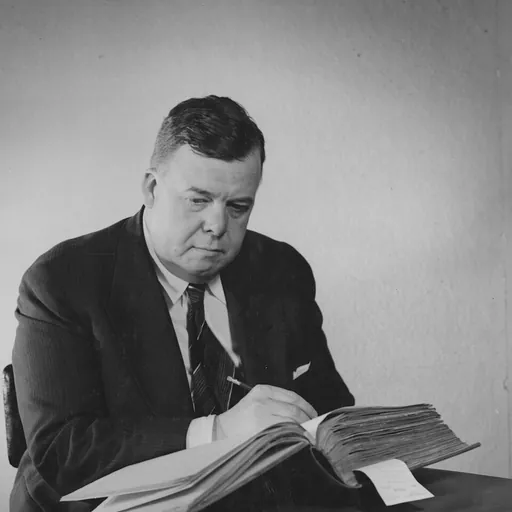
About George Fort Milton Jr.
Lived 1894 – 1955 (aged 60–61). George Fort Milton Jr. was an American writer, historian and editor.
George Fort Milton Jr. (November 19, 1894 – November 12, 1955) was an American newspaper editor, and author of several histories of the 19th-century United States. He never used Jr. in his own time but it is often applied retroactively to distinguish him from his father, George Fort Milton Sr., who died in 1924 and preceded him as owner of the Chattanooga News of Chattanooga, Tennessee. At the time of his death he was remembered as a "liberal editor keenly interested in the development of the South."
Biography Milton attended prep school in Knoxville, Tennessee, where his father owned the Knoxville Sentinel, and graduated from the University of Virginia in 1916. During his newspaper career, he served as managing editor of the Chattanooga News from 1919 to 1924, and president and editor from 1924 to 1939. He also served as an editor of the Knoxville Sentinel, and wrote editorials for the St. Louis Post-Dispatch and the Buffalo Evening News in the 1940s. Between 1940 and 1944 he "served as consultant to the Bureau of the Budget" in Washington.
Milton signed the bond for John Thomas Scopes of Scopes Trial fame, was friends with William Jennings Bryan, and "established a news bureau in Dayton, Tennessee" to cover the trial.
His racial views were "surely more advanced than most of his fellow southerners," although a certain paternalism was evident in his writings. He was a member of the Commission on Interracial Progress, and chairman of the Southern Commission on the Study of Lynching from 1930 to 1934. W. E. B. DuBois wrote a letter praising his work on lynchings in the south in the 1930s (Milton had written the introduction to the commission's report). Milton opposed a federal anti-lynching law, instead advocating for drastic social and legal reforms by individual Southern states. Milton defended the Scottsboro boys in print, arguing early for their innocence. Conversely, he never opposed segregation in any meaningful way.
Milton died at St. Elizabeth's Hospital in Washington, D.C. after a long illness.
Selected works
The Age of Hate: Andrew Johnson and the Radicals (1931) The Eve of Conflict: Stephen Douglas & the Needless War (1934) Conflict: The American Civil War (1941) Abraham Lincoln and the Fifth Column (1942) The Use of Presidential Power, 1789–1943 (1944)
Don’t just read it —
keep it.
Full-length biographies made to live with: read them, listen on the way to work, watch them tonight.
- E-book
- Audio
- Video
Instant download · yours to keep · every purchase keeps this site free
Important facts
People in George Fort Milton Jr.'s life
Named in this biography and alive at the same time



Related people
Same field, nearest in time





Contemporaries
People whose lives overlapped George Fort Milton Jr.'s


Frequently asked questions
Who was George Fort Milton Jr.?
U.S. historian and newspaperman (1894–1955)
When was George Fort Milton Jr. born?
George Fort Milton Jr. was born in 1894.
When did George Fort Milton Jr. die?
George Fort Milton Jr. died in 1955 in Washington, D.C..
What was George Fort Milton Jr.'s occupation?
George Fort Milton Jr. was a writer, historian and editor.
What nationality was George Fort Milton Jr.?
George Fort Milton Jr. was American.
Sources & further reading
· Wikipedia: George Fort Milton Jr.
· DBpedia: George Fort Milton Jr.
Cite this page
APA: Biography.guide. (2026). George Fort Milton Jr.. https://biography.guide/george-fort-milton-jr/
MLA: "George Fort Milton Jr.." Biography.guide, https://biography.guide/george-fort-milton-jr/.
Chicago: "George Fort Milton Jr.." Biography.guide. https://biography.guide/george-fort-milton-jr/.
Data last updated: 2026-09-20 · Spot an error? Report a correction.
Portrait: Wikimedia Commons · author & licence
Page generated 2026-09-27 04:57 UTC