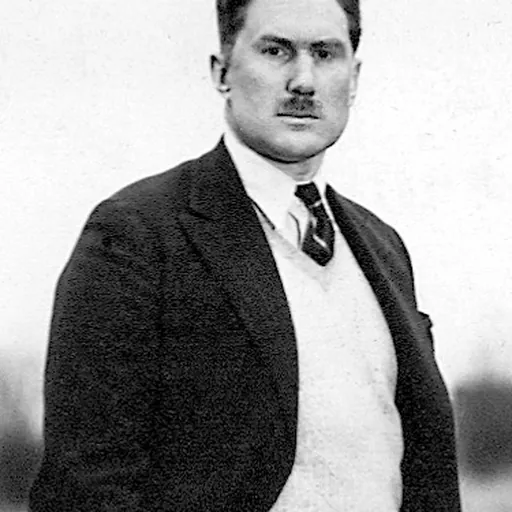
About George Eyston
Lived 1897 – 1979 (aged 81). George Eyston was a British engineer, racing automobile driver and inventor.
Early life George Eyston was educated at Stonyhurst College and Trinity College, Cambridge. His study of engineering at Cambridge was interrupted by World War I when he was commissioned in the Dorset Regiment and later served in the Royal Field Artillery. After the war he returned to Trinity College and was captain of the First Trinity Boat Club.
Career
Motor racing Eyston's racing career began before World War One, when he was still a schoolboy, and raced motorcycles under an assumed name. After the war (in which he was awarded the Military Cross)
Later he became well known for racing supercharged MGs such as the Magic Midget and the K3 Magnette. His entries with the K3 included the 1933 Isle of Man and 1934 Northern Ireland Tourist Trophy events, and the 1934 Mille Miglia
Speed records He fitted a diesel engine from an AEC bus into a car built on a Chrysler chassis and used it to set high-speed endurance records at Brooklands, attaining 100.75 mph in 1933 and 106 mph in 1936. He also achieved his fastest at 357.5 mph in 1938.
In 1935, he was one of the first British racers to travel to the Bonneville salt flats of Utah, with his 24- and 48-hour record-setting car Speed of the Wind.
He is best known today for land speed records set in his car Thunderbolt. Between 1937 and 1939 he set three new land speed records, wresting them from Malcolm Campbell's Blue Bird, but was twice bettered by John Cobb.
The rivalry was friendly, and in later years Eyston, as competitions manager for Castrol, assisted with Cobb's ill-fated attempt on the water speed record in Crusader.
Thunderbolt's first record was set at (502.12 km/h) on 19 November 1937 on the Bonneville Salt Flats. Within a year, Thunderbolt returned with improved aerodynamics and raised its record to on 27 August 1938.
Eyston was also involved in the design of his Thunderbolt car at the Bean Cars factory in Tipton, Staffordshire (now West Midlands).
Patents and engineering As an engineer and inventor, he held a number of patents related to motor engineering and particularly supercharging. His work on developing high-power gearboxes was important for Thunderbolt, along with his invention of the Powerplus supercharger used on MGs.
World War II During World War II Eyston served on various bodies connected with industry and was a Regional Controller for the Ministry of Production.
Honours and awards Eyston was awarded the Military Cross on 18 July 1917 - 2nd Lt. (temp Lt.) George Edward Thomas Eyston, RFA., Spec. Res. For conspicuous gallantry and devotion to duty. He rendered most valuable service when carrying out reconnaissance under heavy fire. On several occasions he went forward under heavy shell and machine gun fire. He carried out his duties with great courage and determination, and was able to obtain most valuable information. He was awarded the Segrave Trophy in 1935. He was made a chevalier of the Légion d'honneur in 1938.
Racing record
24 Hours of Le Mans results Year Team Co-Drivers Car Class Laps 1928 Aston Martin International A C Bertelli Aston Martin 1½ International 1.5 32 DNF DNF 1929 Colonel Warwick Wright Richard Watney Stutz DV32 8.0 104 DNF DNF
Complete European Championship results (key) (Races in bold indicate pole position) (Races in italics indicate fastest lap) Year Entrant Chassis Engine 1 2 3 Pts 1931 Sir Henry Birkin Maserati 26M Maserati 2.5 L8 ITA FRA4 BEL —
Don’t just read it —
keep it.
Full-length biographies made to live with: read them, listen on the way to work, watch them tonight.
- E-book
- Audio
- Video
Instant download · yours to keep · every purchase keeps this site free
Important facts
People in George Eyston's life
Named in this biography and alive at the same time



Related people
Same field, nearest in time


Contemporaries
People whose lives overlapped George Eyston's


Frequently asked questions
Who was George Eyston?
British racing driver (1897-1979)
When was George Eyston born?
George Eyston was born on 28 June 1897 in Bampton.
When did George Eyston die?
George Eyston died on 11 June 1979 in Lambeth.
What was George Eyston's occupation?
George Eyston was an engineer, racing automobile driver and inventor.
What nationality was George Eyston?
George Eyston was British.
Sources & further reading
Cite this page
APA: Biography.guide. (2026). George Eyston. https://biography.guide/george-eyston/
MLA: "George Eyston." Biography.guide, https://biography.guide/george-eyston/.
Chicago: "George Eyston." Biography.guide. https://biography.guide/george-eyston/.
Data last updated: 2026-09-22 · Spot an error? Report a correction.
Portrait: Wikimedia Commons · author & licence
Page generated 2026-09-27 05:01 UTC