
George Eastham
English association football player and manager
About George Eastham
Lived 1936 – 2024 (aged 88). George Eastham was a British association football player, association football coach and international sportsperson.
Newcastle United F.C. in 1960 with this players – from the left, standing: James "Jimmy" Scoular, Richard Matthewson "Dick" Keith, Bryan Harvey (goalkeeper), Bob Stokoe, Alf McMichael and George Eastham; seated: "Terry" W. L. Marshall, Ivor J. Allchurch, Leonard Roy "Len" White, John McGuigan and Liam Tuohy. George Edward Eastham, OBE (23 September 1936 – 20 December 2024) was an English footballer who played as a midfielder or inside forward for Newcastle United, Arsenal and Stoke City, as well as being a member of England's 1966 World Cup-winning squad. He is also notable for his involvement in a 1963 court case which proved a landmark in improving players' freedom to move between clubs.
Eastham began his career with Northern Irish side Ards before moving back to England to play for Newcastle United in 1956. He became an inside forward for them but then demanded a move away which Newcastle rejected. Eastham went to court and won his case before moving to Arsenal. Eastham spent six seasons at Highbury, making 223 appearances scoring 41 goals before joining Stoke City in 1966. His experience helped Stoke enjoy a successful spell in the early 1970s and Eastham scored the winning goal in the 1972 League Cup Final.
Eastham also spent time coaching in South Africa, playing for Hellenic before returning to Stoke to become assistant manager to Tony Waddington. When Waddington resigned in March 1977 Eastham was appointed manager but was unable to prevent Stoke being relegated in 1976–77. After failing to mount a promotion challenge the following season Eastham was sacked in January 1978. He then returned to coach in South Africa.
Playing career
Newcastle United Eastham was part of a footballing family – his father, George Eastham Sr., was an England international who played for Bolton Wanderers and Blackpool, while his uncle Harry Eastham played for Liverpool and Accrington Stanley. In his youth he was a useful cricketer, playing in the same Blackpool CC team as his future fellow international, Jimmy Armfield.
Eastham junior first played for Northern Irish club Ards, where his father was player-manager, and the two played together on the pitch. A skilful midfielder/inside forward, he was signed by Newcastle United in 1956, and made his debut against Luton Town on 6 October 1956, in a match which finished 2–2. He spent four seasons with the Magpies and during his time there he won caps for the Football League and the England U23 side. He played 125 games for Newcastle, scoring 34 goals, With his contract due to expire soon, in 1959, Eastham refused to sign a new one and requested a transfer. However, Newcastle refused to let Eastham go. At the time, clubs operated a system known as retain-and-transfer, which meant that teams could keep a player's registration (thus preventing them from moving) while refusing to pay them if they had requested a transfer. As Eastham later recounted:
Unable to leave, Eastham went on strike at the end of the 1959–60 season, moving south to work for an old family friend, Ernie Clay (who later became chairman of Fulham), selling cork in Guildford, Surrey, a venture which earned him more money than his Newcastle contract paid. Finally in October 1960 Newcastle relented and sold Eastham to Arsenal for £47,500. However, Eastham considered the point worth fighting for, and backed by the Professional Footballers' Association (who provided £15,000 to pay for Eastham's legal fees), he took the club to the High Court in 1963.
In the case, Eastham v. Newcastle United Ch. 413, Eastham argued that it was an unfair restraint of trade, and that Newcastle owed him £400 in unpaid wages and £650 in unpaid bonuses. The judge, Mr Justice Wilberforce, ruled partly in Eastham's favour, stating that the retain-and-transfer system was unreasonable, although he ruled that as Eastham had refused to play for Newcastle, that any payment of wages for the disputed period was at Newcastle's discretion. As a result, although Eastham did not gain personally, he succeeded in reforming the British transfer market. The "retain" element of retain-and-transfer was greatly reduced, providing fairer terms for players looking to re-sign for their clubs, and setting up a transfer tribunal for disputes. Later on that same season, he scored the equaliser against his former club Newcastle United at St James' Park, in a 3–3 draw, during which he was called "Judas" and pelted with apples. Throughout his six seasons at Arsenal, he was a regular for the side; though not a prolific goalscorer, Eastham was one of the most talented players of what was an average Arsenal side at the time; under George Swindin and Billy Wright, Arsenal never finished higher than 7th during his time there.
Eastham's time at Arsenal was often turbulent; as well as the court case against Newcastle United, he fell out with Arsenal after asking for a pay rise following the maximum wage's abolition in 1961 (but eventually Arsenal relented and met his demands), and he asked for a transfer after being replaced by Joe Baker up front at the start of the 1962–63 season. However, Billy Wright sought a compromise and eventually restored Eastham to the side, behind Baker; Eastham's form returned, he came off the transfer list and in both 1963–64 and 1964–65 he scored ten goals, the most per season during his Arsenal career, which included two in a 4–4 draw in a memorable North London derby match against Tottenham Hotspur at Highbury in October 1963.
Eastham continued to be a regular and served as Arsenal captain between 1963 and 1966, but Arsenal's declining form – finishing 14th in 1965–66 — led to Wright's dismissal in the summer of 1966. By now Eastham was nearly 30, and the new Arsenal management sought to dismantle Wright's side in favour of younger players. He joined Stoke City in August 1966, having scored 41 goals in 223 matches for the Gunners.
In February 1971, at the age of 34, Eastham took a break from playing to develop his coaching ability, with the view of going into management. He embarked on a trip to South Africa, playing on loan with Cape Town City before having a spell as player-manager of Hellenic, who had previously been managed by his father. Eastham returned to Stoke in October 1971, to continue his playing career.
Eastham made 194 league appearances for Stoke City in total, ten of them as a substitute, scoring four goals. Eastham retired from playing in 1974, having been appointed an OBE for services to football the previous year.
International career Eastham joined the England squad for the 1962 FIFA World Cup as an uncapped player, but did not play in the tournament; his England debut finally came on 8 May 1963, against Brazil. His final game for England came in a warmup game for the 1966 FIFA World Cup, against Denmark in Copenhagen on 3 July 1966, scoring in a 2–0 win.
Managerial career Eastham became Tony Waddington's assistant at Stoke, and succeeded Waddington as Stoke manager after the latter resigned in March 1977, becoming only the club's fourth manager since 1935. He took over a side depleted of their best players who had been sold off to pay for repair work at the Victoria Ground and in trouble, and their relegation from the First Division was confirmed while he was in charge, finishing 21st out of 22 in 1976–77 after a run of just one win in 13 games.
Career statistics Club
International
Managerial statistics + Managerial record by team and tenure
!!!!!!!!
England FIFA World Cup: 1966 PFA Merit Award 1976 Officer of the Order of the British Empire (OBE): 1973
Don’t just read it —
keep it.
Full-length biographies made to live with: read them, listen on the way to work, watch them tonight.
- E-book
- Audio
- Video
Instant download · yours to keep · every purchase keeps this site free
Important facts
People in George Eastham's life
Named in this biography and alive at the same time
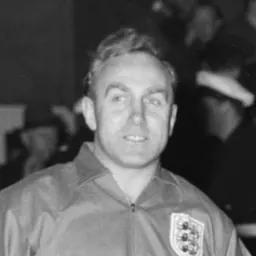




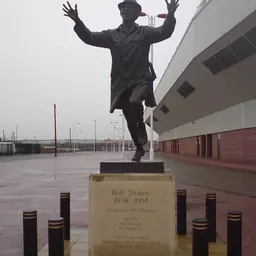

Related people
Same field, nearest in time




Contemporaries
People whose lives overlapped George Eastham's




Frequently asked questions
Who was George Eastham?
English association football player and manager (1936-2024)
When was George Eastham born?
George Eastham was born on 23 September 1936 in Blackpool.
When did George Eastham die?
George Eastham died on 20 December 2024 in London.
What was George Eastham's occupation?
George Eastham was an association football player, association football coach and international sportsperson.
What nationality was George Eastham?
George Eastham was British.
Sources & further reading
Cite this page
APA: Biography.guide. (2026). George Eastham. https://biography.guide/george-eastham/
MLA: "George Eastham." Biography.guide, https://biography.guide/george-eastham/.
Chicago: "George Eastham." Biography.guide. https://biography.guide/george-eastham/.
Data last updated: 2026-09-20 · Spot an error? Report a correction.
Page generated 2026-09-27 05:21 UTC