
George Dinnie
Scottish sportsman and professional wrestler
About George Dinnie
Lived 1875 – 1939 (aged 63). George Dinnie was a British professional wrestler, dog breeder and strongman.
George Dinnie (18 July 1875 – 13 June 1939) was a sportsman, strongman, wrestler and champion dog breeder. For a while, he was part of the travelling show promoted by Henry Jasper Redfern in Sheffield, England, and often billed as the "strongest man on earth".
Early life
In 1875, Dinnie was born at Ayr, South Ayrshire, Scotland, United Kingdom, although this has not been substantiated.
While many newspapers reported Dinnie as being the son of world-renown strongman and noted champion of the Highland Games, Donald Dinnie (1837–1916), no specific evidence confirms this familial relation. If George Dinnie was related to Donald Dinnie, George was considered to have not reached the level of the famous Dinnie. Even while George Dinnie was alive, the lack of association was stated:
The first man to wrestle in true Highland costume, "kilties an' a'" was the famous Donald Dinnie. He was the original Dinnie of 45 years ago, and no connection, except from a namesake point of view of George Dinnie, late of the W.A. Police Department and now farming up in the Midlands.
Athletic career
Making his mark in the catch-as-catch-can and Cumberland styles of wrestling, Dinnie had been toured English and Scottish music halls as the wrestling partner of American Jack Carkeek (1861–1924). Both Dinnie and Carkeek migrated to Australia in 1904, under contract to Harry Rickards (1843–1911). Dinnie's shoulder was pinned frequently by Carkeek, 'but every time Dinnie — whose occasional exclamations showed him to be the possessor of a rich Scotch accent — by some clever counter move managed to wriggle out of Carkeek's hold'. The finish was sensational at 9 minutes and 5 seconds, Carkeek winning by throwing Dinnie within fifteen minutes.
Following a difference of opinion, Carkeek and Dinnie went their separate ways. They later met up at a Hay Street venue, and Dinnie won again – but because he had taken French leave (absent without approval) from duty, he was suspended pending an inquiry, for which he then resigned and returned to the music halls. Singh was billed by Wirth Brothers Circus as one of the 'champion Hindu wrestlers of Australia'. The meeting between the 'burly Scotchman and the sinewy Hindu', weighing and ) respectively, saw Singh use Dinnie's force to his own advantage, with a result that neither man could throw the other: 'Dinnie was too heavy and powerful for Buttan to pin to the mat, and Buttan was too clever for Dinnie. After an hour and a-quarter's wrestling, during which Buttan gave an exhibition of wonderful skill, a draw was declared'.
A return match for the 'championship of Australia' and £100 on Saturday night, 15 August 1908, was organised, with Dinnie securing two out of the three falls, 'his great strength telling'.
He returned to Perth, and competed against big Lancashire wrestler Peter Bannon at His Majesty's Theatre on 21 September 1908; the decision going to Bannon, setting about a dispute for more than two decades.
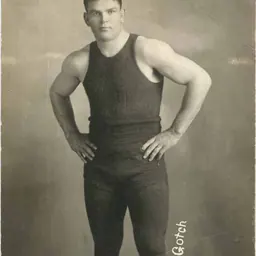
By December 1908, Dinnie lost to American champion Frank Gotch (1877–1917), in Sheffield, England in very quick successive bouts.
From the music halls, when World War I broke out, Dinnie enlisted at Bunbury.
In Saturday, 5 July 1924, aged 48, at a concert and dance evening around the town of Dalwallinu, mid-west WA, Dinnie did some displays of weight lifting with ease, holding 'the onlookers spell bound for several seconds'.
By October 1929, Dinnie stated he was "not satisfied that 'Americanised' wrestling is more effective than the old style which was once so popular here".
Accomplishments
In his heyday, Dinnie was described as: weight – (Donald: ) chest – (Donald: ) biceps – (Donald: ) forearms – neck – thigh – (Donald: ) calf – . Western Australian Heavyweight Championship (2 times) Perth Promoting Company South-West Championship (1 time)
Military service New enlistments at Bunbury railway station, 18 August 1914, Bunbury volunteers selected for the 11th Battalion of the Expeditionary Force for the landing at Gallipoli on 24 April 1915. Photograph provides names and details of service in the Gallipoli campaign.
In August 1914 at the age of having just turned 36, of 593 candidates, Dinnie was one of sixty selected for the Australian Imperial Force at the outbreak of World War I at Midland, Western Australia.
His enlistment papers of Monday, 7 September 1914, indicated his next of kin as Mrs Janet McKenna of Sorn, Ayrshire, Scotland; not married; occupation as horseshoer, having been an apprentice at Wilmot, Sorn, Ayrshire for 4.5 years; four years in the police; of the Presbyterian religion; and a tattoo of a ship on his right wrist. Dinnie was described as: height – (Donald: ) weight – (Donald: ) chest – (Donald: ) eyes – blue hair – red complexion – ruddy.
No further history of his military involvement was recorded on his papers, other than being assigned to the 11th Battalion (Australia) AIF. George Dinnie's military service then appears to be short-lived and possibly embellished:
A newspaper of 3 September 1914 was indicated in an article that Dinnie, with less than a month's service, was a provost sergeant with the military police, at Bellevue Camp, before they were to depart 'for regions unknown'. By 24 September 1914, Dinnie was reported in a military list to be a corporal in 'E' Company. In late October 1914, Dinnie was going to 'lift a motor car with six people' at Meekatharra, and perform at Kalgoorlie and the adjoining Boulder in late January 1915, and mid-February 1915. On Thursday, 6 May 1915, Dinnie was showing feats of strength and tug-of-war, as part of Hyland's Circus in Kalgoorlie. It was stated fourteen years later, a shrapnel-torn arm allegedly delivered Dinnie back to Australia. After being discharged at Bunbury, he was now living at 492 Hay Street, Perth. At this point Dinnie stated he was a widower with two dependants (yet single only two years prior). He also underplayed his age by four years (with a real age of about 41). He was 'not in love with the job I have got. If you have a suitable job in hand I will be pleased to take it'.
Later life
After Gallipoli, Dinnie worked in Western Australia's north-west, then embarked on sheep breeding. Keeping in shape, he did win by two falls to one over wrestler Jumbo Johnson at Collie in south-west WA in 1919, but otherwise did little mat work.
Dinnie died on 13 June 1939 at Kalgoorlie, Western Australia. There was no reference to a wife or children.
Don’t just read it —
keep it.
Full-length biographies made to live with: read them, listen on the way to work, watch them tonight.
- E-book
- Audio
- Video
Instant download · yours to keep · every purchase keeps this site free
Important facts
People in George Dinnie's life
Named in this biography and alive at the same time



Related people
Same field, nearest in time
Contemporaries
People whose lives overlapped George Dinnie's


Frequently asked questions
Who was George Dinnie?
Scottish sportsman and professional wrestler
When was George Dinnie born?
George Dinnie was born on 18 July 1875 in Ayr.
When did George Dinnie die?
George Dinnie died on 13 June 1939 in Kalgoorlie.
What was George Dinnie's occupation?
George Dinnie was a professional wrestler, dog breeder and strongman.
What nationality was George Dinnie?
George Dinnie was British.
Sources & further reading
Cite this page
APA: Biography.guide. (2026). George Dinnie. https://biography.guide/george-dinnie/
MLA: "George Dinnie." Biography.guide, https://biography.guide/george-dinnie/.
Chicago: "George Dinnie." Biography.guide. https://biography.guide/george-dinnie/.
Data last updated: 2026-09-20 · Spot an error? Report a correction.
Page generated 2026-09-27 05:33 UTC