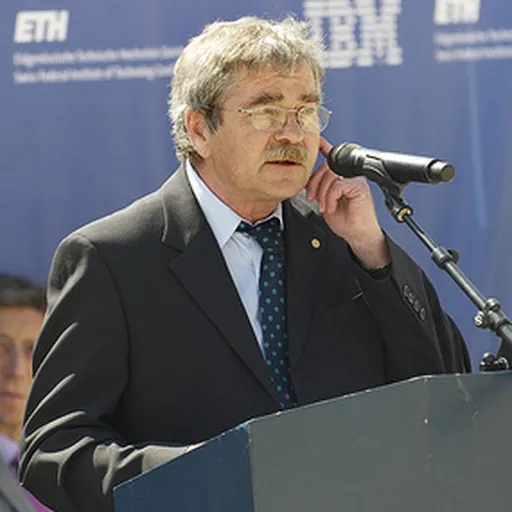
About Georg Bednorz
Born 1950. Georg Bednorz is a German physicist, known for High-temperature superconductivity.
Johannes Georg Bednorz (; born 16 May 1950) is a German physicist who, together with K. Alex Müller, discovered high-temperature superconductivity in ceramics, for which they shared the 1987 Nobel Prize in Physics.
Biography Johannes Georg Bednorz was born on 16 May 1950 in Neuenkirchen, North Rhine-Westphalia, the fourth child of Anton Bednorz, an elementary school teacher, and his wife Elisabeth, a piano teacher. His parents were both from Silesia in Central Europe, but were forced to move westwards in turbulences of World War II.
As a child, his parents tried to get him interested in classical music, but he was more practically inclined, preferring to work on motorcycles and cars. (Although as a teenager he did eventually learn to play the violin and trumpet.) In high school he developed an interest in the natural sciences, focusing on chemistry, which he could learn in a hands-on manner through experiments.
After another visit in 1973, Bednorz came to Zurich in 1974 for six months to do the experimental part of his master’s thesis. Here he grew crystals of SrTiO3, a ceramic material belonging to the family of perovskites. Müller, himself interested in perovskites, urged him to continue his research. After graduating from Münster in 1976, Bednorz started a Ph.D at ETH Zurich under the supervision of Heini Gränicher and Alex Müller. In 1978, his future wife, Mechthild Wennemer, whom he had met in Münster, followed him to Zurich to start her own Ph.D. The following year, Bednorz and Müller began a systematic study of the electrical properties of ceramics formed from transition metal oxides, and in 1986 they succeeded in inducing superconductivity in a lanthanum barium copper oxide (LaBaCuO, also known as LBCO). The oxide's critical temperature (Tc) was 35 K, a full 12 K higher than the previous record. This discovery stimulated a great deal of additional research in high-temperature superconductivity on cuprate materials with structures similar to LBCO, soon leading to the discovery of compounds such as BSCCO (Tc 107K) and YBCO (Tc 92K).
In 1987, Bednorz and Müller were jointly awarded the Nobel Prize in Physics "for their important break-through in the discovery of superconductivity in ceramic materials." The same year, Bednorz was appointed an IBM Fellow.
Recognition Awards Year Organization Award Citation 1986 Marcel Benoist Foundation Marcel Benoist Prize — 1987 Royal Swedish Academy of Sciences Nobel Prize in Physics "For their important break-through in the discovery of superconductivity in ceramic materials." 1987 Göttingen Academy of Sciences and Humanities Dannie Heineman Prize "For their research in physics." 1987 — Klung Wilhelmy Science Award "For his discovery of a new class of superconductors with unprecedented high transition temperatures." 1988 American Physical Society International Prize for New Materials "For discoveries of superconducting oxide materials with high transition temperatures." 1988 European Physical Society EPS Europhysics Prize "For the discovery of high-temperature superconductivity."
Memberships Year Organization Type 2011 Swiss Physical Society Honorary Member 2018 National Academy of Sciences International Member
Don’t just read it —
keep it.
Full-length biographies made to live with: read them, listen on the way to work, watch them tonight.
- E-book
- Audio
- Video
Instant download · yours to keep · every purchase keeps this site free
Important facts
People in Georg Bednorz's life
Named in this biography and alive at the same time


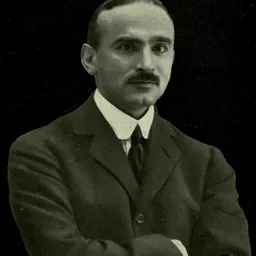
Related people
Same field, nearest in time

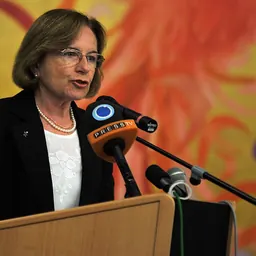

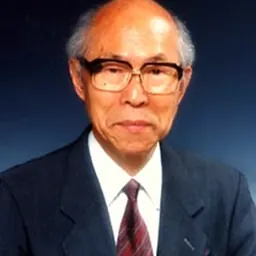
Contemporaries
People whose lives overlapped Georg Bednorz's



Frequently asked questions
Who is Georg Bednorz?
physicist
When was Georg Bednorz born?
Georg Bednorz was born on 16 May 1950 in Neuenkirchen.
What is Georg Bednorz's occupation?
Georg Bednorz is a physicist.
What is Georg Bednorz known for?
Georg Bednorz is known for High-temperature superconductivity.
What nationality is Georg Bednorz?
Georg Bednorz is German.
Sources & further reading
Cite this page
APA: Biography.guide. (2026). Georg Bednorz. https://biography.guide/georg-bednorz/
MLA: "Georg Bednorz." Biography.guide, https://biography.guide/georg-bednorz/.
Chicago: "Georg Bednorz." Biography.guide. https://biography.guide/georg-bednorz/.
Data last updated: 2026-09-21 · Spot an error? Report a correction.
Portrait: Wikimedia Commons · author & licence
Page generated 2026-09-27 05:01 UTC