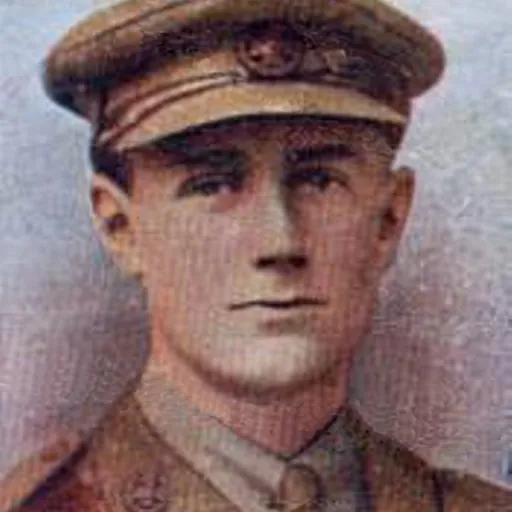
Geoffrey Vickers
English military officer, lawyer, and systems scientist (1894–1982); recipient of the Victoria Cross
About Geoffrey Vickers
Lived 1894 – 1982 (aged 87). Geoffrey Vickers was a British cyberneticist, military personnel, jurist, scientist and systems scientist.
Colonel Sir Charles Geoffrey Vickers, VC (13 October 1894 – 16 March 1982) was an English lawyer, administrator, writer and pioneering systems scientist. He had varied interests with roles at different times with the London Passenger Transport Board, Law Society, Medical Research Council and Mental Health Research Fund. In the later years he wrote and lectured on social systems analysis and the complex patterns of social organisation. The Sir Geoffrey Vickers Memorial Award has been presented by the International Society for the Systems Sciences since 1987 in his memory.
He was awarded the Victoria Cross in World War I while serving in The Sherwood Foresters, and was knighted following World War II, during which he served as Deputy Director General at the Ministry of Economic Warfare, in charge of economic intelligence and as a member of the Joint Intelligence Committee.
Biography
Early life Geoffrey Vickers was born and grew up in Nottingham, where his father Charles Henry Vickers ran a successful lace business, Vickers & Hine Ltd. He described his first day of school as "school introduced me to the anguish reserved both for the non-conformist who wishes to conform and the awkward who long to excel in dexterity".
He later described his home as "a place of unalloyed happiness. The only stresses of the time came from the external world of school or the internal world of awakening conflict and confusion ... I remember nothing desired that was satisfied by spending money of mine and nothing that was denied for lack of money ... we moved by bicycle and bus, played in each other's gardens and stayed in farmhouses". He described his father as "the best and most lovable man I ever knew; and he seemed to combine the two superlatives without the slightest effort". first as a second lieutenant, promoted to temporary captain in 1915 and then to major and as second in command, 1 Bn, The Lincolnshire Regiment in 1918. Explaining his thoughts about going to war, he later wrote
Quote|In August Germany invaded Belgium, we had a treaty with Belgium, so we all stopped what we were doing and went off to war. It was as simple as that. The citation for his VC, appearing in The London Gazette in November 1915, reads as follows:
His brother Burnell was killed in action on 21 June 1917 while serving with the 184th Siege Battery of the Royal Garrison Artillery.
In June 1918 he commanded a composite battalion in the Second Battle of the Marne for which he was awarded the Belgian Croix de Guerre.
Inter-war years After the war he returned to Oxford and took a pass degree in French, European history and law in 1919. and during the 1930s he was also involved in negotiating the extension of the German debt.
In 1938 he established and chaired the 'Association for Service and Reconstruction.
World War II Vickers served in World War II; he was re-commissioned as a colonel, and was seconded as Deputy Director General at the Ministry of Economic Warfare, in charge of economic intelligence.
He was also a member of the London Passenger Transport Board (1942–46) and of the Council of Law Society (1938–50). became part of the largest employer in the western world where he worked alongside E. F. Schumacher. On the inside jacket cover he muses 'The Industrial band-wagon rolls ever faster onwards, remaking the world we live in and with it ourselves. Are we in the driving seat or merely passengers – or even under the wheels? What part does human decision making play in directing or controlling the process?'.
His second wife, and close companion, died in 1972. His manuscripts for 'Western Culture and Systems Thinking' and 'Autonomy and Responsibility' were constantly rejected for publication.
In 1977 he moved to a retirement home, on the same street in Goring-on-Thames on which he had lived for many years. His military medals were left to the Sherwood Foresters Collection and are on display in Nottingham Castle. Vickers is regarded as a systems practitioner rather than an academic. He introduced the concept of appreciative systems to describe human activity. He recognised that appreciation of systems requires the participation of not only the observer, but also that of the subject.
Appreciative systems and appreciative behaviour Much of his work is devoted to the analysis of judgement in terms of what he called 'appreciative behaviour': this is described most effectively in The Art of Judgement (1965). He believed that social institutions are best analysed as systems, and his published work, notably Human Systems are Different (1983), made far-reaching contributions to systems thinking in its applications to human society. In "Human Systems are Different" (1983) Vickers explained: I find it surprising that we have no accepted word to describe the activity of attaching meaning to communication or the code by which we do so, a code which is constantly confirmed, developed or changed by use. I have for many years referred to this mental activity as "appreciation'; and to the code which it uses, as its "appreciative system'; and to the state of that code at any time as its "appreciative setting'. I call it a system because, although tolerant of ambiguity and even inconsistency, it is sensitive to them and tries to reconcile them.
In a 1978 interview Vickers added: I'm interested in Systems from the personal up to the very large, human, social systems, I'm also interested in systems of concepts and values through which we see all the others which I call appreciative systems.
A response by Peter Checkland in his "Systems Thinking Systems Practice": Vickers argues that our human experience develops within us 'readiness to notice particular aspects of our situation, to discriminate them in particular ways and to measure them against particular standards of comparison...' These readinesses are organized into an appreciative system which creates for all of us, individually and socially, our appreciated world....The appreciative settings condition new experience but are modified by the new experience. Such circular relations Vickers takes to be the common facts of social life, but we fail to see this clearly, he argues, because of the concentration in our science-based culture on linear causal chains and on the notion of goal-seeking. Vickers suggests replacing the goal-setting and goal-seeking with feedback models in which personal, institutional or cultural activity consists in maintaining desired relationships and eluding undesired ones. The process is a cyclical one which operates like this: Our previous experiences have created for us certain 'standards' or 'norms', usually 'tacit' (and also, at a more general level, 'values', more general concepts of what is humanly good and bad); the standards, norms and/or values lead to readiness to notice only certain features of our situations, they determine what 'facts' are relevant; the facts noticed are evaluated against the norms, a process which leads to our taking regulatory action and modifies the norms or standards, so that future experiences will be evaluated differently.
Geoffrey Vickers continued corresponding with Peter Checkland in the years before Vickers' death and discussed the relationship between systems ideas and real-world experience. From those discussions Checkland created the model of the appreciative process, that may be used as a basis for making sense of the world we live in. Checkland (2004) worked on numerous examples to demonstrate the way in which the model may be applied in very different situations.
Moral and political philosophy Geoffrey Vickers' perspectives on moral and political philosophy can be presented through three key terms: Our human capacity to respond aptly to our situation; The analysis of modern society in terms of institutions; and The moral importance of responsibility to the maintenance of human culture and cooperation
Publications Systems thinking
Edited papers
For children – circa 1926
Poetry
World War II
Vickers writings in Adolph Lowe Archive "Purpose and Force; The Bases of Order" (pub), 1940. "Incomes and Earnings–A Steady State?" (pub.), circa 1960. "The Management of Conflict" (pub.), 1972. "Towards a More Stable State" (pub.), 1972. Copies of Vickers-Simon Correspondence (unpub. TS), 1973. "Whither the Mixed Economy?" (pub.), 1973. "Some Implications of Systems Thinking" (unpub. TS), 1978. "The Poverty of Problem-Solving" (unpub. TS), 1980. "Autonomous Yet Responsible?" (unpub. TS), undated. "The Weakness of Western Culture" (unpub. TS), undated.
Don’t just read it —
keep it.
Full-length biographies made to live with: read them, listen on the way to work, watch them tonight.
- E-book
- Audio
- Video
Instant download · yours to keep · every purchase keeps this site free
Important facts
People in Geoffrey Vickers's life
Named in this biography and alive at the same time




Related people
Same field, nearest in time





Contemporaries
People whose lives overlapped Geoffrey Vickers's

Frequently asked questions
Who was Geoffrey Vickers?
English military officer, lawyer, and systems scientist (1894–1982); recipient of the Victoria Cross
When was Geoffrey Vickers born?
Geoffrey Vickers was born on 13 October 1894 in Nottingham.
When did Geoffrey Vickers die?
Geoffrey Vickers died on 16 March 1982 in Goring-on-Thames.
What was Geoffrey Vickers's occupation?
Geoffrey Vickers was a cyberneticist, military personnel, jurist, scientist and systems scientist.
What nationality was Geoffrey Vickers?
Geoffrey Vickers was British.
Sources & further reading
Cite this page
APA: Biography.guide. (2026). Geoffrey Vickers. https://biography.guide/geoffrey-vickers/
MLA: "Geoffrey Vickers." Biography.guide, https://biography.guide/geoffrey-vickers/.
Chicago: "Geoffrey Vickers." Biography.guide. https://biography.guide/geoffrey-vickers/.
Data last updated: 2026-09-22 · Spot an error? Report a correction.
Portrait: Wikimedia Commons · author & licence
Page generated 2026-09-27 05:03 UTC