
About Gazi Evrenos Bey
Lived 1330 – 1417 (aged 86–87). Gazi Evrenos Bey was a Turkish military personnel.
Evrenos or Evrenuz (died 1417, Yenice-i Vardar) was an Ottoman military commander and frontier lord active during the expansion of Ottoman power into the Balkans in the second half of the 14th century.
He served as a general under Süleyman Pasha, Murad I, Bayezid I, Süleyman Çelebi and Mehmed I, and played a central role in the Ottoman conquest and consolidation of large parts of Macedonia, Thrace, and central Greece.
Birth and early life
The exact date and place of Evrenos Bey's birth are not recorded in contemporaneous Ottoman or Byzantine sources. No surviving chronicle, archival document, or inscription provides a definitive year of birth. As a result, modern scholarship treats his birth date as unknown.
Some later narratives and modern secondary accounts have suggested that Evrenos was born in 1288 and lived for more than a century. However, such claims are not supported by primary historical documentation and are generally regarded as legendary. According to modern historians, these accounts likely arose from the conflation of Evrenos Bey's own career with the military activities and offices held by his descendants, several of whom remained influential in the Balkans well into the 15th century.
Career
Evrenos first appears in historical records as an Ottoman military commander operating in the Balkans during the mid-14th century. He participated in and led campaigns during the reigns of multiple Ottoman rulers, a fact that has contributed to later exaggerations of his lifespan.
He took part in major Ottoman victories, including the Battle of Kosovo (1389) and the Battle of Nicopolis (1396), and is credited with the conquest or incorporation of numerous towns and regions, including Keşan, İpsala, Komotini, Feres, Xanthi, Maroneia, Serres, Monastir, and Corinth in 1397. His activities were instrumental in establishing long-term Ottoman control over much of the southern Balkans.
Identity and origin
Evrenos is also known in some sources by the name Gavrinos. Several historians have suggested that he may have been of Greek origin or descended from a Byzantine family that entered Ottoman service during the period of frontier expansion.
Byzantine sources preserve multiple variant forms of his name, reflecting both linguistic adaptation and the difficulty of identifying frontier figures across cultural and political boundaries. A Greek legend maintains that Evrenos' father was a certain Ornos, renegade Byzantine governor of Bursa (Prusa) who defected to the Ottomans, and then on to Karasi, after the Siege of Bursa, in 1326. Stanford J. Shaw states that Evrenos was originally a Byzantine Greek feudal prince in Anatolia who had entered Ottoman service following the capture of Bursa, converted to Islam, and later became a leading military commander under both Orhan and Murat. Joseph von Hammer regarded Evrenos as simply a Byzantine Greek convert to Islam. Peter Sugar considers the family to be of Greek origin as well. Turkish sources report that the family was of Turkish origin. However, others dismiss this, noting that the Evrenos family were certainly of non-Turkish origin.
Evrenos led important campaigns and battles in Bulgaria, Thessaly, and Serbia; after his participation in the 1362 Ottoman conquest of Adrianopolis, Evrenos was appointed uc beği (frontier warlord) of Thessaly. Later, Evrenos also led the conquest of Serres.
The most famous battle Evrenos participated in was the shattering victory of the battle of Maritsa, where a small Ottoman force launched a devastating night raid and routed over 50,000 Serbian Empire soldiers. Later, Evrenos and his Akinjis fought in the Battle of Kosovo (1389) and the Battle of Nicopolis (1396). Evrenos conquered Keşan, İpsala, Komotini, Feres, Xanthi, Maroneia, Monastir, and in 1397, Corinth. He founded the town Yenice-i Vardar, modern Giannitsa.
Gazi Evrenos died at an advanced age in Yenice-i Vardar. He was buried in a mausoleum there in 1417. The mausoleum survives but was badly damaged in the 19th century and served for a time as an agricultural store.
Heritage and descendants
Some argue that the name Evrenos (also Evrenuz) is not Turkish. Heath Lowry theorized that the father of Hayreddin Barbarossa perhaps was a Sipahi cavalry served under Evrenos. What is certain is that Gazi Evrenos was from Ottoman Anatolia and first appears as bey. But modern historians generally reject these views. In light of a newly discovered vâkfiye (pious endowment charter) drawn up in 1456–1457 by İsa Beğ (one of Evrenos' seven sons), it posits a new explanation for the ethnic origins of the family. In this regard it advances the hypothesis that to his contemporaries 'Evrenos' was actually known as 'Evreniz/Evrenüz' or 'Avraniz/Avranüz.' Further, according to Heath W. Lowry, that his father's actual name was Branko/Pranko Lazart, which, according to Lowry, raises the possibility of a Serbian origin for the family. Others, such as Stanford J. Shaw, Dimitri Kitsikis, Peter Sugar, and Joseph Von Hammer propose a Greek origin for the family, with Shaw noting that he was a Byzantine feudal prince in Anatolia who converted to Islam and entered Ottoman service following the capture of Bursa.
Together with the Mihaloğulları (from the Ottoman Beylik ), Malkoçoğulları (from Serbia), Ömerli/Ömeroğlu, and the Turahanoğulları, Evrenos' descendants, the Evrenosoğulları, constitute one of the Byzantine families that effectively formed the early Ottoman warrior nobility.
Don’t just read it —
keep it.
Full-length biographies made to live with: read them, listen on the way to work, watch them tonight.
- E-book
- Audio
- Video
Instant download · yours to keep · every purchase keeps this site free
Important facts
People in Gazi Evrenos Bey's life
Named in this biography and alive at the same time
Related people
Same field, nearest in time
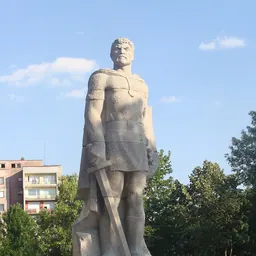


Contemporaries
People whose lives overlapped Gazi Evrenos Bey's

Frequently asked questions
Who was Gazi Evrenos Bey?
Ottoman akıncı (d. 1417)
When was Gazi Evrenos Bey born?
Gazi Evrenos Bey was born in 1330 in Beylik of Karasi.
When did Gazi Evrenos Bey die?
Gazi Evrenos Bey died on 17 November 1417 in Giannitsa.
What was Gazi Evrenos Bey's occupation?
Gazi Evrenos Bey was a military personnel.
What nationality was Gazi Evrenos Bey?
Gazi Evrenos Bey was Turkish.
Sources & further reading
Cite this page
APA: Biography.guide. (2026). Gazi Evrenos Bey. https://biography.guide/gazi-evrenos-bey/
MLA: "Gazi Evrenos Bey." Biography.guide, https://biography.guide/gazi-evrenos-bey/.
Chicago: "Gazi Evrenos Bey." Biography.guide. https://biography.guide/gazi-evrenos-bey/.
Data last updated: 2026-09-20 · Spot an error? Report a correction.
Page generated 2026-09-27 05:07 UTC