
About Gazbia Sirry
Lived 1925 – 2021 (aged 96). Gazbia Sirry was a painter.
Gazbia Sirry (11 October 1925 – 10 November 2021 ) was an Egyptian painter.
Born in Cairo, Gazbia Sirry studied fine arts at the Higher Institute of Art Education for Women Teachers in 1950 (currently known as the Faculty of Art Education at Helwan University), where her dissertation traced Egypt's political history. She later became a professor there, and also at the American University in Cairo. She has had more than 50 personal exhibitions, official purchases by international museums, international prizes, scholarships and university chairs. The paintings of Sirry capture the relationship between social reform, feminist consciousness and advocacy of women. Because of their eclecticism and heterogeneity of modern Egypt, Sirry's paintings were widely celebrated.
Her early work was dominated by images of women in unmistakable poses of power, performing roles in the public and private spheres, and celebrating female unity. In the late nineteen fifties, Sirry made stylistic and thematic changes to reflect the grim mood created by discontent with the crackdown on dissent and curtailment of political freedom across the country. It also became increasingly abstract: by the 1960s this shift was apparent. While on fellowship at the Huntington Hartford Foundation in Pacific Palisades, California, 1965, she was introduced to the American style of abstract expressionism; in interviews Sirry credited this time in her life with "profound impact upon her art practice." Her shift towards abstraction has also been linked some scholars to political unrest and especially the Six-Day War of1967. The full abstraction was replaced in the early 1970s by the reappearance of human forms, but the dark paintings represent the fears of Sirry about the fortunes of women's emancipation. The dominant bright colors and pyramidal shapes of her paintings show the national pride and enthusiasm following the Ramadan/Yom Kippur War of 1973 in the later part of the 1970s.
Early life Sirry was born to an aristocratic Turkish family in 1925, and was raised with her two sisters, by both her mother and her grandmother in an elegant villa in the Helmeya neighborhood, where most of the surrounding community lived more modestly. She lost her father, Hassan Sirry Nammy, when she was four years old and her mother, Esmat El-Daly, was the one to take control of her education. Her uncles on her father's side were the ones who contributed to her introduction to art by taking her to the theater and giving her the opportunity to become familiar with the expansive library.
Education Raised by two women, Sirry's maternal caregivers were tasked to bring up Sirry alone. Her mother was left a widow after Sirrys' father's death and with that, Sirry's female leadership figures took charge of her education and played a prominent role in the empowering feminist artwork that she would create later in life. Sirry witnessed the struggle that her caretakers endured during her upbringing in Cairo. Although her mother and grandmother had no attachment directly to a man, her uncles (on her paternal side) inspired her connection to art, theater, culture, and art history.
Career Gazbia Sirry's career as an artist can be loosely arranged into three distinct time periods. In these works, she emphasizes the role of diverse, powerful women in Egypt as well as their importance in defining a new Egyptian Republic. She was interested in people's lives, representing marginalized groups. Sirry's paintings reflected traditions and culture, focusing on people and houses in Cairo. During this era of her artistic practice, Sirry utilized strong black contours to highlight figures on a flat plane, similar to that of Pharaonic art and Coptic icons. In 2014, Shems Friedlander, professor of practice in the Department of Journalism and Mass Communication and director of The Photographic Gallery, described Sirry as "a senior Egyptian artist who is recognised on an international level. Her value to both the University and Egypt is both as an artist and a historian of Egypt's culture for over 60 years. She has both joined and led the trends in Egyptian art for several decades." In 2016, Sirry held her last exhibition titled 'Art Is My Life' which reflected on her 68 year long career, showcasing works from the 1940s to 2010. Sirry's paintings permanently reside at the Museum of Modern Egyptian Art in Cairo, the Alexandria Modern Art Museum, the Marine Museum in Alexandria, along with other establishments.
Artistic impact Sirry and her art have majorly contributed to discourse pertaining to nationalism, cultural emancipation, gender politics, and individual freedoms within a sovereign state. She is the longest living female artist belonging belongs to a generation of artists of artists that came to prominence in the years before Nasser's Revolution.
International recognition Sirry received several prestigious awards and prizes, including the following: Prize of Rome,1952 Honorary Prize, Venezia Biennale,1956 Honorary Prize for Creative Painting, Cairo,1957 Second Prize (lithography) Alexandria Biennale, 1959 First Prize (painting) Alexandria Biennale, 1963 First Prize, Salon du Caire, 1960 Fourth great Prize of International Contemporary Art, Monaco, 1968 State Prize and Order of Sciences and Arts of First Degree, 1970 Prize of Cairo Opera for Quadruple Tapestry Design, 1990 State Merit Prize, 2000
Collections Sirry's work has been collected by the following institutions: Egypt Modern Art Museum, Cairo Alexandria Modern Art Museum Marine Museum in Alexandria The Egyptian National Bank in Cairo Al-Ahram newspaper, Cairo The Ministry of Foreigners and Egyptian embassies abroad The Egyptian Art Academy in Rome Arts and Sciences Museum in Evansville, Indiana, USA Vincent Price Art Collection in Los Angeles, USA Faculties of fine arts and art education in Cairo, Alexandria and Menia Josef Museum of Unaligned Countries in Belgrade, Yugoslavia Living Art Museum in Tunis The Grand Conference Hall at Cairo Opera House and Cairo The National Museum of Women Arts in Washington Arab World Institute in Paris Museum of Art and Sciences in Evansville, Indiana, USA Unaligned Countries Museum in Yugoslavia The American University in Cairo Cairo Opera House Great Cairo Library Mubarak Public Library in Giza The Supreme Council of Culture, Cairo Press Syndicate, Cairo Novotel Hotel in Cairo Airport Sheraton Hotel in Giza Sheraton Atoun Hotel in Nuba
Don’t just read it —
keep it.
Full-length biographies made to live with: read them, listen on the way to work, watch them tonight.
- E-book
- Audio
- Video
Instant download · yours to keep · every purchase keeps this site free
Important facts
People in Gazbia Sirry's life
Named in this biography and alive at the same time



Related people
Same field, nearest in time

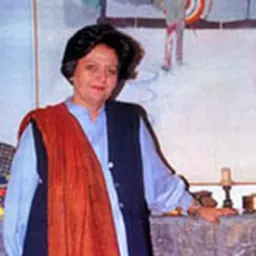
Contemporaries
People whose lives overlapped Gazbia Sirry's



Frequently asked questions
Who was Gazbia Sirry?
Egyptian painter (1925–2021)
When was Gazbia Sirry born?
Gazbia Sirry was born on 11 October 1925 in Cairo.
When did Gazbia Sirry die?
Gazbia Sirry died on 10 November 2021 in Cairo.
What was Gazbia Sirry's occupation?
Gazbia Sirry was a painter.
What nationality was Gazbia Sirry?
Gazbia Sirry's recorded nationality: Kingdom of Egypt, Republic of Egypt, United Arab Republic.
Sources & further reading
Cite this page
APA: Biography.guide. (2026). Gazbia Sirry. https://biography.guide/gazbia-sirry/
MLA: "Gazbia Sirry." Biography.guide, https://biography.guide/gazbia-sirry/.
Chicago: "Gazbia Sirry." Biography.guide. https://biography.guide/gazbia-sirry/.
Data last updated: 2026-09-20 · Spot an error? Report a correction.
Page generated 2026-09-27 04:57 UTC