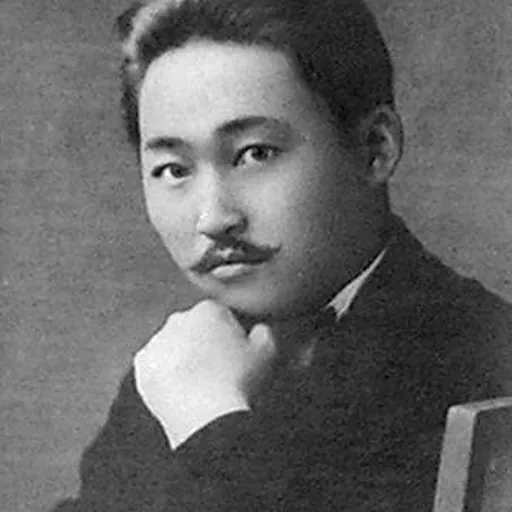
About Gavriil Ksenofontov
Lived 1888 – 1938 (aged 50). Gavriil Ksenofontov was a Russian historian, politician and ethnologist.
Gavriil Vasilyevich Ksenofontov ( — 28 August 1938) was a Yakutian historian, politician and lawyer who studied the history, ethnography and folklore of the Yakut, Evenki and Buryat peoples. He also served in the Russian Constituent Assembly and the during the Russian Revolution.
Biography Gavriil Ksenofontov was born on January 4 (16), 1888 in the Tiit Aryy, 4th Malzhagarsky nasleg, West Kangalassky ulus of Yakutia. He was the son of the head of the trading post, and had many brothers and sisters, among them , a leader of the anti-Bolshevik movement during the Russian Civil War.
Members of the from Yakutia, 1917. Ksenofontov is seated on the far right.
In 1907, he graduated from the Yakutsk Real School. He received his education at the Law Faculty of , from which he graduated in 1912. From 1913 to 1917 he worked as a lawyer in Yakutsk. He served on the regional Public Safety Committee and the regional zemstvo council. Ksenofontov was one of the founders of the "Yakutsk Labor Union of Federalists" that emerged on June 25, 1917, from which he was elected to the All-Russian Constituent Assembly.
From 1920 to 1923 he worked as an employee of the Irkutsk State University, where he was supervised by Bernhard Eduardovich Petri. Collecting materials for his research, he undertook a number of expeditions:
1921 - in the central regions of Yakutia; 1923-1924 - in the lower reaches of the Lena and Olenka; 1925-1926 - along a route that passed through Yakutsk, West Kangalassky ulus, Vilyuisky district, Chona, Erbogachen, Lower Tunguska, Krasnoyarsk, Khakassia, and Western Buryatia.
The material collected during the expeditions served as the basis for a number of works on folklore, ethnography and history. Ksenofontov's main idea was the conviction that folk memory in the form of oral traditions preserves information about real historical events and, therefore, it is possible to try to reconstruct this history by means of a careful comparative analysis of the records of oral traditions. Pointing towards this is fact that comparatively recent traditions are confirmed in Russian written sources.
From 1928 he lived in Irkutsk. In the 1930s he worked as a researcher at the . He prepared two large works: “Elleyad” and “Uraanghai-sakhalar.” “Elleiad” is a collection of oral traditions dedicated to the legendary ancestor and cultural hero of the Yakuts . His manuscript was discovered in 1965 by P. E. Efremov in the archives of the publishing house of anti-religious literature and published in 1977. “Uraanghai-sakhalar: Essays on the ancient history of the Yakuts" was published in 1937. In 1937 he moved to the city of Dmitrov, where he finished the second volume of “Uraanghai-sakhalar.”
On April 22, 1938, he was arrested in Moscow in the "Yakut case" together with Platon Oyunsky. On August 28, 1938, the Military Collegium of the Supreme Court of the Soviet Union sentenced him to death for espionage and executed him the same day. He was buried in the NKVD "Kommunarka" training ground. The Military Collegium rehabilitated him on August 22, 1957.
Legacy The name of G. V. Ksenofontov was given to the local history museum in Pokrovsk, and to the secondary school in the village of Tiit Aryy, Khangalas ulus (1993).
Major works Prologue to the heroic epics of the Yakuts: olonkho [from the epic “Ereideeh Buruidaah Er sokotokh” / trans. from Yakut G.V. Ksenofontova] // Siberian Lights. - 1927. - No. 2. - P. 64-67. Nomadic life and religion: based on Yakut, Tungus and Buryat materials: fundamentals. abstract // Buryatology. - 1928. - No. 1-2. (5-6). - P. 1-11. New research on the history of the Yakut people // gas. Autonomous Yakutia. 1927. - No. 135, 136 Images on the rocks of the Lena River within the Yakutsk District // Buryat Studies. 1927. - No. 3/4. - P. 64-70; Legends and stories about shamans among the Yakuts, Buryats and Tungus: (Materials on the mythology of the Ural-Altai tribes in Northern Asia). - Irkutsk, 1928 (republished: M., 1930); Khrestes, Shamanism and Christianity: (Facts and Conclusions). - Irkutsk, 1929; The cult of madness in Ural-Altai shamanism: (On the issue of the dying and resurrecting god). — Irkutsk, 1929; Pastoral life and mythological views of the peoples of the classical East. - Irkutsk, 1929; Deciphering two monuments of Orkhon writing from the western Baikal region by M. Rezenen // Language and Thinking. Vol. 1. - L., 1933. - P. 170-173; Uraanghai-sakhalar: Essays on the ancient history of the Yakuts. T. 1. - Irkutsk: Vost.-Sib. region book publishing house, 1937. - T. 1. - 576 pp.; 2nd ed.: [in 2 books/introductory article. V. N. Ivanova] - Yakutsk: Nat. publishing house of the Republic Sakha (Yakutia), 1992. - 416 pp.; Elleyada: Materials on the mythology and legendary history of the Yakuts. - M.: Nauka, 1977. - 348 p. (USSR Academy of Sciences. Sib. Department of Yakut Phil. Institute of Language, Literature and History); 2nd ed.: [compiled, edited, V. M. Nikiforov] - Yakutsk: Bichik, 2004. - 352 pp.; Shamanism: Selected Works (published 1928-1929). - M.: "North-South", 1992. - 318 p.; A. S. Pushkin “Altan Attaakyn” symbollaryn tuhunan (1937)// “I inspired good feelings with the lyre” (collection of articles)/ Comp. V. N. Pavlova; National b-ka RS(Y). - Yakutsk: Sakhapoligraphizdat, 1999; Letters of the ancient Turkic population of the Baikal region (from the handwritten materials of Ksenofontov G.V.) // Ilin. - 2005. - No. 5. - P. 55-66;
Don’t just read it —
keep it.
Full-length biographies made to live with: read them, listen on the way to work, watch them tonight.
- E-book
- Audio
- Video
Instant download · yours to keep · every purchase keeps this site free
Important facts
Related people
Same field, nearest in time

Contemporaries
People whose lives overlapped Gavriil Ksenofontov's




Frequently asked questions
Who was Gavriil Ksenofontov?
Russian historian (1888-1938)
When was Gavriil Ksenofontov born?
Gavriil Ksenofontov was born on 15 January 1888 in Khangalassky District.
When did Gavriil Ksenofontov die?
Gavriil Ksenofontov died on 28 August 1938 in Kommunarka.
What was Gavriil Ksenofontov's occupation?
Gavriil Ksenofontov was a historian, politician and ethnologist.
What nationality was Gavriil Ksenofontov?
Gavriil Ksenofontov was Russian.
Sources & further reading
· Wikipedia: Gavriil Ksenofontov
· DBpedia: Gavriil Ksenofontov
Cite this page
APA: Biography.guide. (2026). Gavriil Ksenofontov. https://biography.guide/gavriil-ksenofontov/
MLA: "Gavriil Ksenofontov." Biography.guide, https://biography.guide/gavriil-ksenofontov/.
Chicago: "Gavriil Ksenofontov." Biography.guide. https://biography.guide/gavriil-ksenofontov/.
Data last updated: 2026-09-23 · Spot an error? Report a correction.
Portrait: Wikimedia Commons · author & licence
Page generated 2026-09-27 05:08 UTC