
About Gary Freeman
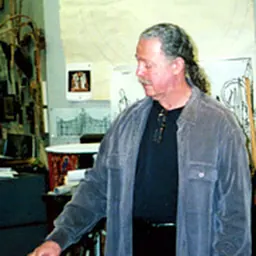
Lived 1937 – 2014 (aged 76). Gary Freeman was an American and New Zealand sculptor.
Gary Freeman (1937–2014) was an American sculptor from Indianapolis, Indiana. He was Professor Emeritus of Indiana University-Purdue University Indianapolis (IUPUI) and served as head of the Herron School of Art Sculpture Department for 33 years, from 1968 until his retirement in 2001.
Freeman was born in Wellington, Kansas. He received his BFA in 1961 from the Kansas City Art Institute. He received his MFA in 1963 from Tulane University. Between 1975 and 1990 Freeman received seven public and private art commissions, including Indianapolis companies such as Indiana Energy Inc., Indianapolis Heliport Corporation, Indianapolis Art Center and Borns Management Company. He also received seven grants, including one to study Stainless Steel Production Methods in Mexico and throughout Europe. His work is in 23 public and private collections, including the Indianapolis Museum of Art, New Orleans Museum of Art, Kalamazoo Institute of Arts, and the Newcomb Art School, Tulane University.
Career From 1966 to 1968 Freeman was the head of the sculpture program at Kalamazoo Art Center in Kalamazoo, Michigan. In 1968 he was hired as professor and chair of the Sculpture Department at the Herron School of Art at Indiana University-Purdue University of Indianapolis (IUPUI) due to his expertise in metal casting. In addition to heading the Sculpture Department, Freeman was also tasked with creating a bronze foundry for students. Freeman hoped that the foundry would allow students a more hands-on experience with metal sculpture, allowing them to experiment with various methods and materials that they might not otherwise have access to. His vision was for students to be able to utilize a casting system in order to control the production of metal sculpture through the entire process. Freeman believed, "A sculptor's success with bronze pieces can depend upon availability of such facilities." In an interview with the Indianapolis Star, Freeman stated, "I have learned that with a metal casting system, a sculptor seeks more and more to control production of a piece of metal sculpture beginning with modeling through the finishing process. As an artist, I can not find anyone to process my work the way I would like to do it. I can't blueprint my pieces."
In January 1970, after 16 months of preparation converting a radiator shop into an operational facility, Freeman debuted the new foundry with a demonstration of a metal casting for students and faculty. Freeman had acquired all of the tools for carving, casting and building sculptures, from a pair of crucible furnaces, to a walk-in kiln, welding equipment, and sandmillers, grinders, and drills. The IMA later acquired the larger sculpture, Broken Walrus II, as a gift from Robert A. Borns.
Major themes Throughout his career, Freeman has used precision to create, "meticulously machined and geometrically solved" pieces. Fellow IUPUI professor, artist, and art critic Steve Mannheimer described Freeman's work as a "search for the nearly accidental, the unplanned and irregular, the search for the found, the creation of the done rather than the considered." Freeman utilizes the bases of his sculptures to define the space, brace the work, and anchor it to the ground to make it seem monumental.
Exhibitions Gary Freeman has been featured in many exhibitions throughout Indiana, as well as Louisville, Kentucky, Milwaukee, Wisconsin, and Chicago, Illinois. His pieces have been featured in multiple shows in the Herron Gallery, IUPUI, including Sculpture Indiana: Breath and Beauty in 1980 and Boundaries, 1989. Solo shows have included Recent Sculpture: Gary Freeman at the Washington Gallery, Indianapolis, in 1979 and more recently Gary Freeman: Small Sculpture from the Evaporation Series at the Shircliff Gallery Of Art, Vincennes University, Indiana, in 2001.
Gary Freeman: A Decade of Sculpture 1979 to 1989 was a retrospective exhibit held at the Herron Galleries at IUPUI from January 19 to February 21, 1990. The collection featured 44 works, including zinc plated steel, copper plated steel, painted steel, and painted wood. A variety of Freeman's series were included in the exhibition. The "Low Profile" series, featured minimal, abstract pieces such as Sally's Jams (1982) and Cadinza's Hill (1982). The "A.U.L" series (1985) included sculptures created for the American United Life Company competition, which were made to seem as if the pieces were in mid-fall. The "Table Statements" series (1987–1989) were functional furniture pieces suggestive of landscapes.
Don’t just read it —
keep it.
Full-length biographies made to live with: read them, listen on the way to work, watch them tonight.
- E-book
- Audio
- Video
Instant download · yours to keep · every purchase keeps this site free
Important facts
Related people
Same field, nearest in time



Contemporaries
People whose lives overlapped Gary Freeman's


Frequently asked questions
Who was Gary Freeman?
American sculptor (1937–2014)
When was Gary Freeman born?
Gary Freeman was born on 7 October 1937 in Wellington.
When did Gary Freeman die?
Gary Freeman died on 6 January 2014 in Indianapolis.
What was Gary Freeman's occupation?
Gary Freeman was a sculptor.
What nationality was Gary Freeman?
Gary Freeman was American and New Zealand.
Sources & further reading
· DBpedia: Gary Freeman (sculptor)
Cite this page
APA: Biography.guide. (2026). Gary Freeman. https://biography.guide/gary-freeman-sculptor/
MLA: "Gary Freeman." Biography.guide, https://biography.guide/gary-freeman-sculptor/.
Chicago: "Gary Freeman." Biography.guide. https://biography.guide/gary-freeman-sculptor/.
Data last updated: 2026-09-20 · Spot an error? Report a correction.
Page generated 2026-09-27 05:31 UTC