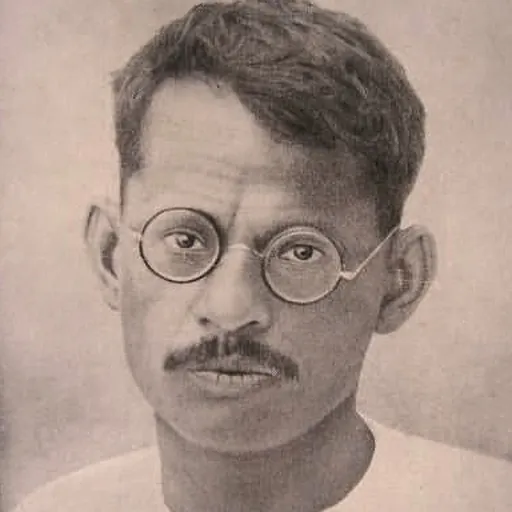
About Ganesh Shankar Vidyarthi
Lived 1890 – 1931 (aged 40). Ganesh Shankar Vidyarthi was a journalist.
Ganesh Shankar Vidyarthi (26 October 1890 – 25 March 1931) was an Indian journalist, a leader of the Indian National Congress and an independence movement activist. He was an important figure in the non-cooperation movement and the freedom movement of India, who once translated Victor Hugo's novel Ninety-Three, and is mostly known as the founder-editor of the Hindi language newspaper, Pratap.
Life Ganesh Shankar was born on 26 October 1890 in a Hindu Kayastha family at Allahabad, the then capital of North-Western Provinces. His father Munshi Jai Narain, also spelled as Jainarayan, was a teacher in a middle school namely Anglo-Vernacular School in Mungaoli which is now the tehsil of Ashoknagar district of Madhya Pradesh. He was poor but a deeply religious Hindu and dedicated to high ideals. It was under him that Ganesh Shankar received his early schooling and passed the high school examination privately in 1907 after studying in Mungaoli and Vidisha. His admission register is available in this school. He could not study further due to poverty and became a clerk in the currency office and later a teacher in high school in Kanpur. At age 16, he also wrote his first book Hamari Atmogsargart and wed his wife Chandraprakashwati Vidyarthi on 4 June 1909.
His real interest, however, was in journalism and public life and he came early under the influence of the nationalist upsurge, which was taking place in the country. He became an agent of the well-known revolutionary Hindi and Urdu journals – Karamyogi and Swarajya and also began to contribute to them. He adopted the pen-name 'Vidyarthi' – the seeker of knowledge. He attracted the notice of Pt. Mahabir Prasad Dwiwedi, the doyen of Hindi journalism who offered him the job of a sub-editor in his famous literary monthly, "The Saraswati", in 1911. Ganesh Shankar, however, was more interested in current affairs and politics and therefore joined the Hindi weekly "Abhyudaya" a political journal of the time. He thus served his apprenticeship under two of the greatest figures in Hindi literature and journalism of the time.
In 1913 Ganesh Shankar came back to Kanpur and launched his career as a crusading journalist and freedom fighter, which was only to end with his death 18 years later. He founded 'Pratap', his famous revolutionary weekly, which identified itself with the cause of the oppressed wherever they might be and Pratap would prove to be widespread as its circulation jumped from five hundred in 1913 to six hundred in 1916. It was through this paper that he waged his famous fights for the oppressed peasants of Rae Bareli, the workers of the Kanpur mills and the downtrodden people of Indian states. During the course of these fights, he had to face numerous prosecutions, pay heavy fines and suffer five prison sentences. On 11 January 1915, he said the following quote:
Later on 31 May, he also said:
He first met Gandhiji in 1916 in Lucknow and threw himself whole-heartedly in the national movement. He took a leading part in the Home Rule Movement of 1917–18 and led the first strike of textile workers in Kanpur. In 1920 he launched the daily edition of Pratap and it was in this year that he was sentenced to two years rigorous imprisonment for championing the cause of peasants of Rae Bareli. He was released in 1922 and almost immediately sent to jail again, for delivering a "seditious" speech as the President of the Provincial Political Conference at Fatehgarh. In 1924, he met and protested along with Bhagat Singh, who became a close colleague and friend. He would also later associate himself with Chandra Shekhar Azad. Vidyarthi was released in 1924, greatly shattered in health, but he knew no respite and founded a short-lived union In 1926, Vidyarthi, who was considered an important member of Congress, encouraged Shiv Narayan Tandon to also join Congress. In 1928, he also founded the Mazdur Sabha and led it until his death in 1931. and in March 1930 at Shraddhanand Park in New Delhi. Despite being scheduled to proceed for the Karachi Congress Session, he chose to stay back and rescue the people before felling to the mob. His daughter also claimed that the murder was manifested by the colonial government. Vidyarthi's disfigured body—showing multiple stab wounds—would only be found a few days later, near litter. Fatehpur's senior journalist Premshankar Awasthi tells that who does not know Amar Shaheed Ganesh Shankar Vidyarti? Those who laid the foundation of Hindu-Muslim unity by sacrificing their lives for communal harmony proved to be an example in the history of Indian journalism. How can the country forget the immortal sacrifice of journalist Siromani Ganesh Shankar Vidyarthi?"
Legacy Mahatma Gandhi paid him the following tribute in the pages of 'Young India': "The death of Ganesh Shankar Vidyarthi was one to be envied by us all. His blood is the cement that will ultimately bind the two communities. No pact will bind our hearts. But heroism such as Ganesh Shankar Vidyarthi showed is bound in the end to melt the stoniest hearts, melt them into one. The poison has however gone so deep that the blood even of a man so great, so self-sacrificing and so utterly brave as Ganesh Shankar Vidyarthi may today not be enough to wash us of it. Let this noble example stimulate us all to a similar effort should the occasion arise again". Author Siyaramsharan Gupta also made Vidyarthi the subject of the works Atmotsarg Patheya and Mrinmoyee Atmotsarg.
In 2006, there was a controversy involving an unauthorized unveiling of a statue in Mungawali, Madhya Pradesh honoring Vidyarthi by Member of Parliament of INC, Jyotiraditya Madhavrao Scindia. The police and state government claimed it was unauthorized and seized the statue despite local congressman and journalists insisting it be restored. In 2007, journalist Alok Mehta was awarded the Ganesh Shankar Vidyarthi Award by the Makhanlal Chaturvedi National University of Journalism and Communication.
Personal life Ganesh Shankar Vidyarthi had one son, Hari Shankar Vidyarthi and two grand daughters Srilekha Vidyarthi and Madhulekha Vidyarthi.
Honors
Ganesh Shankar Vidyarthi Puraskar is given to renowned journalists by honourable President of India every year from 1989. The Ganesh Shankar Vidyarthi Memorial (GSVM) Medical College Kanpur is named in his remembrance. Ganesh Chowk, a square is named after him in the heart of the city of Gorakhpur. Phool Bagh, earlier Queen's Park in Kanpur is also called as Ganesh Vidyarthi Udyan. The Ganesh Shanker Vidyarthi Inter College (GSV Inter College Hathgaon-Fatehpur) is named in his remembrance. Ganesh Shankar Vidyarthi Smarak Inter College (GSVS Inter College Maharajganj, UP) is named after his remembrance. On 18 July 2017, the Uttar Pradesh government has renamed Kanpur Airport as Ganesh Shankar Vidyarthi Airport to pay respect to his contribution for the independence of India.
Don’t just read it —
keep it.
Full-length biographies made to live with: read them, listen on the way to work, watch them tonight.
- E-book
- Audio
- Video
Instant download · yours to keep · every purchase keeps this site free
Important facts
People in Ganesh Shankar Vidyarthi's life
Named in this biography and alive at the same time




Related people
Same field, nearest in time



Contemporaries
People whose lives overlapped Ganesh Shankar Vidyarthi's



Frequently asked questions
Who was Ganesh Shankar Vidyarthi?
Indian journalist (1890-1931)
When was Ganesh Shankar Vidyarthi born?
Ganesh Shankar Vidyarthi was born on 26 October 1890 in Prayagraj.
When did Ganesh Shankar Vidyarthi die?
Ganesh Shankar Vidyarthi died on 25 March 1931 in Kanpur.
What was Ganesh Shankar Vidyarthi's occupation?
Ganesh Shankar Vidyarthi was a journalist.
Sources & further reading
· Wikipedia: Ganesh Shankar Vidyarthi
· DBpedia: Ganesh Shankar Vidyarthi
Cite this page
APA: Biography.guide. (2026). Ganesh Shankar Vidyarthi. https://biography.guide/ganesh-shankar-vidyarthi/
MLA: "Ganesh Shankar Vidyarthi." Biography.guide, https://biography.guide/ganesh-shankar-vidyarthi/.
Chicago: "Ganesh Shankar Vidyarthi." Biography.guide. https://biography.guide/ganesh-shankar-vidyarthi/.
Data last updated: 2026-09-23 · Spot an error? Report a correction.
Portrait: Wikimedia Commons · author & licence
Page generated 2026-09-27 05:08 UTC