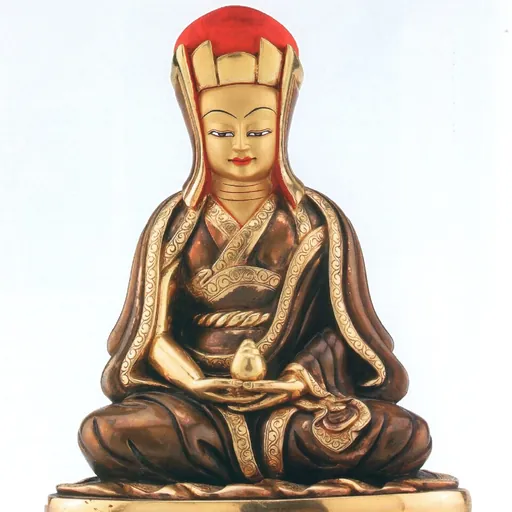
About Gampopa Sonam Rinchen
Lived 1079 – 1153 (aged 73–74). Gampopa Sonam Rinchen was a writer and buddhism.
Gampopa Sönam Rinchen (, 1079–1153) was the main student of Milarepa, and a Tibetan Buddhist master who codified his own master's ascetic teachings, which form the foundation of the Kagyu educational tradition. Gampopa was also a doctor and tantric master. He authored the first Lamrim text, Jewel Ornament of Liberation, and founded the Dagpo Kagyu school. He is also known as Dvagpopa, and by the titles Dakpo Lharjé "the physician from Dakpo" and Daö Zhönnu, "Candraprabhakumara" .
Biography Gampopa was born in the Nyal (or Nyel) district, Central Tibet and from an early age was a student of medicine in the Indian, Chinese and Tibetan medical traditions. Later in his life he moved to the region of Dakpo (dwags po) in southern Tibet and hence was also called Dakpopa (dwags po pa), the man from Dakpo. The region is also near Gampo Hills, hence his other name, Gampopa. In his youth Gampopa studied under the Nyingma lama Barey as well as under the Kadampa teacher Geshe Yontan Drag. After becoming a monk in the Kadampa lineage under Geshe Lodan Sherab and focused on studying the Kadampa teachings, Milarepa instructed him in the practice of Vajravārahī, tummo (gtum mo) and Mahāmudrā.
Gampopa's position in the transmission lineage of the Mahamudra teaching is as follows: Tilopa (988-1069), the Indian yogi who experienced the original transmission of the Mahamudra Naropa (1016–1100), who perfected the methods of accelerated enlightenment described in his Six Yogas of Naropa. Marpa (1012–1097), the first Tibetan in the lineage, who translated the Vajrayana and Mahamudra texts into Old Tibetan Milarepa (1040–1123), poet and master who overcame Marpa's reluctance to teach but nonetheless attained enlightenment in a single lifetime Gampopa, Milarepa's most important student, who integrated Atiśa's Kadam teachings and Tilopa's Mahamudra teaching to establish the Kagyü lineage
This lineage sequence, taken together, is called the "Five Founding Masters" by the Kagyu school.
After his studies with Milarepa, Gampopa founded Daklha Gampo Monastery (Dwags lha sgam po) in 1121 CE. He had many great students who were accomplished tantric practitioners, both monks and laymen. Gampopa's teaching joined the Lamrim teachings of the Kadampa school with the Mahamudra and tantric teachings of the Kagyu school. According to Tony Duff, he taught Mahamudra in two approaches, "one is a gradual approach called the Four Yogas of Mahamudra, the other is a sudden approach called Essence Mahamudra."
Dagpo Kagyu Lineages Gampopa taught extensively, and attracted many students. He is the source of the major surviving Kagyu sub-schools, all known as the Dagpo Kagyu. Following Gampopa, there evolved the so-called "Four Major and Eight Minor" lineages of the Dagpo (sometimes rendered "Tagpo" or "Dakpo") Kagyu School. This phrase is descriptive of the generation or order in which the schools were founded, not of their importance. The four "major" Kagyu schools were those of:
Barom Kagyu founded by Barompa Darma Wangchug (1127-1194?) Phagdru Kagyu founded by Phagmo Drupa Dorje Gyalpo (1110-1170) Karma Kagyu, founded by Düsum Khyenpa, 1st Karmapa Lama (1110-1193) Tsalpa Kagyu founded by Zhang Yudragpa Tsondru Drag (1123-1193)
The succession of Gampopa's own monastery passed to his nephew, Dakgom Tsültrim Nyingpo (, 1116-1169).
Teachings Gampopa's most famous teaching is known as "The Four Dharmas of Gampopa", this is outlined, for example, in a key text of Gampopa called The Four Dharmas in Brief: "It is necessary for: dharma to turn to dharma; dharma to turn into the path; the path to dispel confusion; and confusion to turn into wisdom" The Four Dharmas in Brief further states about each of the four Dharmas:
(1) Dharma to turn to dharma means to meditate on impermanence, the fact that all things will be left behind at death and that only Dharma is of use, all must be renounced except Dharma. The doctrine is the subject of several further short texts found in Gampopa's collected works and numerous commentaries by later authors. It also has a close connection to Sachen Kunga Nyingpo's Parting from the Four Attachments.
Works Gampopa's collected works (known as the Dags po'i Bka' 'bum) were published in Dvag Lha Gampo monastery, but that edition has been lost. There are three main editions extant today:
An edition made in Hemis Monastery, Ladhak, in the nineteenth century; A copy of the above, published in February 1982, in India; The Derge wood block edition.
Gampopa's The Jewel Ornament of Liberation is one of his most important works, it has been translated into English, first by Herbert Guenther in 1959 and again by Khenpo Konchok Gyeltsen in 1998.
Don’t just read it —
keep it.
Full-length biographies made to live with: read them, listen on the way to work, watch them tonight.
- E-book
- Audio
- Video
Instant download · yours to keep · every purchase keeps this site free
Important facts
People in Gampopa Sonam Rinchen's life
Named in this biography and alive at the same time
Related people
Same field, nearest in time



Contemporaries
People whose lives overlapped Gampopa Sonam Rinchen's



Frequently asked questions
Who was Gampopa Sonam Rinchen?
Tibetan Buddhist teacher, monk and philosopher (1079–1153)
When was Gampopa Sonam Rinchen born?
Gampopa Sonam Rinchen was born in 1079 in Tibet.
When did Gampopa Sonam Rinchen die?
Gampopa Sonam Rinchen died in 1153.
What was Gampopa Sonam Rinchen's occupation?
Gampopa Sonam Rinchen was a writer and buddhism.
Sources & further reading
· Wikipedia: Gampopa Sonam Rinchen
Cite this page
APA: Biography.guide. (2026). Gampopa Sonam Rinchen. https://biography.guide/gampopa-sonam-rinchen/
MLA: "Gampopa Sonam Rinchen." Biography.guide, https://biography.guide/gampopa-sonam-rinchen/.
Chicago: "Gampopa Sonam Rinchen." Biography.guide. https://biography.guide/gampopa-sonam-rinchen/.
Data last updated: 2026-09-22 · Spot an error? Report a correction.
Portrait: Wikimedia Commons · author & licence
Page generated 2026-09-27 05:00 UTC