Gallagh Man
Iron Age bog body from Ireland
About Gallagh Man
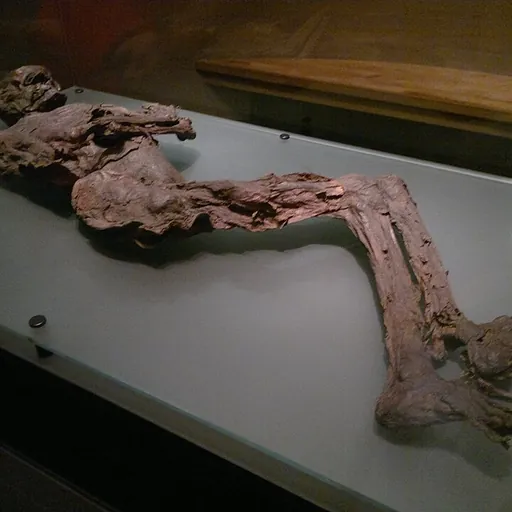
Gallagh Man is the name given to a preserved Iron Age bog body found in County Galway, Ireland, in 1821. The remains date to , and are of a tall, healthy male with dark and reddish hair, who is estimated to have been about 25 years old at the time of death. The presence of a withy hoop – rope made from twisted willow twigs – found wrapped around his throat indicates that he was strangled during a ritual killing or executed as a criminal.
Gallagh Man was found buried in a deep grave in a peat bog, dressed in a long leather mantle, and pinned down by two long wooden stakes. His teeth and hair were almost fully preserved, and even though the body is severely dehydrated and thus shrivelled, it has suffered from little shrinkage and is overall exceptionally well-preserved.
Discovery
The individual now known as Gallagh Man was discovered in 1821 by labourers cutting peat on land belonging to the O'Kelly family at Gallagh, a townland near Castleblakeney, County Galway, Ireland. The precise location of the grave was not recorded.
The body lay approximately below the surface of the bog. Two long, pointed wooden stakes had been driven into the peat over the remains, holding the body down. A withy hoop made from twisted willow was found around his neck, and a deerskin mantle was associated with the burial.
Archaeologist Eamonn P. Kelly has placed the probable find area near the boundaries of a townland, civil parish and barony. Kelly notes that this location also corresponded with the medieval boundary of the Uí Maine kingdom, ruled by the O'Kelly (Ó Ceallaigh) dynasty. Condition and preservation Close view of head and torsoAfter his discovery in 1821, Gallagh Man soon became a local curiosity. Over the following eight years, the O'Kelly family periodically exhumed the body to display him to paying visitors before reburying him in the bog. This repeated handling damaged parts of the remains and associated artefacts.
Gallagh Man nevertheless retains much of his original height and bodily proportions, although the remains became dehydrated and shrivelled after their removal from the bog. His teeth, long dark reddish-brown hair and beard are also preserved.
Clothing and associated items He was buried naked except for a long deerskin mantle or cape, which reached to his knees, while a long stick was placed in the grave alongside him. The condition of the remains changed after their removal from the peat bog. Drying caused a reduction of up to 50 per cent in the body's surface area and the loss of some head and facial hair.
Gallagh Man was discovered before the development of modern methods of archaeological excavation, documentation and conservation. His repeated exhumation and reburial damaged parts of the remains and associated artefacts, while the precise location of the grave was not recorded. Later study has therefore relied on the surviving remains, early written descriptions and drawings of the original burial.
The withy hoop around his neck may have been part of a spancel for restraining animals. It was probably used as a garrotte to strangle him, perhaps during a ritual involving human sacrifice,
It is also possible that he was simply murdered or executed as a criminal.
Exhibition
After his discovery in 1821, Gallagh Man remained at the find site in County Galway for eight years, during which the O'Kelly family periodically exhumed the body for public viewing. In 1829, the remains were purchased by the Royal Irish Academy, Ireland's principal learned society, and became part of its archaeological collections. The exhibition explores archaeological evidence for violence, ritual deposition, kingship and religious belief in Iron Age Ireland , and examines how archaeological interpretations of bog bodies have changed over time.
Don’t just read it —
keep it.
Full-length biographies made to live with: read them, listen on the way to work, watch them tonight.
- E-book
- Audio
- Video
Instant download · yours to keep · every purchase keeps this site free
Frequently asked questions
Who was Gallagh Man?
Iron Age bog body from Ireland
Sources & further reading
Cite this page
APA: Biography.guide. (2026). Gallagh Man. https://biography.guide/gallagh-man/
MLA: "Gallagh Man." Biography.guide, https://biography.guide/gallagh-man/.
Chicago: "Gallagh Man." Biography.guide. https://biography.guide/gallagh-man/.
Data last updated: 2026-09-21 · Spot an error? Report a correction.
Portrait: Wikimedia Commons · author & licence
Page generated 2026-09-27 05:00 UTC