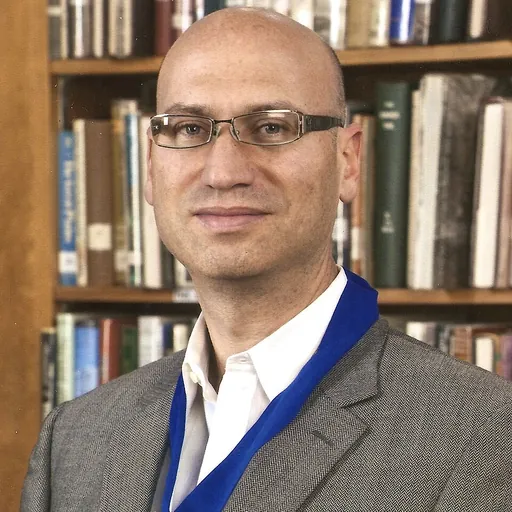
About Gabriel Wilensky
Born 1964. Gabriel Wilensky is an American historian.
Gabriel Wilensky (born April 23, 1964) is an American author, software developer and entrepreneur. He was born in Uruguay, where his Eastern-European grandparents had emigrated to before the Second World War. He is the author of the books Six Million Crucifixions, which traces the history of antisemitism in Christianity and the role it played in the Holocaust, Two Dozen Thoughts (2022), a collection of essays on topics related to antisemitism and Israel, and Fuel for Thought (2025), which examines the changes needed in both society and individuals to create a future guided by reason, compassion, and progress, leading to a more enlightened world.
Software development Wilensky co-founded the software company Gryphon Software in the early 1990s. The company produced the software product Morph, which introduced the computer graphics effect of morphing to personal computers. Gryphon Software then developed a pioneering new line of edutainment products, the Activity Centers. Gryphon developed many products in that line, some of which used well-known characters from Disney, Warner/DC Comics, and others. The Activity Center line of products introduced video from the feature films and cartoons in the application. Gryphon was acquired by Cendant Software (then CUC International).
Wilensky contributed to the development of these various products in the areas of software and user interface design, product management, audio and video production and new research and development work on audio/video compression. His software was used to make some of the special effects of several feature films, such as Francis Ford Coppola's Bram Stoker's Dracula (1992), Robin Hood: Men in Tights (1993), Dragon: The Bruce Lee Story (1993) and others.
After Gryphon Software Wilensky worked on the development of other software products in the areas of user interface software for wireless devices, web site development, and TV broadcasting for mobile devices. Most recently he was responsible for the development of the GoPro software applications.
Research and writing Six Million Crucifixions Wilensky spent years of research into the question of why the Holocaust happened. He used his technical background for a methodical study of the question and then wrote Six Million Crucifixions: How Christian Teachings About Jews Paved the Road to the Holocaust, published in 2009.
Six Million Crucifixions provides an account of the almost two-thousand-year-old Christian teaching of contempt for Jews, and argues that it was this relentless animosity and even hatred toward Jews and Judaism in predominantly Christian lands that laid the foundation on which racial antisemitism stood, and which eventually led to the Holocaust. As Holocaust scholar John K. Roth argued in the foreword of the book, "Absent Christianity, no Holocaust would have taken place."
The book provides an account of how antisemitism developed from the very early days of the Christian movement into full-blown hatred by the time of the Crusades. Six Million Crucifixions shows how anti-Jewish sentiment stemmed out of Christian Scriptures and the teachings of the Church Fathers, until it became second-nature to European Christians. As Dr. Carol Rittner, Distinguished Professor of Holocaust & Genocide Studies at The Richard Stockton College wrote, "Too many of those hate-filled words had their origin in the Christian Scriptures and were uttered by Christian preachers and teachers, by Christians generally, for nearly two millennia."
The book also describes the role of both the Catholic and Protestant churches in the period leading to and beyond the Second World War, and sharply criticizes the Catholic Church (in particular), as well as the Protestant churches for their lack of loud and clear objection to the extermination of the Jews, for the assistance some members of the clergy gave the Nazis in their persecution of the Jews and the help some members of the Vatican gave to people who should have been regarded as war criminals to escape justice after the war. As Holocaust scholar and Director of the Sigi Ziering Institute Michael Berenbaum wrote, "Gabriel Wilensky's Six Million Crucifixions is a powerful and passionate indictment of the Vatican for acts of omission and acts of commission." BYTE Magazine Award of Excellence UCSD Connect Most Innovative New Product Award Bronze Award in New Media Magazine's InVision Contest Two MacUser Editor's Choice Awards - Finalist Discover Magazine Award for Technological Innovation - Finalist
Published works Six Million Crucifixions: How Christian Teachings About Jews Paved the Road to the Holocaust, San Diego : QWERTY Publishers, 2010, Two Dozen Thoughts: Collected Essays on Christian Antisemitism and the Role it Played in the Holocaust, San Diego : QWERTY Publishers, 2022 Fuel for Thought: Ideas to Revolutionize Our Lives, Improve Civilization, and Build a Better World, San Diego : QWERTY Publishers, 2025, ISBN 978-0-9843346-0-5
Don’t just read it —
keep it.
Full-length biographies made to live with: read them, listen on the way to work, watch them tonight.
- E-book
- Audio
- Video
Instant download · yours to keep · every purchase keeps this site free
Important facts
People in Gabriel Wilensky's life
Named in this biography and alive at the same time






Related people
Same field, nearest in time



Contemporaries
People whose lives overlapped Gabriel Wilensky's


Frequently asked questions
Who is Gabriel Wilensky?
American historian
When was Gabriel Wilensky born?
Gabriel Wilensky was born on 23 April 1964.
What is Gabriel Wilensky's occupation?
Gabriel Wilensky is a historian.
What nationality is Gabriel Wilensky?
Gabriel Wilensky is American.
Sources & further reading
Cite this page
APA: Biography.guide. (2026). Gabriel Wilensky. https://biography.guide/gabriel-wilensky/
MLA: "Gabriel Wilensky." Biography.guide, https://biography.guide/gabriel-wilensky/.
Chicago: "Gabriel Wilensky." Biography.guide. https://biography.guide/gabriel-wilensky/.
Data last updated: 2026-09-22 · Spot an error? Report a correction.
Portrait: Wikimedia Commons · author & licence
Page generated 2026-09-27 05:02 UTC