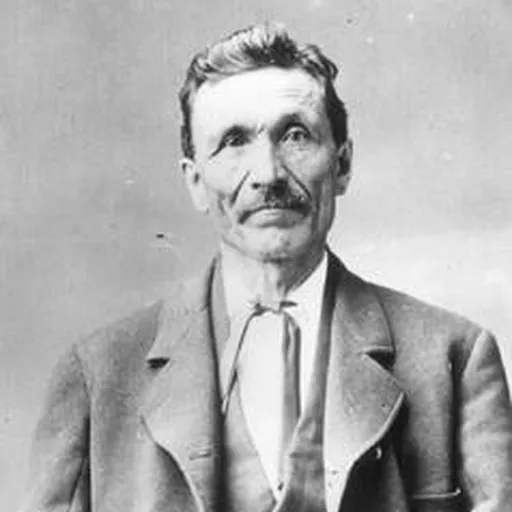
Gabriel Renville
Sisseton Wahpeton Oyate Sioux leader
About Gabriel Renville
Lived 1825 – 1892 (aged 67). Gabriel Renville was an American.
Gabriel Renville (April 1825 – August 26, 1892), also known as Ti'wakan (Sacred Lodge), was a US-government appointed chief of the Sisseton Wahpeton Oyate Sioux Tribe from 1866 until his death in 1892. He opposed conflict with the United States during the Dakota War of 1862 and was a driving force within the Dakota Peace Party. In 1863, Renville volunteered to serve as a Dakota scout serving in US military leader Henry Hastings Sibley's punitive expedition against Dakota escapees, hunting those considered "hostile" including Little Crow.
Victor Renville was ambushed and killed by a group of Ojibwes in August 1832 as he returned from leading a group of soldiers on a retaliatory raid.
A few years after his death, Winona Crawford married Akipa, later known as Joseph Akipa Renville (c. 1810–1891), a Dakota from the Wahpeton band. (Akipa, son of Buffalo Man, was "neither a Renville nor a Mdewakanton" but admired Gabriel's famous uncle and adopted his English name in tribute.)
In 1838, Gabriel Renville settled on Grey Cloud Island in Washington County, Minnesota with his brother-in-law and legal guardian, Joseph R. Brown; his half-sister, Susan Frenier Brown; and his stepfather, Akipa.
Education Joseph R. Brown (1805–1870), Gabriel Renville's brother-in-law, became his legal guardian Gabriel Renville received little formal education beyond classes at the school at Lac qui Parle Mission, where he learned to read and write the Dakota language, and do arithmetic.
To compensate for their loss, the U.S. government authorized a swap, offering "land scrip" to eligible mixed-race applicants in exchange for giving up their claim to the "half-breed tracts." in an effort to become self-sufficient and support his growing family. His house was modern, featuring "the first brick fireplace in the region, a progressive symbol for that time." The peace party sought to end the war and secure the release of prisoners captured by the Dakota soldiers, and made it difficult for the soldiers to sustain the war effort.
Evacuation and stand at Yellow Medicine Agency On the morning of August 19, 1862, having heard about the attacks on Redwood Agency the night before from Solomon Two Stars, Renville rode out toward the Yellow Medicine Agency to check on his relatives. On the way, he encountered Rev. Thomas Smith Williamson, who was initially unconvinced that he was in danger, and persuaded him to flee. Renville went home to find the horses already hitched to the wagon, and headed towards the agency with his family. They later saw Williamson's family crossing the river to flee eastward with a Native American who was sympathetic to the European Americans of the region and had already helped Riggs's family to safety. Four miles on, Renville was accosted by drunken soldiers who had pillaged the agency, but forced his way through.
Fort Snelling
On September 28, 1862, a commission appointed by Colonel Sibley began interrogating Dakota men to determine their involvement in the war.
In his memoir, Gabriel Renville wrote, "Then word came that the Indians would be sifted as you would sift wheat, the good grain to be put into the bin, but the chaff and the bad seeds to be burned. This was done, and all those who by good evidence were proven to have done anything against the whites were put into irons."
Renville and Akipa and their families were acknowledged as friendlies and were initially allowed to move freely outside the Native American camp. Renville went home to discover that everything he owned had been taken or destroyed by opposing soldiers. He moved his camp to Redwood Agency with other "friendlies" camped on the north side of Sibley's command. Those who were suspected of having acted against the white settler-colonists were camped on the south side of the troops.
In the weeks before the mass execution, the convicted men were taken to Mankato, whereas their families together with the "friendlies" were taken to Fort Snelling. The Renvilles, Browns and other "friendly" families joined approximately 1,600 Native Americans sent to a compound below Fort Snelling. On their way there, the residents of Henderson threw stones in anger at the Native Americans passing through; among the general white population of Minnesota at the time, all Dakota were blamed for the deaths and destruction that occurred in August 1862. Once they arrived, many of their horses and oxen were stolen from their camps.
Renville recalled, "Then a fence was built on the south side of the fort and close to it. We all moved into this inclosure, but were so crowded and confined that an epidemic broke out among us and children were dying day and night, among them being Two Stars' oldest child, a little girl."
John Williamson, son of Thomas Smith Williamson, received permission to enter the compound housing the Dakota and found many members of the former mission community there, including Gabriel Renville, who lay sick in his tent with a serious case of malaria. Between 130 and 300 people died of various illnesses inside the camp.
Designation as Chief Gabriel Renville in 1867 (Washington, DC)Thanks to his service during the war, Renvile obtained in 1863 the post of Chief of Scouts in the service of Minnesota state militia Colonel Henry Hastings Sibley—later to become the first governor of the state of Minnesota. His service to the U.S. Army ended in 1865.
For his military service, he was appointed by Sibley as Chief of the Sisseton Wahpeton Oyate in 1866. His people seconded Sibley's appointment a year later by declaring Renville chief-for-life. His tenure as chief saw the creation and settlement of his people on the Lake Traverse Reservation. He is buried atop a bluff near Old Agency, South Dakota.
Don’t just read it —
keep it.
Full-length biographies made to live with: read them, listen on the way to work, watch them tonight.
- E-book
- Audio
- Video
Instant download · yours to keep · every purchase keeps this site free
Important facts
People in Gabriel Renville's life
Named in this biography and alive at the same time


Contemporaries
People whose lives overlapped Gabriel Renville's





Frequently asked questions
Who was Gabriel Renville?
Sisseton Wahpeton Oyate Sioux leader
When was Gabriel Renville born?
Gabriel Renville was born on 1 April 1825 in Roberts County.
When did Gabriel Renville die?
Gabriel Renville died on 26 August 1892 in Traverse County.
What nationality was Gabriel Renville?
Gabriel Renville was American.
Sources & further reading
Cite this page
APA: Biography.guide. (2026). Gabriel Renville. https://biography.guide/gabriel-renville/
MLA: "Gabriel Renville." Biography.guide, https://biography.guide/gabriel-renville/.
Chicago: "Gabriel Renville." Biography.guide. https://biography.guide/gabriel-renville/.
Data last updated: 2026-09-24 · Spot an error? Report a correction.
Portrait: Wikimedia Commons · author & licence
Page generated 2026-09-27 05:08 UTC