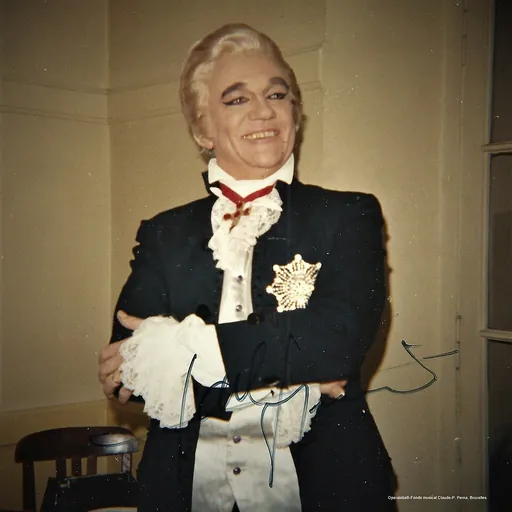
About Gabriel Bacquier
Lived 1924 – 2020 (aged 95). Gabriel Bacquier was a French opera singer and baritone.
Gabriel Bacquier (; 17 May 1924 – 13 May 2020) was a French operatic baritone. One of the leading baritones of the 20th century and particularly associated with the French and Italian repertoires, he was considered a fine singing actor equally at home in dramatic or comic roles and gave regular song recitals. He was a long-term member of the Opéra-Comique and the Paris Opera, but forged a long career internationally at leading opera houses in Europe and the U.S. His large discography spans five decades, and he was considered as “the ambassador of French song”.
Early life and studies
Born Gabriel Augustin-Raymond-Théodore-Louis Bacquier in Béziers, France, on 17 May 1924, As a young boy, he was fascinated by everything to do with singing: records, broadcasts and photos of singers. Leaving school aged 14, he worked at his uncle's print-shop, while studying in Montpellier to become a commercial artist, but during the Vichy regime, to avoid the round-ups and deportations by the Service du travail obligatoire, his parents arranged for him to do national service in the Chantiers de Jeunesse on the railways during the Occupation. and graduated in 1950. In his final year, the director of the Conservatoire, Claude Delvincourt, allowed him leave to work at the Opéra de Nice in the 1949–50 season, singing small roles in operas and operettas; this along with regular singing spots in cinemas gave him important experience and income before his next career steps. While at the Monnaie, the French soprano Martha Angelici, whose husband was François Agostini, director of the Opéra-Comique at the time, sang in Les pêcheurs de perles with him; she suggested that he audition for the Paris company, which accepted him.
International fame He was invited to the Glyndebourne Festival in 1962, to sing Count Almaviva in Mozart's Le nozze di Figaro.
Bacquier made his American debut at a Carnegie Hall concert, including the premiere of a new production of Tosca with Birgit Nilsson and Franco Corelli. He also sang frequently at the Philadelphia Lyric Opera Company between 1963 and 1968, making his debut on 22 February 1963 as Zurga in Bizet's Les pêcheurs de perles with Ferruccio Tagliavini as Nadir and Adriana Maliponte as Leïla. His other roles in Philadelphia included Nilakantha in Lakmé opposite Joan Sutherland in the title role, Germont with Sutherland as Violetta and John Alexander as Alfredo, Iago in Verdi's Otello, Scarpia, and Escamillo in Bizet's Carmen. He made his debut at the San Francisco Opera in 1971 as Michele in Puccini's Il tabarro. In 1978, he appeared at the Metropolitan Opera as Golaud alongside Teresa Stratas as Mélisande. A reviewer of The New York Times noted "the precise, fluent inflection of his singing, which has to be delicate and yet weighted with feeling". Thomas Allen classified Bacquier as a 'singer-actor': "...a voice and a knowledge of his body language such that one can be forgiven for asking the question 'Is this an actor singing or a singer acting?'".
Though closely associated with the French repertory, especially Golaud, Bacquier resisted being typecast as a 'French baritone' and added many Italian roles to his repertory, in addition to those already mentioned, such as the Verdi roles Renato in Un ballo in maschera, Melitone in La forza del destino, Posa in Don Carlos and Falstaff, as well as comic roles such as Mozart's Leporello in Don Giovanni and Alfonso in Cosi fan tutte, among others. In 1975 a critic reviewing Donizettis's L'elisir d'amore commented that "broad humour is quite foreign to Bacquier's nature ... his doctor [Dulcamara] is a serious Archie Rice type, no caricature but a real man weighed down by his own charlatanism and basically sad that mankind is so gullible". Rare tentatives in non-French and Italian repertoire came with Wolfram in Tannhäuser by Wagner, praised by André Pernet, Other world premieres included Maurice Thiriet's La véridique histoire du Docteur and Menotti's Le Dernier Sauvage at the Opéra-Comique. In May 1980 he created the title role in the premiere of an opera Cyrano de Bergerac by Paul Danblon, as part of the commemoration of the 150th anniversary of the founding of the state of Belgium, in Liège at the Opéra Royal de Wallonie. He sang in the premieres of two operas by Jean-Michel Damase, L'Escarpolette on television in 1982, and the comédie musicale L'as-tu revue? at the Opéra-Comique in 1991, and in Les Bals de Paris by Émile Desfossez, and Le Capitaine et la mort by Maurice Fouret. He made his last stage appearance in Paris in June 1994, with a final performance of Don Pasquale at the Opéra-Comique. and took part in later public performances, such as Somarone in concert performances of Berlioz's Béatrice et Bénédict in Toulouse and Paris in February 2003, and as the reciter in Françaix's Les Inestimables Chroniques du bon géant Gargantua in Vichy in December later that year.
He was also active in the field of mélodies, and made recordings of songs by Maurice Ravel, Déodat de Séverac, Marc Berthomieu, Francis Poulenc and others. Two live recitals of mélodies from 1961 and 1972 were issued on CD in 1987. In 2007, Bacquier recorded thirteen songs by the actor and songwriter Pierre Louki, with musicians directed by Jacques Bolognesi. He recorded six Poulenc songs, accompanied by Jacques Février, for French television in June 1964, subsequently issued on DVD.
Later career Bacquier was also active as a teacher, first at the vocal school of the Paris Opera and later at the Paris Conservatory until 1987, He was one of the lead signatories to a petition in 2008 Appel à la Refondation des Troupes de Théâtre Lyrique to defend and promote French singing.
Bacquier died on 13 May 2020 in his home at Lestre in the Manche department, only four days shy of turning 96.
Christophe Ghristi, artistic director of the Théâtre du Capitole, said of him: "A southern personality who had an animal presence on stage. He was one of the rare French singers of that time to have had such an international career".
Several recordings in which he sang won the Prix du Disque (L'heure espagnole, DGG, 1967; Les contes d'Hoffmann, Decca, 1972) and Enescu's Œdipe (EMI, 1984) won a Grand Prix du Disque et Prix de Ministère de la Culture. In 2004 he was awarded an Orphée d'Or Herbert von Karajan for his career, and in the same year a Lauréat des Victoires de la Musique. He also received a Médaille de la Ville de Paris. Bizet: Les pêcheurs de perles. Janine Micheau, Alain Vanzo, Gabriel Bacquier (Zurga), Chœur de la RTF, Orchestre Radio-Lyrique, Conductor: Manuel Rosenthal. Paris, 25 June 1959. GALA GL 100.504. Debussy: Pelléas et Mélisande. Gabriel Bacquier (Golaud), Michèle Command, Claude Dormoy, Orchestre de Lyon. Conductor: Serge Baudo. Eurodisc. Donizetti: Don Pasquale. Gabriel Bacquier (Don Pasquale), Barbara Hendricks, Gino Quilico, Luca Canonici, Opéra de Lyon. Conductor: . Erato, 1990. Mozart: Così fan tutte. Pilar Lorengar, Teresa Berganza, Jane Berbié, Ryland Davies, Tom Krause, Gabriel Bacquier (Alfonso), London Philharmonic Orchestra. Conductor: Georg Solti. Decca, 1973. Offenbach: La Périchole. Teresa Berganza, José Carreras, Gabriel Bacquier (Don Andrès), Orchestre & Choeurs du Théâtre du Capitole de Toulouse. Conductor: Michel Plasson. EMI, 1981. Ravel: L'Heure espagnole. Jane Berbié, Gabriel Bacquier (Ramiro), Michel Sénéchal, José van Dam, Jean Giraudeau, Orchestre National de Paris, Lorin Maazel. Deutsche Grammophon, 1964. Verdi: Otello. Carlo Cossutta, Margaret Price, Gabriel Bacquier (Iago), Wiener Staatsoper & Philharmoniker. Conductor: Georg Solti. Decca, 1977. Verdi: La forza del destino. Leontyne Price, Sherrill Milnes, Plácido Domingo, Fiorenza Cossotto, Gabriel Bacquier (Fra Melitone), John Alldis Choir, London Symphony Orchestra. Conductor: James Levine. RCA Red Seal, 1976.
Film and television Bacquier appeared in the 1976 film La Grande Récré (as 'Caruso'), and in a cameo singing role in the wedding scene of the 1986 film Manon des Sources. He also starred in the 1979 film of Falstaff directed by Götz Friedrich (sound recorded Vienna 1978, filmed Berlin 1979), and the studio film of The Love for Three Oranges in 1989.
Oussenko also lists many television broadcasts involving Bacquier, from Aix, Paris, New York, Rouen and Geneva, of Don Giovanni, Così fan tutte, Pelléas et Mélisande, Andréa del Sarto, Tosca, L'elisir d'amore, Don Pasquale, Louise, Cyrano de Bergerac, Gianni Schicchi, La forza del destino, Il Barbiere di Siviglia, Don Quichotte, La Périchole, La vie parisienne, La belle Hélène, L'as-tu revue, and Les Mousquetaires au couvent, dating from 1960 to 1992.
Don’t just read it —
keep it.
Full-length biographies made to live with: read them, listen on the way to work, watch them tonight.
- E-book
- Audio
- Video
Instant download · yours to keep · every purchase keeps this site free
Important facts
People in Gabriel Bacquier's life
Named in this biography and alive at the same time




Related people
Same field, nearest in time




Contemporaries
People whose lives overlapped Gabriel Bacquier's



Frequently asked questions
Who was Gabriel Bacquier?
French opera singer (1924–2020)
When was Gabriel Bacquier born?
Gabriel Bacquier was born on 17 May 1924 in Béziers.
When did Gabriel Bacquier die?
Gabriel Bacquier died on 13 May 2020 in Lestre.
What was Gabriel Bacquier's occupation?
Gabriel Bacquier was an opera singer and baritone.
What nationality was Gabriel Bacquier?
Gabriel Bacquier was French.
Sources & further reading
Cite this page
APA: Biography.guide. (2026). Gabriel Bacquier. https://biography.guide/gabriel-bacquier/
MLA: "Gabriel Bacquier." Biography.guide, https://biography.guide/gabriel-bacquier/.
Chicago: "Gabriel Bacquier." Biography.guide. https://biography.guide/gabriel-bacquier/.
Data last updated: 2026-09-22 · Spot an error? Report a correction.
Portrait: Wikimedia Commons · author & licence
Page generated 2026-09-27 05:03 UTC