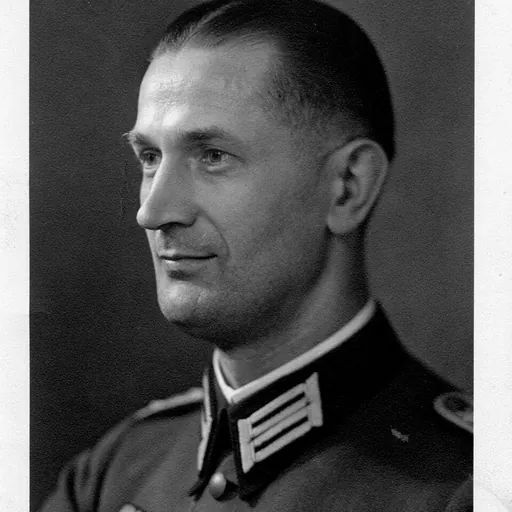
Fritz Menzer
German cryptologist
About Fritz Menzer
Lived 1908 – 2005 (aged 97). Fritz Menzer was a German cryptologist.
Ostwin Fritz Menzer (6 April 1908 in Herrndorf near Niederschöna in Saxony between Chemnitz and Dresden – 25 October 2005 in Bad Homburg vor der Höhe ) was a German cryptologist, who before and during World War II, worked in the In 7/VI, the Wehrmacht signals intelligence agency, later working in (OKW/ Chi) that was the cipher bureau of the supreme command of the Nazi party, and later in Abwehr, the military intelligence service of the Wehrmacht. He was involved in the development and production of cryptographic devices and procedures, as well as the security control of their own methods.
Military career At the age of 18, he joined the Reichswehr as a mechanic and was assigned to a motorized battalion with a location in Leipzig. Menzer had already developed an interest in cryptography and was granted a patent for a "combined measuring apparatus for angles and lengths, the data [from which was] expressed in an enciphered form in a four-place combination of letters". After his inclination and aptitude test for cryptanalysis work had been recognized at the Army Signal School, he was transferred to the Cipher Department of the High Command of the Wehrmacht (OKW/Chi) in May 1933, where he was taught cryptanalysis techniques, among others by the head of the main group B, Wilhelm Fenner. A year later, in 1936, in a team led by Otto Buggisch, he had developed cryptanalytic methods to break the C-36, a rotor-key cipher machine of the Sweden Boris Hagelin type. In addition, he developed a cryptanalytic method for breaking the Wehrmacht's own machine, the Enigma machine. Subsequently, he was commissioned to lead his own unit within OKW/Chi, which had to deal with the cryptanalysis of foreign cryptographic methods, as well as the development and security check of own procedures and construction of new cryptanalytic aids. Thus, at the age of 28, Fritz Menzer became the Chief of Communications Security for the German Army. On 1 April 1940, he was promoted to the rank of Superior Government Inspector. With the increased emphasis on cryptographic security and long range communications, in early 1942, Menzer's section was broken up into three functional subsections. Later in 1942, Admiral Canaris gave Menzer the responsibility of testing the security of the Abwehr cryptographic systems.
Later in 1942, Canaris commissioned Menzer to carry out security checks on their own cryptographic procedures. Menzer recognized blatant cryptographic weaknesses of the methods used, and in the summer of 1943 reworked all the manual methods used by the Abwehr. He introduced the ABC Schlüssel, Procedure 62 and Procedure 40, which were all double transposition (Transposition cipher) and substitution systems, as well as the Schlüsselrad or Cipher Wheel, a hand cranked autoclave.
He remained as an adviser cryptologist in the defense until the end of the war, which he did not experience in Berlin, but together with part of the OKW/Chi under the direction of Wilhelm Fenner in the south of the Reich, in Werfen. On 23 April 1945, OKW/Chi was officially disbanded and the staff was assigned to the General der Nachrichtenaufklärung (GdNA) Just before the American army reached its location about 40 km south of Salzburg, they burned their documents or threw them into the Salzach. With the capitulation of the Wehrmacht on 8 May 1945, the service was terminated for all former members of the OKW. Menzer was captured and interned at the US camp Neufeld near Munich. Dr Walter Fricke was responsible for initial design of the device. Schlüsselgerät 39 (SG-39) Key device 39 1939 M40 Device 40 February 1940 This was a machine designed by Menzer in 1940 and never put into use. The machine was mechanical in operation. It was a cylinder, with about 30 slots for cipher alphabets. These slots were rotated by a hand crank, and might move from 0 to 3 slots after each letter. The plain text alphabet was mixed and was in a fixed horizontal slot. The plain text was enciphered by reading from this plain text alphabet to the cipher alphabet which had been brought next to it. Otto Buggisch described the principles as that of the Trittheim Table, a historic cryptographic principle from the 17th century.
It was a form of Polyalphabetic cipher. The motion was governed by 3 (or possibly 4) with positive and negative lug settings as with the Hagelin machines. The motion was the sum of the positive settings, subject to an overlap principle, similar in principle to the M-209 device. Otto Buggisch did not know the cycle of the motion of the wheels, or the details of the construction by which they acted to vary the motion when the crank was turned. Schlüsselkasten Key case, Cipher Box The Cipher Box was a mechanical cipher device making use of the principles of sliding strips. Basically, it was a 3/4 pound aluminum box containing three Hagelin pin wheels and a coil spring which determined the stepping of a sliding strip or slide rule on the top of the box."
Two alphabets were written on the slide rule, 13 characters of each on the fixed base, and 13 characters of each on the top and the bottom of the sliding strip. The latter were so written that only one alphabet at a time was in phase. Alphabets could be changed as often as required.
In use, the slide was pulled to the right until it stopped, winding the spring that drove the mechanism. Pressing a button released the slide to move left. When at either or both of reading positions, , the pinks were all inactive, the slide stopped and the encipherment took place. If the step came from alone, or and together, the slide took an additional step. When the slide stopped, either the top or the bottom alphabet would be in phase and the cipher value could be read off. Pressing the button again would allow the strip to slide left to its next stop.
Many Enigma devices were planned to be replaced with the Schlüssselkasten. It had a fairly high level of security. Given the alphabets on the side rule, it was possible to recover the pin patterns with a crib of about 30 letters. Without the crib, computer assistance would have been necessary and large quantities of cipher would have been required to recover the alphabets. A modification was considered in which two 26-character alphabets were slid against one another, rather than the 13 character segments. This would have increased the device security considerably, since more text would have been required to recover the alphabets. It would, however, have simplified recovery of the pin pattern after alphabet recovery. The solution of a single message was most unlikely Schlüsselscheibe Lock washer This was designed by Menzer for use by agents. The principle of operation was similar to the Schlüssselkasten. Three resettable but permanently notched wheels were used. For encryption, the inner disk was rotated to wind the spring. Pressing the key would release the inner disk and allow it to rotate until stopped by the notched rings. If the inner disk stopped in a position were its letters were in phase with those of the outer disk, the cipher value would be read directly. If the stop was in an intermediate position, the number of the line opposite the plain value would be read, and the cipher value taken from the cell with that number. Schlüssselrad Key Wheel The Schlüssselrad was a hand-operated cipher device also designed for agent use. It was made up of two disks. The lower disk had 52 notches or holes around its edge, into which a pencil or stylus could be inserted to turn a disk. On the face of the disk were 52 cells into which a keyboard-mixed alphabet could be inscribed twice, clockwise. The upper disk had a direct standard alphabet inscribed clockwise on one half of its periphery, next to a semicircle windows that, when two disks were assembled concentrically, revealed 26 characters of mixed sequence on the lower disk. The upper disk also had a notch into its edges which exposed ten of the holes on the lower disk. This notch had the digits 0 to 9 inscribed next to it, in a counterclockwise direction so that when the exposed holes were lined up with the numbers, the letters on the lower disk were lined up with the letters on the upper disk.
Various methods of key generation were used. On Chilean links, an 11-letter key word was numbered as for a transposition key, with the first digit of a two-digit numbers dropped. This key was extended by appending a two-digit group count and a four-digit time group:
A N T O F O G A S T A 1 6 0 7 4 8 5 2 9 1 3 1 2 1 4 4 0
On other links, a Fibonacci sequence of 100-125 digits would be generated through various manipulations of date, time and a secret number. If a message were longer that the key, it would be reversed as many as times as necessary. Key generation tables were also used.
In use, the key constituted the input to an autoclave. After aligning the alphabets according to a prearranged system or according to an indicator in the message, a stylus was inserted into the hole corresponding to the first key digit, and the lower disk was rotated clockwise until the stylus was stopped by the end of the notch. The plain text was then found on the upper disk and its cypher value read off the lower disk. The stylus was then placed in the whole corresponding to the second digit of the key, and the same procedure was repeated for the second letter of the text. Thus, the true key at any point in the same cypher was equal to the sum of all previous key inputs (mod 26).
Don’t just read it —
keep it.
Full-length biographies made to live with: read them, listen on the way to work, watch them tonight.
- E-book
- Audio
- Video
Instant download · yours to keep · every purchase keeps this site free
Important facts
People in Fritz Menzer's life
Named in this biography and alive at the same time



Related people
Same field, nearest in time



Contemporaries
People whose lives overlapped Fritz Menzer's





Frequently asked questions
Who was Fritz Menzer?
German cryptologist (1908-2005)
When was Fritz Menzer born?
Fritz Menzer was born on 6 April 1908 in Herrndorf.
When did Fritz Menzer die?
Fritz Menzer died on 25 October 2005 in Bad Homburg vor der Höhe.
What was Fritz Menzer's occupation?
Fritz Menzer was a cryptologist.
What nationality was Fritz Menzer?
Fritz Menzer was German.
Sources & further reading
Cite this page
APA: Biography.guide. (2026). Fritz Menzer. https://biography.guide/fritz-menzer/
MLA: "Fritz Menzer." Biography.guide, https://biography.guide/fritz-menzer/.
Chicago: "Fritz Menzer." Biography.guide. https://biography.guide/fritz-menzer/.
Data last updated: 2026-09-23 · Spot an error? Report a correction.
Portrait: Wikimedia Commons · author & licence
Page generated 2026-09-27 05:05 UTC