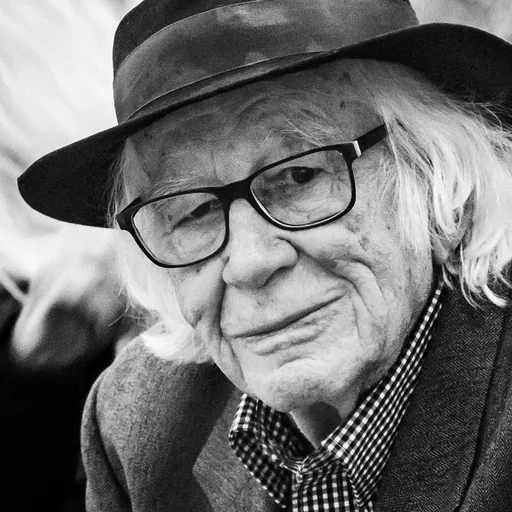
About Fritz Koenig
Lived 1924 – 2017 (aged 92). Fritz Koenig was a German sculptor, politician, draftsperson, painter, visual artist and medalist.
Fritz Koenig (; 20 June 1924 – 22 February 2017) was a German sculptor, considered one of the most important international German sculptors of the 20th century. The artifact, weighing more than 20 tons, was the only remaining work of art to be recovered largely intact from the ruins of the collapsed twin towers after the attacks. With its damage deliberately left unrepaired, the sculpture now stands in Manhattan's Liberty Park as a memorial to the victims of the September 11 attacks.
Koenig's oeuvre includes other works, including other memorials. Numerous works by Koenig and his renowned collections with artifacts from antiquity to the 20th century are located in the Koenigmuseum in Landshut, which he designed and established by the Fritz and Maria Koenig Foundation.
Biography Koenig was born in Würzburg on 20 June 1924. His family moved to Landshut in 1930, when he was six years old. He entered the Oberrealschule (today the Hans-Leinberger-Gymnasium) in 1942, and in the same year, he was drafted into the Wehrmacht and sent to the Eastern Front, where he was taken as a prisoner of war.
In the years after World War II, he studied art at the Academy of Fine Arts in Munich starting in 1946 and graduating in 1952. In 1951, he studied in Paris on a scholarship. In 1957, Koenig was selected to receive a scholarship from the Villa Massimo in Rome. In 1958, Koenig presented at the XXIX. Biennale in Venice and designed the West German pavilion at the world exhibition Expo 58 in Brussels with his art. In 1959, Koenig was able to exhibit at the II. documenta in Kassel. In addition, the Günther Franke gallery in Munich presented Koenig's first solo exhibition. Also in the same year, 1959, Koenig married his wife Maria, who was born in Landshut (1921-2010). In 1960, Koenig and his wife bought an agricultural property in the Altdorf district of Ganslberg near Landshut. In 1961, a house, studio and stables were built according to his ideas. Rural life made it possible for the passionate rider and horse lover to set up his own thoroughbred Arabian breed, which achieved worldwide fame and was also of great importance for his artistic work.
Koenig achieved his final international breakthrough in 1961 with a solo exhibition at the Staempfli Gallery in New York. Exhibitions at documenta III and XXXII. Bienniale followed in 1964.
Work
In his work, Koenig was primarily concerned with the elementary "existence" of humans and animals in the area of tension between religiosity and mythology. The human being in the fragility of his existence, in the field of tension between love, death and impermanence, was another major leitmotif of Fritz Koenig's work. The combination of geometric forms like cuboids, spheres and bodies and limbs of cylinders to create new, organic-looking objects cast in metal made Koenig known in the early 1950s. The Corriere della Sera compared Koenig to Michelangelo, and a reviewer from the Frankfurter Allgemeine Zeitung saw a connection to Donatello.
Documentary Several documentaries coveres Koenig and his work, including: Fritz Koenig und seine Welt. BR, 1974 Percy Adlon: Fritz Koenig. BR, 1979–2002 Percy Adlon: Fritz Koenigs Kugel – Der deutsche Bildhauer Fritz Koenig im Trümmerfeld von Ground Zero. BR, 2002 Astrid Bscher: Koenigs New Yorker Kugel – Eine Skulptur wird zum Symbol. BR, 2021
Exhibitions in 2024 Several exhibitions have been held in 2024, the centenary of his birth: Fritz Koenig – Lebensstationen, KOENIGmuseum, Landshut Fritz Koenig in New York at the Goethe-Institut, New York Fritz Koenig und die Antike, Glyptothek, Munich
Don’t just read it —
keep it.
Full-length biographies made to live with: read them, listen on the way to work, watch them tonight.
- E-book
- Audio
- Video
Instant download · yours to keep · every purchase keeps this site free
Important facts
People in Fritz Koenig's life
Named in this biography and alive at the same time


Related people
Same field, nearest in time



Contemporaries
People whose lives overlapped Fritz Koenig's


Frequently asked questions
Who was Fritz Koenig?
German sculptor (1924–2017)
When was Fritz Koenig born?
Fritz Koenig was born on 20 June 1924 in Würzburg.
When did Fritz Koenig die?
Fritz Koenig died on 22 February 2017 in Altdorf.
What was Fritz Koenig's occupation?
Fritz Koenig was a sculptor, politician, draftsperson, painter, visual artist and medalist.
What nationality was Fritz Koenig?
Fritz Koenig was German.
Sources & further reading
Cite this page
APA: Biography.guide. (2026). Fritz Koenig. https://biography.guide/fritz-koenig/
MLA: "Fritz Koenig." Biography.guide, https://biography.guide/fritz-koenig/.
Chicago: "Fritz Koenig." Biography.guide. https://biography.guide/fritz-koenig/.
Data last updated: 2026-09-21 · Spot an error? Report a correction.
Portrait: Wikimedia Commons · author & licence
Page generated 2026-09-27 04:59 UTC