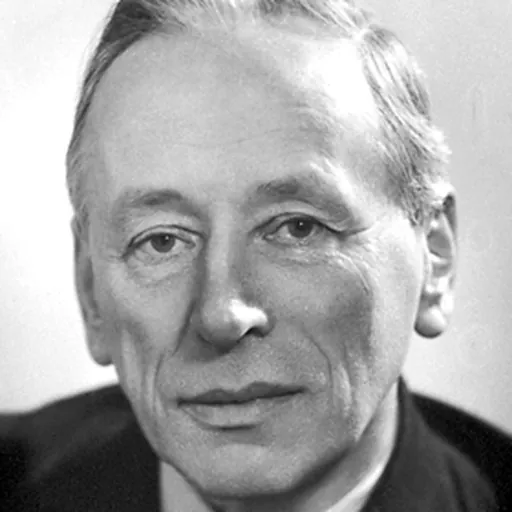
About Frits Zernike
Lived 1888 – 1966 (aged 77). Frits Zernike was a Dutch physicist, mathematician, inventor, university teacher and chemist, known for Ornstein–Zernike equation, Phase-contrast microscopy and Van Cittert–Zernike theorem.
Frederik Frits Zernike (; 16 July 1888 – 10 March 1966) was a Dutch physicist who received the Nobel Prize in Physics in 1953 for his invention of the phase-contrast microscope.
Early life and education Frederik Zernike was born on 16 July 1888 in Amsterdam, the second son of Carl Frederik August Zernike and Antje Dieperink. Both parents were teachers of mathematics, and he especially shared his father's passion for physics. In 1905, he enrolled at the University of Amsterdam, studying chemistry (his major), mathematics, and physics. He received his B.Sc. in Chemistry in 1912 and his Ph.D. in Physics in 1915.
Academic career In 1912, Zernike was awarded a prize for his doctoral work on opalescence in gases. In 1913, he became assistant to Jacobus Kapteyn in the astronomical laboratory at the University of Groningen. In 1914, Zernike and Leonard Ornstein were jointly responsible for the derivation of the Ornstein–Zernike equation in critical-point theory. In 1915, he became lector in theoretical mechanics and mathematical physics at the same university and in 1920 he was promoted to Professor of Mathematical Physics.
In 1930, Zernike was conducting research into spectral lines when he discovered that the so-called ghost lines that occur to the left and right of each primary line in spectra created by means of a diffraction grating, have their phase shifted from that of the primary line by 90 degrees. It was at a Physical and Medical Congress in Wageningen in 1933, that Zernike first described his phase contrast technique in microscopy. He extended his method to test the figure of concave mirrors. His discovery lay at the base of the first phase contrast microscope, built during World War II. The phase-contrast microscope became particularly important in biology because it made colorless, transparent living cells visible without staining them.
He also made another contribution in the field of optics, relating to the efficient description of the imaging defects or aberrations of optical imaging systems like microscopes and telescopes. The representation of aberrations was originally based on the theory developed by Ludwig Seidel in the middle of the nineteenth century. Seidel's representation was based on power series expansions and did not allow a clear separation between various types and orders of aberrations. Zernike's orthogonal circle polynomials provided a solution to the long-standing problem of the optimum 'balancing' of the various aberrations of an optical instrument. Since the 1960s, Zernike's circle polynomials are widely used in optical design, optical metrology and image analysis.
Zernike's work helped awaken interest in coherence theory, the study of partially coherent light sources. In 1938 he published a simpler derivation of Van Cittert's 1934 theorem on the coherence of radiation from distant sources, now known as the Van Cittert–Zernike theorem.
Personal life and death Zernike was married to Dora van Bommel van Vloten, with whom he had one son. Dora died in 1945. He married his second wife Lena Koperberg-Baanders in 1954. After his retirement, they moved to Naarden.
His granddaughter is the journalist Kate Zernike. His great-nephew Gerard 't Hooft won the Nobel Prize in Physics in 1999.
Recognition Memberships Year Organization Type 1946 Royal Netherlands Academy of Arts and Sciences Member 1954 Optical Society of America Honorary Member 1956 Royal Society Foreign Member
Awards Year Organization Award Citation 1952 Royal Society Rumford Medal "In recognition of his outstanding work in the development of phase contrast microscopy." 1953 Royal Swedish Academy of Sciences Nobel Prize in Physics "For his demonstration of the phase contrast method, especially for his invention of the phase contrast microscope."
Commemoration The university complex (Zernike Campus) to the north of the city of Groningen is named after him, as is the crater Zernike on the Moon and the minor planet 11779 Zernike.
The Oz Enterprise, a Linux distribution, was named after Leonard Ornstein and Frits Zernike.
Don’t just read it —
keep it.
Full-length biographies made to live with: read them, listen on the way to work, watch them tonight.
- E-book
- Audio
- Video
Instant download · yours to keep · every purchase keeps this site free
Important facts
People in Frits Zernike's life
Named in this biography and alive at the same time


Related people
Same field, nearest in time

Contemporaries
People whose lives overlapped Frits Zernike's




Frequently asked questions
Who was Frits Zernike?
Dutch physicist (1888–1966)
When was Frits Zernike born?
Frits Zernike was born on 16 July 1888 in Amsterdam.
When did Frits Zernike die?
Frits Zernike died on 10 March 1966 in Amersfoort.
What was Frits Zernike's occupation?
Frits Zernike was a physicist, mathematician, inventor, university teacher and chemist.
What was Frits Zernike known for?
Frits Zernike was known for Ornstein–Zernike equation, Phase-contrast microscopy, Van Cittert–Zernike theorem and Zernike polynomials.
What nationality was Frits Zernike?
Frits Zernike was Dutch.
Sources & further reading
Cite this page
APA: Biography.guide. (2026). Frits Zernike. https://biography.guide/frits-zernike/
MLA: "Frits Zernike." Biography.guide, https://biography.guide/frits-zernike/.
Chicago: "Frits Zernike." Biography.guide. https://biography.guide/frits-zernike/.
Data last updated: 2026-09-20 · Spot an error? Report a correction.
Portrait: Wikimedia Commons · author & licence
Page generated 2026-09-27 04:58 UTC