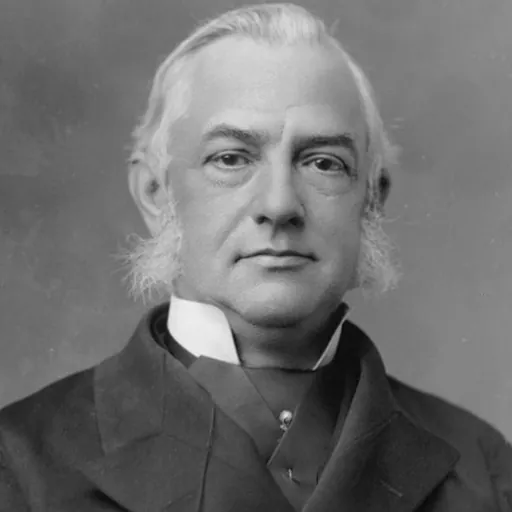
About Friedrich Max Müller
Lived 1823 – 1900 (aged 76). Friedrich Max Müller was a British linguist, librarian, historian of religion, translator, university teacher and mythographer.
Friedrich Max Müller (; 6 December 1823 – 28 October 1900) was a German-born British comparative philologist and Orientalist. He was one of the founders of the Western academic disciplines of Indology and religious studies. Müller wrote both scholarly and popular works on the subject of Indology. He directed the preparation of the Sacred Books of the East, a 50-volume set of English translations which continued after his death. He was also the first major scholar to compile the Rigveda Samhita along with the Sāyanācarya commentary, in six volumes entitled Rig-Veda-Sanhita, The Sacred Hymns Of The Brahmans.
Müller became a professor at Oxford University, first of modern languages, then of comparative philology
Müller was named after his mother's elder brother, Friedrich, and after the central character, Max, in Weber's opera Der Freischütz. Later in life, he adopted Max as a part of his surname, believing that the prevalence of Müller as a name made it too common. and in some other publications.
Müller entered the gymnasium (grammar school) at Dessau when he was six years old. In 1835, at the age of twelve, he was sent to live in the house of the painter Carl Gustav Carus and attended the Nikolaischule at Leipzig, where he continued his studies of music and classics. It was during his time in Leipzig that he frequently met Felix Mendelssohn. His final dissertation was on Spinoza's Ethics. He had an aptitude for classical languages, learning Greek, Latin, Arabic, Persian and Sanskrit.
Sanskrit studies In 1844, Müller studied in Berlin with Friedrich Schelling. He began to translate the Upanishads for Schelling, and continued to research Sanskrit under Franz Bopp, the first systematic scholar of the Indo-European languages (IE). Schelling led Müller to relate the history of language to the history of religion. At this time, Müller published his first book, a German translation of the Hitopadesa, a collection of Indian fables.
In 1845, Müller moved to Paris to study Sanskrit under Eugène Burnouf. Burnouf encouraged him to publish the complete Rigveda, making use of the manuscripts available in England. He moved to England in 1846 to study Sanskrit texts in the collection of the East India Company. He supported himself at first with creative writing, his novel German Love being popular in its day.
Müller's connections with the East India Company and with Sanskritists based at Oxford University led to a career in Britain, where he eventually became the leading intellectual commentator on the culture of India. At the time, Britain controlled India as part of its Empire. This led to complex exchanges between Indian and British intellectual culture, especially through Müller's links with the Brahmo Samaj.
Müller's Sanskrit studies came at a time when scholars had started to see language development in relation to cultural development. The recent discovery of the Indo-European language group had started to lead to much speculation about the relationship between Greco-Roman cultures and those of more ancient peoples. In particular the Vedic culture of India was thought to have been the ancestor of European Classical cultures. Scholars sought to compare the genetically related European and Asian languages to reconstruct the earliest form of the root-language. The Vedic language, Sanskrit, was thought to be the oldest of the IE languages.
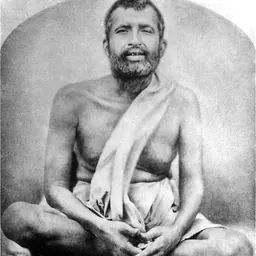
Müller devoted himself to the study of this language, becoming one of the major Sanskrit scholars of his day. He believed that the earliest documents of Vedic culture should be studied to provide the key to the development of pagan European religions, and of religious belief in general. To this end, Müller sought to understand the most ancient of Vedic scriptures, the Rigveda. Müller translated the Rigveda Samhita book written by the 14th century Sanskrit scholar Sayanacharya from Sanskrit to English. Müller was greatly impressed by Ramakrishna Paramhansa, his contemporary and proponent of Vedantic philosophy, and wrote several essays and books about him.
For Müller, the study of the language had to relate to the study of the culture in which it had been used. He came to the view that the development of languages should be tied to that of belief-systems. At that time the Vedic scriptures were little-known in the West, though there was increasing interest in the philosophy of the Upanishads. Müller believed that the sophisticated Upanishadic philosophy could be linked to the primitive henotheism of early Vedic Brahmanism from which it evolved. He had to travel to London to look at documents held in the collection of the British East India Company. While there he persuaded the company to allow him to undertake a critical edition of the Rigveda, a task he pursued over many years (1849–1874).
For Müller, the culture of the Vedic peoples represented a form of nature worship, an idea clearly influenced by Romanticism. Müller shared many of the ideas associated with Romanticism, which coloured his account of ancient religions, in particular his emphasis on the formative influence on early religion of emotional communion with natural forces. He saw the gods of the Rigveda as active forces of nature, only partly personified as imagined supernatural persons. From this claim Müller derived his theory that mythology is "a disease of language". By this he meant that myth transforms concepts into beings and stories. In Müller's view, "gods" began as words constructed to express abstract ideas, but were transformed into imagined personalities. Thus the Indo-European father-god appears under various names: Zeus, Jupiter, Dyaus Pita. For Müller all these names can be traced to the word "Dyaus", which he understood to imply "shining" or "radiance". This leads to the terms "deva", "deus", "theos" as generic terms for a god, and to the names "Zeus" and "Jupiter" (derived from deus-pater). In this way a metaphor becomes personified and fixed.
Academic career
In 1850 Müller was appointed deputy Taylorian professor of modern European languages at Oxford University.
He was defeated in the 1860 election for the position of Boden Professor of Sanskrit, which was a "keen disappointment" to him. Müller was far better qualified for the post than the other candidate, Monier Monier-Williams, but Müller's theological views, Lutheranism, German birth, and lack of practical first-hand knowledge of India spoke against him. After the election he wrote to his mother, "all the best people voted for me, the Professors almost unanimously, but the vulgus profanum made the majority".
Later in 1868, Müller became Oxford's first professor of comparative philology,
Scholarly and literary works
Gifford Lectures 1875 Vanity Fair caricature of Müller confirming that, at the age of fifty-one, with numerous honours, he was one of the truly notable "Men of the Day". In 1888, Müller was appointed Gifford Lecturer at the University of Glasgow. These Gifford Lectures were the first in an annual series, given at several Scottish universities, that has continued to the present day. Over the next four years, Müller gave four series of lectures.
Natural Religion. This first course of lectures was intended as purely introductory, and had for its object a definition of Natural Religion in its widest sense. Physical Religion. This second course of lectures was intended to show how different nations had arrived at a belief in something infinite behind the finite, in something invisible behind the visible, in many unseen agents or gods of nature, until they reached a belief in one god above all those gods. In short, a history of the discovery of the infinite in nature. Anthropological Religion. This third course was intended to show how different nations arrived at a belief in a soul, how they named its various faculties, and what they imagined about its fate after death. Theosophy or Psychological Religion. The fourth and last course of lectures was intended to examine the relation between God and the soul ("these two Infinites"), including the ideas that some of the principal nations of the world have formed concerning this relation. Real religion, Müller asserted, is founded on a true perception of the relation of the soul to God and of God to the soul; Müller wanted to prove that this was true, not only as a postulate, but as an historical fact. The original title of the lectures was 'Psychological Religion' but Müller felt compelled to add 'Theosophy' to it. Müller's final Gifford Lecture is significant in interpreting his work broadly, as he situates his philological and historical research within a Hermetic and mystical theological project.
As translator In 1881, he published a translation of the first edition of Kant's Critique of Pure Reason. He agreed with Schopenhauer that this edition was the most direct and honest expression of Kant's thought. His translation corrected several errors that had been committed by previous translators. In his Translator's Preface, Müller wrote:
Müller continued to be influenced by the Kantian Transcendentalist model of spirituality, and was opposed to Darwinian ideas of human development. He argued that "language forms an impassable barrier between man and beast".
Views on India Early career On 25 August 1866, Müller wrote to Chevalier Bunsen:
In his career, Müller several times expressed the view that a "reformation" within Hinduism needed to occur, comparable to the Christian Reformation. In his view, "if there is one thing which a comparative study of religions places in the clearest light, it is the inevitable decay to which every religion is exposed... Whenever we can trace back a religion to its first beginnings, we find it free from many blemishes that affected it in its later states".
He used his links with the Brahmo Samaj to encourage such a reformation on the lines pioneered by Ram Mohan Roy. Müller believed that the Brahmos would engender an Indian form of Christianity and that they were in practice "Christians, without being Roman Catholics, Anglicans or Lutherans". In the Lutheran tradition, he hoped that the "superstition" and idolatry, which he considered to be characteristic of modern popular Hinduism, would disappear.
Müller wrote: The translation of the Veda will hereafter tell to a great extent on the fate of India, and on the growth of millions of souls in that country. It is the root of their religion, and to show them what the root is, I feel sure, is the only way of uprooting all that has sprung from it during the last 3,000 years... one ought to be up and doing what may be God's work.
Müller hoped that increased funding for education in India would promote a new form of literature combining Western and Indian traditions. In 1868 he wrote to George Campbell, the newly appointed Secretary of State for India:
Late career
In his sixties and seventies, Müller gave a series of lectures, which reflected a more nuanced view in favour of Hinduism and the ancient literature from India. In his lecture "What can India teach us?" at the University of Cambridge, he championed ancient Sanskrit literature and India as follows:
Müller conjectured that the introduction of Islam in India in the 11th century had had a deep effect on the psyche and behaviour of Hindus in another lecture, "Truthful Character of the Hindus":
Swami Vivekananda, who was the foremost disciple of Ramakrishna Paramahamsa, met Müller over a lunch on 28 May 1896. Regarding Müller and his wife, the Swami later wrote:
Visit to Istanbul and meeting with Abdul Hamid II In 1893, Müller and his wife traveled to the Ottoman Empire, visiting Istanbul and Bursa. The primary purpose was to visit his son, Wilhelm Max-Müller, who worked as a diplomat at the British embassy. During this stay, Müller was granted a private audience with Sultan Abdul Hamid II at the Yıldız Palace. In return, the Sultan presented the Müller family with various gifts and decorated him with an Ottoman imperial order.
The journey significantly altered Müller's perspectives on Islam and the Turks. Prior to 1893, his views reflected typical 19th-century European prejudices regarding Ottoman rule in Anatolia and the Balkans.
Although Müller took a strong religious and academic interest in Hinduism and other non-Christian religions, and often compared Christianity to religions that many traditional Protestants would have regarded as primitive or false, he grounded his Perennialism in a belief that Christianity possessed the fullest truth of all living religions. Twenty-first century scholars of religion, far from accusing Müller of being anti-Christian, have critically examined Müller's theological project as evidence for a bias towards Christian conceptions of God in early academic religious studies.
Darwin disagreement
Müller attempted to formulate a philosophy of religion that addressed the crisis of faith engendered by the historical and critical study of religion by German scholars on the one hand, and by the Darwinian revolution on the other. He was wary of Darwin's work on human evolution, and attacked his view of the development of human faculties. His work was taken up by cultural commentators such as his friend John Ruskin, who saw it as a productive response to the crisis of the age . He analyzed mythologies as rationalisations of natural phenomena, primitive beginnings that we might denominate "protoscience" within a cultural evolution. Müller proposed an early, mystical interpretation of theistic evolution, using Darwinism as a critique of mechanical philosophy.
In 1870 Müller gave a short course of three lectures for the British Institution on language as the barrier between man and beast, which he called "On Darwin's Philosophy of Language". Müller specifically disagreed with Darwin's theories on the origin of language and that the language of man could have developed from the language of animals. In 1873, he sent a copy of his lectures to Darwin reassuring him that, though he differed from some of Darwin's conclusions, he was one of his "diligent readers and sincere admirers".
Opposition to Aryanism
Müller's work contributed to the developing interest in Aryan culture, which often set Indo-European ("Aryan") traditions in opposition to Semitic religions. He "was deeply saddened by the fact that these classifications later came to be expressed in racist terms", as this was far from his intention. For Müller, the discovery of common Indian and European ancestry was a powerful argument against racism, arguing that "an ethnologist who speaks of Aryan race, Aryan blood, Aryan eyes and hair, is as great a sinner as a linguist who speaks of a dolichocephalic dictionary or a brachycephalic grammar" and that "the blackest Hindus represent an earlier stage of Aryan speech and thought than the fairest Scandinavians".
Turanian
Müller put forward and promoted the theory of a "Turanian" family of languages or speech, comprising the Finnic, Samoyedic, "Tataric" (Turkic), Mongolic and Tungusic languages. According to Müller, these five languages were those "spoken in Asia or Europe not included under the Arian [sic] and Semitic families, with the exception perhaps of the Chinese and its dialects". In addition, they were "nomadic languages," in contrast to the other two families (Aryan and Semitic), which he called State or political languages.
The idea of a Turanian family of languages was not accepted by everyone at the time. Although the term "Turanian" quickly became an archaism (unlike "Aryan"), it did not disappear completely. The idea was absorbed later into nationalist ideologies in Hungary and Turkey.
Honours and distinctions
In 1869, Müller was elected to the French Académie des Inscriptions et Belles-Lettres as a foreign correspondent (associé étranger).
Personal life
Müller became a naturalised British citizen in 1855, at the age of 32. He married Georgina Adelaide Grenfell on 3 August 1859 after overcoming the opposition from her family. The couple had four children, including William Grenfell. Two of their children predeceased them.
Death and legacy
Müller's health began deteriorating in 1898 and he died at his home in Oxford on 28 October 1900. He was interred at Holywell Cemetery on 1 November 1900.
The Goethe Institutes in India are named Max Müller Bhavan in his honour, as is a street (Max Mueller Marg) in New Delhi.
Müller's biographies include , and . Nirad C. Chaudhuri's Scholar Extraordinary was awarded the Sahitya Akademi Award for English by Sahitya Akademi, India's National Academy of Letters. In addition, Stephen G. Alter's 2005 book William Dwight Whitney and the Science of Language contains a chapter on Müller's rivalry with the American linguist William Dwight Whitney.
Swami Vivekananda praised Mueller, and remarked, "Max Müller is a Vedantist of Vedantists. He has, indeed, caught the real soul of the melody of the Vedanta, in the midst of all its settings of harmonies and discords — the one light that lightens the sects and creeds of the world, the Vedanta, the one principle of which all religions are only applications."
Other Indian figures such as Nirad C. Chaudhuri, Sri Aurobindo and others were also influenced by Mueller.
Publications
Müller's scholarly works, published separately as well as an 18-volume Collected Works, include:
5 vols.
2 vols.
4 vols.
2 vols.
Don’t just read it —
keep it.
Full-length biographies made to live with: read them, listen on the way to work, watch them tonight.
- E-book
- Audio
- Video
Instant download · yours to keep · every purchase keeps this site free
Important facts
Family & relationships
People in Friedrich Max Müller's life
Named in this biography and alive at the same time




Related people
Same field, nearest in time


Contemporaries
People whose lives overlapped Friedrich Max Müller's




Frequently asked questions
Who was Friedrich Max Müller?
German-born British philologist, orientalist and indologist (1823–1900)
When was Friedrich Max Müller born?
Friedrich Max Müller was born on 6 December 1823 in Dessau.
When did Friedrich Max Müller die?
Friedrich Max Müller died on 28 October 1900 in Oxford.
What was Friedrich Max Müller's occupation?
Friedrich Max Müller was a linguist, librarian, historian of religion, translator, university teacher and mythographer.
What nationality was Friedrich Max Müller?
Friedrich Max Müller was British.
Sources & further reading
· Wikipedia: Friedrich Max Müller
Cite this page
APA: Biography.guide. (2026). Friedrich Max Müller. https://biography.guide/friedrich-max-muller/
MLA: "Friedrich Max Müller." Biography.guide, https://biography.guide/friedrich-max-muller/.
Chicago: "Friedrich Max Müller." Biography.guide. https://biography.guide/friedrich-max-muller/.
Data last updated: 2026-09-21 · Spot an error? Report a correction.
Portrait: Wikimedia Commons · author & licence
Page generated 2026-09-27 05:00 UTC