
Frida Stéenhoff
Swedish writer and women's rights activist
About Frida Stéenhoff
Lived 1865 – 1945 (aged 79). Frida Stéenhoff was a Swedish writer, women's rights activist, painter, draftsperson, handicrafter and journalist.
Helga Frideborg Maria "Frida" Stéenhoff (; 11 December 1865 – 22 June 1945) was a Swedish writer and women's rights activist. She was a leading participant of the public debate of gender equality and a contributor of several radical progressive publications. She was engaged in the women suffrage movement and several humanitarian organisations.
Life Frida Wadström was born to the chaplain Carl Bernhard Philonegros Wadström (1831–1918) and Helga Westdahl (1838–1879), and was the sister of the suffragist and writer Ellen Hagen. In 1887 she married the physician Gotthilf Stéenhoff.
During World War II, she participated in anti-fascist work. Stéenhoff was a leading central figure of the free love movement in Sweden, for birth control, sex and romance without marriage, and critical toward the institution of marriage, subjects for which she became controversially known by her debut novel: Lejonets unge (Lion's Child) from 1896. She is credited with having introduced the modern concept of feminism in Sweden with her publication Feminismens moral (Feminist Morality) from 1903.
She used the male pseudonym Harald Gate. She was among the contributors to the feminist magazine Tidevarvet.
Works Novels and serials 1902 - Det heliga arvet 1904 - Öknen 1911 - Kring den heliga elden 1915 - Ljusa bragder och mörka dåd 1918 - Filippas öden 1937 - Objektiv stats- och könsmoral
Plays 1896 - Lejonets unge 1898 - Sin nästas hustru 1900 - Ärkefienden 1907 - Stridbar ungdom 1908 - Den vita duvans samfund 1910 - Den smala vägen 1911 - Kärlekens rival
Essays and other publications 1903 - Feminismens moral 1904 - Den reglementerade prostitutionen 1905 - Humanitet och barnalstring 1905 - Varför skola kvinnorna vänta 1907 - Fosterlandskänslan 1908 - Penningen och kärleken 1909 - Riktlinjerna i mitt författaskap 1910 - Teatern och livet 1910 - Det nya folket 1912 - Minfru, fru eller fröken 1912 - Äktenskap och demokrati 1913 - Könsslaveri 1915 - Krigets herrar - världens herrar 1924 - Samtal med en borgmästare om prostitutionen (Tidevarvet 1924(2):8, s. 4, 5, 6) 1924 - Ellen Key och Nikodemus (Tidevarvet 1924(2):49, s. 1, 6) 1925 - Babels förbistring: angående befolkningsproblem ... (Tidevarvet 1925(3):7, s. 3) 1925 - Bör nutidsmänniskan tro på drömmar? (Tidevarvet 1925(3):14, s. 4) 1925 - Vad unnar han henne? (Tidevarvet 1925(3):17, s. 4 ) 2007 - Blott ett annat namn för ljus: Tre texter av Frida Stéenhoff (innehåller Feminismens moral, Ett sällsamt öde och Lejonets unge)
Don’t just read it —
keep it.
Full-length biographies made to live with: read them, listen on the way to work, watch them tonight.
- E-book
- Audio
- Video
Instant download · yours to keep · every purchase keeps this site free
Important facts
People in Frida Stéenhoff's life
Named in this biography and alive at the same time
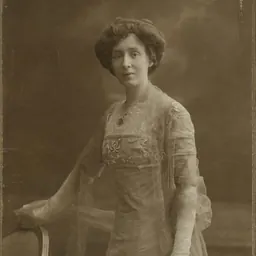

Related people
Same field, nearest in time



Contemporaries
People whose lives overlapped Frida Stéenhoff's




Frequently asked questions
Who was Frida Stéenhoff?
Swedish writer and women's rights activist (1865-1945)
When was Frida Stéenhoff born?
Frida Stéenhoff was born on 11 December 1865 in Jakob parish, Jakob and Johannes parish.
When did Frida Stéenhoff die?
Frida Stéenhoff died on 22 June 1945 in Engelbrekt church parish.
What was Frida Stéenhoff's occupation?
Frida Stéenhoff was a writer, women's rights activist, painter, draftsperson, handicrafter and journalist.
What nationality was Frida Stéenhoff?
Frida Stéenhoff was Swedish.
Sources & further reading
Cite this page
APA: Biography.guide. (2026). Frida Stéenhoff. https://biography.guide/frida-steenhoff/
MLA: "Frida Stéenhoff." Biography.guide, https://biography.guide/frida-steenhoff/.
Chicago: "Frida Stéenhoff." Biography.guide. https://biography.guide/frida-steenhoff/.
Data last updated: 2026-09-20 · Spot an error? Report a correction.
Page generated 2026-09-27 05:19 UTC