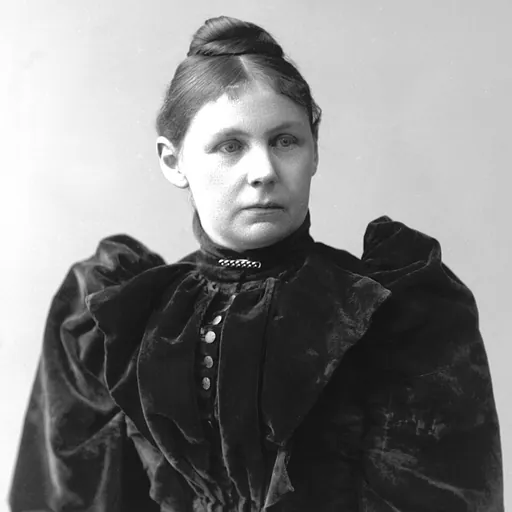
About Frida Hansen
Lived 1855 – 1931 (aged 76). Frida Hansen was a Norwegian textile artist.
Frederikke "Frida" Bolette Hansen (née Petersen; 8 March 1855 – 12 March 1931) was a Norwegian textile artist in the Art Nouveau style. She has been described as a bridge between Norwegian and European tapestry, and several of her weaving designs are considered among the best made in recent European textile art. Her works are owned by a number of museums, including the National Museum of Norway, Drammens Museum, Stavanger Art Museum and the Nordic Museum in Stockholm.
Early life Hansen was born on March 8th 1855 in Stavanger, Norway, to upper class parents Mathilde (née Helliesen; 1824–1915) and Peter Sickerius Petersen (1811–1875). Her father was a successful merchant and head of reputable company Køhler & Co. She was determined to become a painter from a young age and was given art lessons by her parents where she got to paint with Kitty Kielland, Elisabeth Sinding and .
Because her parents had no sons, Hansen was expected to marry in order to carry on the family lineage. In 1872 she got engaged at 18 years old to a 32 year old
In 1888 the city was hit by an economic downturn. Plough & Sundt, the family business that her husband ran, went bankrupt. Her husband fled abroad for a few years, and Hansen was left with sole responsibility for the family. Two of her three children died. In order to obtain an income, Hansen started an embroidery business in her own home. In the embroidery shop old tapestries were repaired and from doing that repair work she became interested in the ancient techniques that were used to create the images.
In 1889 she was a participant in the first course in weaving in the country, hosted by Randi Blehr at Lærdal in Sogn. When the introductory course was given, Hansen acquired a warp-weighted loom, and she quickly began to create her own images. After a short time she started selling tapestries, and she also had exhibitions in several Norwegian cities. In May 1892 Hansen moved to Oslo and founded , complete with a dyeing workshop. Her knowledge about dyeing yarn was the basis for the yarn Norges Husflidslag had for sale.
Studies abroad In the spring of 1895 Hansen was able to study abroad, first to Cologne to study medieval art and then to Paris to study life drawing. The impetus she brought from abroad was crucial to her development. In Europe, the prevailing art movement was in the process of change from the national and tradition-bound to symbolism and Art Nouveau (Jugendstil).
From 1897 to 1906, Hansen ran , a workshop which mainly worked out of her patterns. There she engaged in drawing, weaving and teaching. At the 1900 World's Fair in Paris, Hansen was awarded the gold medal for her tapestry ('The Milky Way'). The carpet was already purchased for the Museum für Kunst und Gewerbe Hamburg. Experimental techniques led to a special transparent weave, which Hansen patented. This technique was used to create porters or room dividers.
After the turn of the century, Art Nouveau gradually went out of fashion, and by 1920 Hansen's art was no longer as much in demand. In 1915 Hansen received the King's Medal of Merit in gold for her work as a textile artist. From 1926 until her death in 1931, Hansen worked on the St. Olav wall tapestry in Stavanger Cathedral. Hansen died in Oslo and was buried at the cemetery of Ullern Church.
Work
Hansen's work forms a bridge between Norwegian and European tapestry. Nature was an important source of inspiration, and flowers were special to her. She was strongly influenced by the theory of English textile designer William Morris. Nature was the key which Morris showed conscientiously with abstraction and simplification. When Hansen wanted to abstract a flower, she drew it straight from above or from the side, just as Morris had done before her. Hansen was particularly concerned that the textiles should not be woven paintings, but should have their own expression. What she and Morris had in common was respect and humility towards nature. Hansen was very fond of flowers, a common theme found in her tapestries.
Her tapestries were often faulted for not expressing Norwegian art and culture. In the 1890s and early 1900s, Norwegian nationality was important with art (among other things) identifying the typical Norwegian essence. Hansen responded to the criticism by making art that was more international, much like the decorative art of Morris. One of Hansen's works hangs in the Royal Palace in Oslo. There are two national tapestries designed by Gerhard Munthe, but woven by Hansen. Munthe believed that she was the best in the country for the task. Tapestries hanging in the castle are from the Saga of Sigurd the Crusader. The design was first drawn on carton and later transferred to the loom. Often a workshop consisted of people with different tasks: one person who dyed yarn and arranged the card, and the weaver who transferred to the loom. However, Hansen was technically adept and did everything herself. She usually created full-size cards, dyed the yarn and took care of the transfer.
Don’t just read it —
keep it.
Full-length biographies made to live with: read them, listen on the way to work, watch them tonight.
- E-book
- Audio
- Video
Instant download · yours to keep · every purchase keeps this site free
Important facts
People in Frida Hansen's life
Named in this biography and alive at the same time


Related people
Same field, nearest in time




Contemporaries
People whose lives overlapped Frida Hansen's


Frequently asked questions
Who was Frida Hansen?
Norwegian textile artist (1855–1931)
When was Frida Hansen born?
Frida Hansen was born on 8 March 1855 in Hillevåg.
When did Frida Hansen die?
Frida Hansen died on 12 March 1931 in Oslo.
What was Frida Hansen's occupation?
Frida Hansen was a textile artist.
What nationality was Frida Hansen?
Frida Hansen was Norwegian.
Sources & further reading
Cite this page
APA: Biography.guide. (2026). Frida Hansen. https://biography.guide/frida-hansen/
MLA: "Frida Hansen." Biography.guide, https://biography.guide/frida-hansen/.
Chicago: "Frida Hansen." Biography.guide. https://biography.guide/frida-hansen/.
Data last updated: 2026-09-24 · Spot an error? Report a correction.
Portrait: Wikimedia Commons · author & licence
Page generated 2026-09-27 05:08 UTC