
Frederic Salmon Growse
British scholar and civil servant in North-Western Provinces, India
About Frederic Salmon Growse
Lived 1836 – 1893 (aged 56–57). Frederic Salmon Growse was a British civil servant, writer, translator, beamter and district magistrate, known for Catholic Church of the Sacred Heart, Garden Gate, Bulandshahr and Government Museum, Mathura.
Frederic Salmon Growse (1836 – 19 May 1893) was a British civil servant of the Indian Civil Service (ICS), Hindi scholar, archaeologist and collector, who served in Mainpur, Mathura, Bulandshahr and Fatehpur during British rule in India.
Growse studied Indian literature and languages, and founded the Catholic Church of the Sacred Heart and the Government Museum, both at Mathura. Between 1876 and 1883, he published in series, the first English translation of the Ramayana of Tulsidas. He also wrote Mathurá: A district memoir (1880) and a description of the district of Bulandshahr (1884) and of its new architecture (1886).
Described as "never a persona grata to his superiors", he was nonetheless gazetted CIE in 1879. was born in 1836 in Bildeston, Suffolk, England, the third and youngest son of Robert and Mary Growse. He matriculated from Oriel College in 1855 and then gained a scholarship at Queen's College, Oxford, from where he received a master's degree after being in the first class of moderations and second class of classics. He was a contemporary of Charles Crosthwaite.
Career
At Bulandshahr between 1878 and 1884 Growse caused a number of buildings to be constructed using native designs and craftsmen which he saw as more in keeping with his "Gothic principles" than the utilitarian colonial buildings preferred by the Public Works Department (PWD). In 1979 he received the CIE. In May 1884, at a meeting of the Royal Society of Arts, Purdon Clarke, keeper of Indian art at the South Kensington museum, was one of the first to commend the work of Growse in Bulandshahr, crediting particularly his efforts on the Bulandshahr Chowk. He encouraged and assisted in the construction of the Bathing Ghat, Garden Gate and the Town Hall. He was one of a few self-professed historians who held the view that Indian architecture was produced through patronage, and achieved by trust rather than written contracts. His work was praised by John Lockwood Kipling in The Journal of Indian Art (1884).
Later Growse was district magistrate and collector at Fatehpur, Uttar Pradesh, from 1885 to 1886 where he produced a supplement to the Fatehpur Gazetteer, paying particular attention to architecture and archaeology which had been largely ignored by the author of the original gazetteer in 1884 who Growse thought had probably not visited any of the places about which he had written, relying instead on native informants who were not equipped to comment on such matters.
He donated a collection of Indian pottery to the British Museum in 1882.
Writing
In 1868 at Mainpur, Growse produced an article on the Prithviraj Raso, a poem about the 12th-century Hindu Emperor, Prithviraj Chauhan.
In 1874, six years after the first local text on the subject was published, In it he included early Buddhist archeology, and chapters on Hindu sects and the origin of place names. In 1876 he published his translation into English It was the first illustrated version of the complete English translation of the Ramcharitmanas, He updated and revised their volume of materials on the history of the Suffolk parish of Bildeston in 1891 which was published in 1892.
Death and legacy
Growse died from tuberculosis at Haslemere, Surrey, on 19 May 1893. Growseganj Gate, one of Bulandshahr's four gates is named for him.
In 2014, a seminar was given at the Nehru Memorial Museum & Library titled "Familiarity with the Familiar: Frederick Salmon Growse's Fragmentary Visions of the Architecture of Bulandshahr, 1878–1886".
Don’t just read it —
keep it.
Full-length biographies made to live with: read them, listen on the way to work, watch them tonight.
- E-book
- Audio
- Video
Instant download · yours to keep · every purchase keeps this site free
Important facts
People in Frederic Salmon Growse's life
Named in this biography and alive at the same time

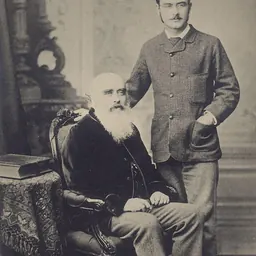


Related people
Same field, nearest in time




Contemporaries
People whose lives overlapped Frederic Salmon Growse's


Frequently asked questions
Who was Frederic Salmon Growse?
British scholar and civil servant in North-Western Provinces, India
When was Frederic Salmon Growse born?
Frederic Salmon Growse was born in 1836 in Bildeston.
When did Frederic Salmon Growse die?
Frederic Salmon Growse died on 19 May 1893 in Haslemere.
What was Frederic Salmon Growse's occupation?
Frederic Salmon Growse was a civil servant, writer, translator, beamter and district magistrate.
What was Frederic Salmon Growse known for?
Frederic Salmon Growse was known for Catholic Church of the Sacred Heart, Garden Gate, Bulandshahr, Government Museum, Mathura, Mathura and Town Hall, Bulandshahr.
What nationality was Frederic Salmon Growse?
Frederic Salmon Growse was British.
Sources & further reading
· Wikipedia: Frederic Salmon Growse
Cite this page
APA: Biography.guide. (2026). Frederic Salmon Growse. https://biography.guide/frederic-salmon-growse/
MLA: "Frederic Salmon Growse." Biography.guide, https://biography.guide/frederic-salmon-growse/.
Chicago: "Frederic Salmon Growse." Biography.guide. https://biography.guide/frederic-salmon-growse/.
Data last updated: 2026-09-22 · Spot an error? Report a correction.
Page generated 2026-09-27 05:00 UTC