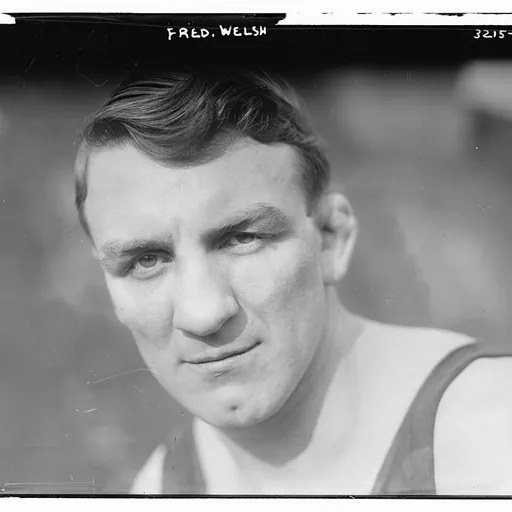
About Freddie Welsh
Lived 1886 – 1927 (aged 41). Freddie Welsh was a British boxer.
Freddie Welsh (born Frederick Hall Thomas; 5 March 1886 – 29 July 1927) was a Welsh World boxing champion. The lightweight boxer was born in Pontypridd, Wales, nicknamed the "Welsh Wizard". Brought up in a tough mining community, Welsh left a working-class background to make a name for himself in America. He turned professional as a boxer in Philadelphia in 1905, and spent the best part of his career fighting in the United States.
Welsh spent much of his career chasing the world championship title, held in turn by Battling Nelson, Ad Wolgast and Willie Ritchie, failing through a series of events to meet each until a successful encounter with Ritchie in July 1914, when he finally became world lightweight champion. Welsh held the title until 1917 when he lost to Benny Leonard, though he continued to fight sparingly until 1922. During his career, he fought in more than 160 professional bouts, suffering defeat on just 5 occasions.
A keen follower of Bernarr Macfadden's physical culture, Welsh believed in exercise and healthy living and was a non-smoker and a vegetarian. In the years following the end of his career, bad business choices cost him his fortune, and after numerous health problems he died in poverty in 1927.
Boxing career
Early life and amateur career Freddie Welsh was born in Pontypridd on 5 March 1886, to John Thomas and his wife Elizabeth Thomas (née Hall). In the late 19th century, Pontypridd was a growing coal mining town, which attracted not only those wishing to make a living in the mines, but also middle-class professionals who saw an opportunity to make a living in a thriving community. Welsh's father was one such commercial immigrant, setting up a business on Taff Street as an auctioneer. A few months after Welsh was born, his mother persuaded her husband to buy the Bridge Inn Hotel on Berw Road, and the family moved there. Welsh's mother was the daughter of a hotelier from Merthyr, and the Bridge Inn was her responsibility, as John Thomas was often away from home. His mother later remarried, to Richard Williams, an innkeeper from Aberdare. At the age of 16 he and three friends decided to find a new life in Canada. They set sail from Liverpool to Vancouver arriving in January 1903, but although his companions were able to find work, Welsh struggled to hold down any steady jobs. It was in Canada that he took a serious interest in bodybuilding and became a firm advocate of Bernarr Macfadden's physical culture regime. After a year Welsh was again homesick and borrowed enough money to return to Britain, but with only $10 he was forced to travel as a worker on a cattle-boat.
With his newfound physical fitness he entered the boxing ring undertaking amateur fights in Scotland, far away from Wales to prevent his mother discovering his passion for fighting.
Welsh failed to find steady work in the States, and although his mother thought he was earning a regular wage and living comfortably, Welsh was actually taking any casual work that was offered him. Initially he rode the rails to the Dakotas to labour in the farm fields, before heading to New York City working long hours as a dishwasher or banner bearer.
But the next day it was cold and snowy, and I walked all day and couldn't get a job or a meal. So that night I was standing there at the lunch counter when my friends came in again. "Billy Elmer will give you five dollars to fight tonight," they said. I was too hungry to stand it any longer. Five dollars meant a thick steak and some browned potatoes and a piece of pie and a cup of real coffee. I stood there and thought with my mouth watering. And then I went upstairs and I won my fight. It was as an instructor he first met his future wife, Brahna Weinstein, a Jewish Russian girl who anglicised her name to Fanny Weston when her family moved to the East Side. Welsh subsidised his work as a trainer, as a boxing instructor and training director at Brown's Gymnasium. When hard times hit the gym, he was put on half time subsidising his earnings as a snow shoveller in Harlem. Welsh then found work at a well-known New York gymnasium for $8 a day, the wage barely paid his meals but he took the job to learn the boxing profession.
Early professional career, 1905–1906 Still with dreams of becoming a culture expert, he moved to Philadelphia to become an instructor at Herman's Institute, while Fanny stayed in New York to finish her studies. Before his first professional fight, Welsh decided to change his name, fearing he may fail and that his mother would find out he was boxing. Welsh took Jack Clancy on as his American manager, and on 21 December 1905 he experienced his first professional bout. His first opponent was Young Williams, and the two novices fought at the Broadway Athletic Club of Philadelphia. Welsh won by knockout in the third round, and was booked to return to the club for his second fight in January. He went six rounds with Johnny Keely on 25 January, with a 'no-decision' verdict, the standard practice in Philadelphia for full-distance fights at the time, given to the fight. From that fight, Welsh started to take more frequent matches, sometimes accepting two bouts a week to build up his experience and stamina. Carsey and Welsh would later become close friends over the years, with Carsey becoming his sparring partner, and was part of Welsh's corner team during his big fights.
Welsh finished June with a gruelling win over Billy Glover, before facing Young Erne, an intelligent boxer from Philadelphia. He faced Jimmy Dunn on 31 August, in a six-round bout that went all the way, the press favouring Dunn.
He fought twice more in America before the end of the year, both six-round results given to Welsh by the press: against Willie Moody on 23 November and then Kid Gleeson in December.
First British fights, 1907 When Welsh returned to Britain, he was still an unknown, even in boxing circles. Despite his mother's illness Welsh arranged boxing matches in Britain, his first was against Seaman Arthur Hayes, a six-round match held at the National Sporting Club (NSC) in London. All three men lasted no more than three rounds. The contest was for a purse of £50 and the Welsh lightweight title, though as a spectacle the match was a disappointment, with Welsh in complete control of the bout from the second round. After a two-month break, Welsh's next fight was a win over Sid Russell of Cheltenham on 18 July; and the next day appeared at an exhibition bout at Pontypridd, where he sparred with Jim Driscoll a fighter who would play a prominent part in Welsh's boxing career. After a win over Young Lilly in August, he followed this with a victory over former amateur featherweight champion, Dick Lee. In Welsh's previous fight Driscoll had been part of Welsh's corner, so it came as some surprise to Driscoll when his friend was over enthusiastic in the challenge, attacking him with kidney and rabbit punches. Driscoll never forgave Welsh for taking such liberties. Some individuals had felt that Welsh had embraced America too much, and had undertaken too many 'Yankee' mannerisms, forgetting his home country. The fight went to sixteen rounds before White, who had suffered since the eleventh, threw in the towel.
Welsh's final fight in Britain until 1910, took place in Pontypridd on 3 October, when he faced two opponents on the same night. He stopped both in five rounds, first beating Gunnar Hart, the welterweight champion of the Royal Navy; then Arthur Ellis. Welsh left for America, catching the train to Liverpool before taking the Lusitania to New York.
An insight into Welsh's personality was recorded in a legal case he raised which was concluded after he had left for the States. Welsh took the case against one of the three boys he travelled to Canada with in 1902, claiming that he had given the defendant, David Davies, £8 for the cost of the trip. On 2 November 1907, Welsh faced Cyclone Johnny Thompson at the National Athletic Club in the city. The six-round encounter ended in a 'no-decision' given by the press to Welsh. The ten-round bout went the distance, with Welsh victorious by points decision, and he was congratulated by Theodore Roosevelt Jr. at the end of the match.
Welsh went on to beat Eddie Carter in Philadelphia on Christmas Day 1907, Kid Locke on 2 January and then Maurice Sayers at the Milwaukee Boxing Club. This was followed by a fight against Chicago boxer Packey McFarland, regarded as one of the greatest lightweight boxers in history, which McFarland won on points. The contest caused controversy after Welsh was floored in the fourth round following what is believed to be a low shot. The referee failed to see the offending blow, and the match continued. When the points decision was announced there was jeering from the crowd, and accusations of favouritism were made,
With fan frustration after the McFarland match, a rematch was arranged for 4 July, with Welsh facing just one opponent in the four and a half months between the bouts, Phil Brock. Welsh was meant to fight Dick Hyland, but blood poisoning to the Welshman's hand meant the Hyland fight did not take place. The Brock encounter, held at Vernon, California, was Welsh's first 25-round bout and ended in a terribly one-sided victory with a plucky Brock losing on points.
The rematch with McFarland was set for 4 July, Independence Day, to coincide with the world lightweight title fight between champion Joe Gans and Battling Nelson held in California. The Welsh-McFarland fight was gaining much press attention, and this increased after fight promoter and owner of the Jeffries Arena, Jim Jeffries, had offered Gans a $20,000 purse to face the winner of the bout in August. In the final two rounds Welsh took a heavy beating and was knocked down to the canvas in the last round.
After the McFarland draw, for the first time the American press began questioning Welsh's credentials as a champion contender, mainly due to his inability to finish off his opponent due to a lack of punching power. Welsh was hurt by the remarks that he was a 'snowflake puncher', and used his next three fights to prove his critics wrong. Johnny Murphy went the full twenty-five rounds but suffered a terrible beating, Under stormy weather conditions, Welsh won by points in a fifteen-round match, with one newspaper reporting that although Attell did not lose his featherweight title, he did "lose the title that he has held for years, that being the cleverest man in the game". Welsh carried on fighting, with one final match in New Orleans against Young Donahue. It was an acrimonious affair before the bout started, and when Welsh rejected the referee before the match began, When the fight reached its ten-round conclusion, the referee called a draw, much to Welsh's annoyance. Welsh finished off his tour of America with far more convincing displays over Jack Goodman and Phil Brock. With his sights now on the Lonsdale Belt, Welsh travelled back to Britain.
On his arrival at Cardiff on 19 June he was greeted by a throng of admirers; one of the first to greet him was Jim Driscoll. Cars had been arranged to take Welsh through Pontypridd, and he asked Driscoll to join him on the journey. Despite Pontypridd having a population of 32,000 at the time, reports were made that 80,000 people lined the streets to see their hero's arrival.
Welsh began his British return with an encounter with Young Joseph at the Pavilion in Mountain Ash, a 20-round match which only reached the eleventh after Young was disqualified for two low punches. Just over a month later, Welsh was back fighting in Mountain Ash, to face little known French lightweight Henri Piet. The press were unimpressed with the choice of opponent, but Piet gave a good account for himself before retiring in the twelfth. After Piet, Welsh faced Joe Fletcher from England; it was a terribly mismatched affair which resulted in negative press reports towards Welsh's choice of opponents. In truth there were very few fighters of a sufficient calibre to test Welsh in Britain,
The Summers fight took part at the National Sporting Club in Covent Garden, with a purse of £2,200 and the Lonsdale Belt at stake. Welsh took control in the first round and never let Summers into the fight. One reporter counted 200 successful blows to Summers head during the match, and he was bleeding as early as the third round. During the fight, some members of the crowd jeered Welsh's use of the kidney punch, which although not outlawed at the time was seen as unsporting; he was also cautioned by the referee for the use of his head in the fifth.
McFarland, Driscoll and Wells, 1910–1911 Welsh took a break away from boxing after winning the Lonsdale Belt, earning good money making theatrical appearances at music halls in London, but a chance meeting with Packy McFarland led to a match being arranged between them. but that title was now held by Ad Wolgast who had beaten Battling Nelson in a shock win in February. McFarland started the fight well, and most reporters gave him the first nine rounds, after that Welsh took most of the rounds, though in the eyes of the British press he failed to claw back the advantage McFarland had opened up in the early rounds. Although the result after twenty rounds was a draw, the British newspapers reported that McFarland had been robbed of a victory.
In the summer of 1910, Welsh was finding it difficult to find a fight. Wolgast was pricing himself out of the market, McFarland could not reach the weight and the National Sporting Centre could not find a credible contender to challenge for the Lonsdale Belt. Jim Driscoll, who had earlier won the flyweight Lonsdale Belt, was in a similar situation and a highly anticipated match was arranged between them. A long build up to the game caused the relationship between Welsh and Driscoll to sour, and when they met to sign the contracts, an argument broke out between the two men over the choice of referee. Driscoll lost his temper with Welsh, became verbally abusive and stormed out of the meeting. Welsh's tactics changed and was now using his kidney punch on his opponent, amidst cries of "foul" from the crowd. By the eighth round Driscoll was coming into the match, and forced the fighting in the ninth.
In early 1911, Welsh was about to set off for the United States when Matt Wells, a little-known British boxer who had recently turned professional, challenged him for his title. Welsh accepted, but was unprepared for Wells, who had been studying Welsh for the last eighteen months. Wells' tactics were finely executed and he built up a healthy lead by attacking Welsh from the first round, he then spent the second half of the match defending his body and his lead. Welsh departed for America on 11 March 1911, no longer a champion.
Reclaiming the British lightweight title 1911–1913
Jones, I would not run the risk of breaking or dirtying my hands on your face. You can't get anything by this and it looks like kid work to me. I thought you were a grown up man. I can make $5,000 and win the lightweight title by licking Wolgast, but if I knocked you down I'd be arrested for hitting a fat man. An easy victory over Pal Moore in March was followed by a trip to California to face Matty Baldwin in San Francisco. Welsh won the Baldwin fight on points in a performance that was considered an excellent display of boxing. The buildup was intense and both camps attempted to use the media to their advantage. Just days before the match, with tickets in high demand, the man named in the fight articles as the referee, Eddie Smith, died. This led to arguments between Welsh and Tom 'Ten per cent' Jones, Wolgast's manager, as both tried to get the most favourable replacement referee. Walgast's last-minute replacement Willie Ritchie took Welsh the full twenty rounds, and although he failed to beat the Welshman, the fight had many fans contemplating how Welsh would have fared against the champion.
In January 1912, Welsh dislocated his neck in a bout of wrestling. He was now unable to box and running low on money after living beyond his means. He left San Francisco in March, travelling to Canada where he took in an exhibition bout with Jack O'Brien, before heading to Chicago where he and Fanny stayed for two months. Welsh then decided to head to New York as to take in some six-round matches to earn some money. On the way through Buffalo he fought Jimmy Duffy, although about half a stone overweight, Welsh was given the bout by the press, and was at least making money again. He fought three more times in America before he returned to Britain, two draws against Grover Hayes and a press decision over Phil Knight. A rematch was planned with Wells for 11 November, and Welsh warmed up with a points win over Jack Langdon in Liverpool. By the tenth round the match was level,
Just before his next fight, news came from America that Willie Ritchie had taken the world title from Wolgast, strengthening Welsh's case for a championship shot. Before he could return a British Empire title fight had been arranged against Australian Hughie Mehegan. The encounter went the full 20 rounds, and although Welsh won on points he took a severe beating, complaining he found it difficult to sleep from the pain three or four days after the fight.
In early January 1913, Welsh's mother, who had been ill for some time, died. He gave up his immediate plans to chase Willie Ritchie and stayed in Wales for a while to be near his family. He fought four more fights in Britain, beginning with a home contest in Aberdare against Frenchman Paul Brevieres, who was stopped in the third.
World title bid 1913–1914
When Welsh returned to America he was intent on fighting Ritchie, having failed to meet both Nelson and Wolgast. He employed the services of Harry Pollok, one of New York's most flamboyant sports impresarios. When Welsh and Fanny arrived in New York on 29 March 1913, Pollok was there orchestrating the reporters and photographers. When Welsh arrived in New York, Billy Dolan, Ritchie's manager, announced that the champion would not be fighting for four months as he was touring Europe to fulfil theatrical commitments. In early July Welsh broke off his Canadian tour to watch Ritchie's return to the ring. It was an unimpressive display over 'Mexican' Joe Rivers, saved only by a knockout in the eleventh. During this period, to insure his name stayed in the papers, Welsh revealed that he and Fanny Weston had actually been married since 1905, a secret kept from all but the closest family members.
Eventually a fight was arranged between Welsh and Ritchie to be fought in Vancouver on 4 September 1913, but when Welsh turned on his ankle in training the date was forced back to the 20th. Worse was to follow when the evening before the fight Ritchie left Vancouver, later citing unhappiness over the filming rights of the fight. Around the same time, a gold belt awarded to Welsh after he won the Commonwealth encounter with Mehegan, was stolen while on display at a tea room near his training quarters. The belt was recovered when an Australian, named Henry Beckett, was caught trying to smuggle it out of the country.
Welsh responded to his bad luck by throwing himself back into competitive fighting. With three months of the year left, he arranged five fights. The first two contests, in Montana, against Fighting Dick Hyland and Leo Kossick were won on points decisions. was able to best Johnny Dundee in New Orleans, followed by a points victory over Frank Whitney in Atlanta. He faced two more opponents in January, Earl Fisher in Cincinnati on the 26th followed by Leo Kelly in Saint Louis on the 29th, both were press decisions for Welsh. With his weight now coming down and his bank account swelled, Welsh and Pollok refocused on Ritchie. The American sportswriters were calling Welsh a 'has-been',
In the spring of 1914, Welsh contacted Ritchie and asked him if he would face him in England, providing he got a satisfactory guarantee of money. Ritchie agreed that he would fight for the right money. Welsh cabled the Olympia Theatre, London, and began booking advertising space. When Ritchie finally stated that he wanted $50,000, win lose or draw, Welsh said the price "would make a horse laugh", and was double what he was expecting. Ritchie accepted the $40,000 but stated a fight was already planned and he would fight who he liked. In almost the first punch that White connected with, Ritchie was in trouble. Staggered, Ritchie was laid open to a battering, but stayed on his feet until the end of the fight. The fight took place on 7 July, and from the first round Welsh took control. It wasn't until the sixth when Ritchie caught Welsh on the jaw that he took a round. In the seventeenth round Ritchie was forced to up his game to find a winning punch, but failed to make significant contact before the end of the bout. After the fight the new champion retired to The Waldorf Hilton, London, to see his daughter for the first time. Thanks to a manager of the White Star Line, he, Fanny and Elizabeth obtained first class passage to America on the Olympic.
In 1914 only two U.S. states allowed twenty round championship bouts to a verdict, Colorado and Louisiana, and no promoters in either state were offering large enough purses to risk losing the championship title for. To earn as much money as he could from being the champion, Welsh fought in as many ten round 'no verdict' matches as he could. As long as he was on his feet at the end of the ten rounds, he could not lose his title. Still, Welsh wanted to show he was not going to choose soft opposition and began a series of bouts against serious contenders. His first defence was against Matty Baldwin on 27 October in Boston, a match he won on points. The fight was a near sell out at Madison Square Garden in New York, with the crowd firmly behind Wolgast.
A week later Welsh faced Charley White, the man most sports-writers believed was the natural contender for the lightweight title. The ten round bout, held in Milwaukee, was a one-sided affair with Welsh landing four times as many punches as White. Despite White having the stronger punch, it was not until the tenth that he managed to draw blood, and many writers failed to give him even one round. However, he continued fighting and retained the title until May 1917, when he was knocked out at the Manhattan Athletic Club by Benny Leonard, the first time in his career that he had been stopped. Leonard was deemed to have controlled the fight. After being floored in the ninth round, Welsh had risen back to his feet and absorbed even more blows before the referee called a halt to the bout.
Later life
Welsh retired from boxing after a defeat by Archie Walker in 1922, but retired as a wealthy man. Before he lost to Leonard in 1917, Welsh bought a farm on Long Hill in Chatham Township, New Jersey. The farm was set in and Welsh spent thousands of dollars on improvements, installing a gymnasium, a state of the art kitchen, golf course, tennis courts and a swimming pool. His idea was to turn it into a health spa, and on 11 August 1917 a host of celebrities and dignitaries were invited to its opening. One of the guests, Bat Masterson, described Long Hill as a 'palatial home sitting high upon a hill, like an acropolis'.
Welsh found Long Hill a poor distraction and thought of joining the British forces, but was persuaded out of the idea by Fanny. Instead he joined the United States Army, serving as a lieutenant and was consigned to the Walter Reed Hospital where he helped rehabilitate disabled veterans.
In 1918 Welsh was struggling with Long Hill and decided he wanted rid of it. Welsh had spent $150,000 on Long Hill, his entire life's earnings, and he placed it on the market for $20,000 cash as his business was close to collapse. He was still unable to find a buyer. Welsh's dream was to earn and run a health farm, held since his first days in America; now with his dream in tatters his life began to disintegrate. On 11 October 1919, Welsh was the only diner in a restaurant on 50th and Broadway, when by coincidence Harry Pollok walked in. The men became violent, and a fight ensued which ended with Pollok being rushed to the Polyclinic Hospital with half his right ear in an ice bucket.
In 1920 he was discharged from his duties at Walter Reed Hospital having reached the rank of captain. He returned to Long Hill, and with his money dwindling made the decision to return to the ring. After six months of preparation he faced 'Kid' Green on 28 December 1920. Despite the three-and-a-half-year absence from the ring, Welsh was in good shape and took only four rounds to beat Green; Welsh then fought twice in May 1921, against Willie Jackson and Kid Murphy, both wins; but the most notable event regarding the bouts was the appearance of heavyweight champion Jack Dempsey, who was spending time relaxing at Welsh's health farm. After two more fights in 1921, both in Canada, Welsh returned to New York to face Archie Walker in April 1922. It was a pitiful display and Welsh never stepped into a professional ring again. While in 1924, through their mutual acquaintance of Ring Lardner, F. Scott Fitzgerald turned up at the farm and sparred three rounds with Welsh. In 1924, Welsh was back in court, after he was involved in a car collision caused by him driving his vehicle on the wrong side of the road. Welsh began looking for other ventures to take him away from the health farm, and in 1925 he rejoined the US Army, becoming a boxing instructor at the Plattsburg Barracks in upstate New York. While in the forces he placed an advertisement for a manager to run Long Hill, which was accepted by neighbour and friend, Sidky Bey, and his wife Hranoush, known as Madame Bey. With strict curfew hours and a no-alcohol policy, Madame Bey made the farm a success, and Long Hill became an important training venue for New York boxers. After discussing the matter with other boxers, Madame Bey left Long Hill and set up her own rival venue. With Long Hill lost, Fanny and Welsh separated, Fanny taking a job as a live-in housekeeper at the St Paul's Hotel on 60th Street, New York, a venue where she and Welsh once lived in a suite of apartments. He faced a charge of disorderly conduct, after he came off worse in a drunken encounter with Edward Delaney of New York. The patrolman who saved Welsh from a serious beating assured the magistrate that it was a friendly fight and the charges were dismissed against both men.
On 28 July 1927 a maid at Hotel Sidney, discovered Welsh laid face downward in his pyjamas and bathrobe.
Legacy Freddie Welsh was inducted into the 'Ring Boxing Hall of Fame' in 1960, the Welsh Sports Hall of Fame in 1994 and the 'International Boxing Hall of Fame' in 1997.
In 2008, Welsh was celebrated by Rhondda Cynon Taf council when it was decided to raise a blue plaque at his former boxing club to commemorate his life. The plaque was unveiled by Welsh boxer Dai Dower the following year.
Record During the time Welsh boxed, scoring resulted in a large number of no-decision fights. However, newspapers commonly reported a winner in the case of no-decision bouts.
Fighting style During his career Welsh was often reported in the British press as having learned his boxing trade in America, and therefore he had an ungentlemanly style of boxing, especially when compared to the darling of the National Sporting Club, 'peerless' Jim Driscoll. Welsh had a history of boxing in his family, with his paternal grandfather being a mountain fighter.
Although Welsh is often criticised throughout his career as being unable to knock out his opponents, his style centred on his footwork and ability to avoid punishment. He was calm, elusive and able to frustrate those who faced him, especially heavy hitters. Welsh would often finish long fights without injury, while his opponents suffered heavy damage, and was described as "essentially a long-distance fighter".
Vegetarianism Welsh, when talking to the press, always stated that he was a vegetarian.
Although he preached the benefits of vegetarianism, he was not averse to eating meat if required. In an interview Welsh once stated, "I don't believe in a variety of cooked dishes. I eat as much raw food as possible, and this second meal consists of all sorts of vegetables, and for the main dish I have a macaroni and cheese, followed by fruit and nuts and a little rice or tapioca pudding. I find plenty of vegetable and fruits to choose from without touching meat at all. I am not a faddist, and, I eat meat when I cannot get anything else."
In his later life his adherence to vegetarianism slipped, and his difficulty in maintaining his weight after 1913 was credited to him switching diets. Welsh was known to slip away after training to secluded roadhouses where he would eat his favourite meal Chicken Maryland.
Selected publications
Training the Body and Brain to Win: What and How to Eat (1915)
Professional boxing record All information in this section is derived from BoxRec, unless otherwise stated.
Official Record
All newspaper decisions are officially regarded as “no decision” bouts and are not counted to the win/loss/draw column.
Unofficial record
Record with the inclusion of newspaper decisions to the win/loss/draw column.
Don’t just read it —
keep it.
Full-length biographies made to live with: read them, listen on the way to work, watch them tonight.
- E-book
- Audio
- Video
Instant download · yours to keep · every purchase keeps this site free
Important facts
People in Freddie Welsh's life
Named in this biography and alive at the same time




Related people
Same field, nearest in time


Contemporaries
People whose lives overlapped Freddie Welsh's



Frequently asked questions
Who was Freddie Welsh?
Welsh boxer (1886–1927)
When was Freddie Welsh born?
Freddie Welsh was born on 5 March 1886 in Pontypridd.
When did Freddie Welsh die?
Freddie Welsh died on 29 July 1927 in New York City.
What was Freddie Welsh's occupation?
Freddie Welsh was a boxer.
What nationality was Freddie Welsh?
Freddie Welsh was British.
Sources & further reading
Cite this page
APA: Biography.guide. (2026). Freddie Welsh. https://biography.guide/freddie-welsh/
MLA: "Freddie Welsh." Biography.guide, https://biography.guide/freddie-welsh/.
Chicago: "Freddie Welsh." Biography.guide. https://biography.guide/freddie-welsh/.
Data last updated: 2026-09-20 · Spot an error? Report a correction.
Page generated 2026-09-27 05:09 UTC