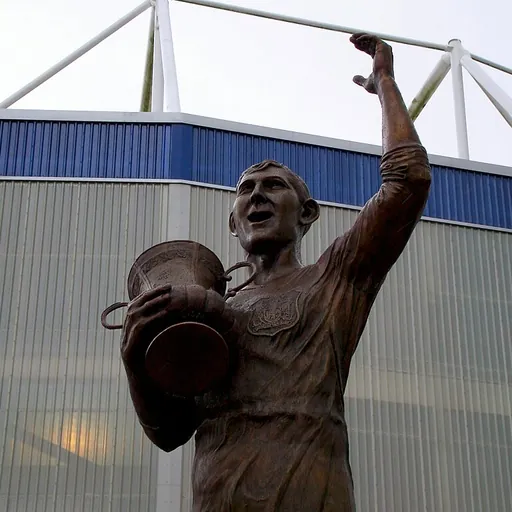
About Fred Keenor
Lived 1894 – 1972 (aged 78). Fred Keenor was a British association football player.
Early life Frederick Charles Keenor was born in Cardiff, Wales, on 31 July 1894. He was one of eleven children born to Robert and Mary Keenor. The family lived in a terraced house in Theodora Street in Roath, a working class suburb of Cardiff. His father was a stonemason in the city, working long hours to be able to afford employing Elizabeth Maler, a live-in nanny, to help his wife care for their children. Although they were not regarded as being in poverty, the family lived in cramped conditions; Keenor shared a bedroom with three of his brothers in a house that did not have an inside toilet. Their home did have electricity, which had been introduced in Cardiff fewer than ten years earlier.
Keenor developed a keen interest in football as a child, using tennis balls to play the game in his local streets. Due to the cost of footballs, he and his friends would also use rags tied together to form a ball. He attended Stacey Road Primary School in Adamsdown where he captained the school's football team for several years. He led the side to an undefeated season to win the local schools division in 1908. He was later selected to represent the city of Cardiff's schoolboy team and developed a reputation as a promising footballer.
Early football career Cardiff City Keenor's former teacher Riden invited him to attend a trial at Cardiff City in 1912 after spotting him playing local amateur football for Cardiff-based side Roath Wednesday. Keenor later said that he "did not think twice about it". He was impressive enough during a trial match to be offered an amateur contract with the club at the age of 17. He joined Cardiff City as the club was looking to establish itself as a professional football team having joined the newly formed Second Division of the Southern Football League two years earlier. The club's amateur side competed in the Western Football League and Keenor appeared several times in games. A loss to Camerton during a Western League fixture left a lasting impression on him after an over-confident Cardiff side suffered an upset, losing 3–1 in a match they were widely expected to win. Keenor often spoke of using the defeat as motivation in later stages of his career, remarking, "In subsequent seasons I always thought of that game when we were supposed to be on a 'good thing'. It has a moral which I pass on to every young footballer".
His whole-hearted performances for the amateur side persuaded the club to offer Keenor his first professional contract. Although he was given a wage of 10 shillings per week, he continued to work locally as a labourer. He described his two streams of income as making him "feel like a millionaire". The pair were impressed by Keenor's performances and handed him first-team opportunities at the end of the 1912–13 season. Keenor featured in two friendly matches, a 9–0 victory over Bridgend YMCA, in which he scored, and a 1–1 draw with Mid Rhondda. The presence of Billy Hardy, Patrick Cassidy and Kidder Harvey, who became known as the "holy three" by fans, restricted his first-team opportunities as the trio ensured the club won promotion to the First Division of the Southern Football League after conceding just 15 goals during the campaign. Keenor was forced to wait until 6 December 1913 to make his competitive debut for the club, playing in a 1–1 draw with Exeter City in the First Division. He endured a difficult start and was described in a local newspaper report as "the weak link in a very strong side". He made just two further appearances for the side during the remainder of the 1913–14 season. He featured in a 2–1 victory over Plymouth Argyle and a 0–0 draw with Millwall.
The following season, Keenor became much more involved in the first team at Ninian Park, Cardiff's home ground. After missing the opening game of the season, a defeat to Watford, he featured in five consecutive matches to replace an injured Cassidy. His performance during a victory over Brighton & Hove Albion earned glowing reviews in the Athletic News.
During the season, Cardiff came under pressure from local newspapers, most notably the Western Mail, for the club's perceived lack of contributions to the war effort. The Western Mail printed numerous scathing comments focused on association football clubs and even refused to report on Cardiff's matches for a time. The club later countered the paper's actions by accusing it of chasing "cheap popularity". Keenor, himself a patriot, was torn between the two, having finally established himself in the first team after three years at Ninian Park. He eventually enlisted in February 1915, along with teammate Jack Stephenson, trainer George Latham, who had previous military experience having served in the Second Boer War, and two of the club's directors. which became known as the Football Battalion due to the many footballers who made up the core of the unit. Led by former England international Frank Buckley, the regiment had been founded by William Joynson-Hicks, 1st Viscount Brentford, in December 1914 in the hope of attracting footballers and fans into enlisting in the armed forces.
Stationed in London with the regiment, an arrangement was made allowing players to return to their clubs for league matches to fulfill their contractual obligations. Keenor travelled by train every weekend to the venue of each Cardiff fixture to keep playing and was listed in the matchday programmes as "Private Keenor" for the remainder of the season. Cardiff finished the season in third place in the First Division. Keenor made 21 appearances in the league during the season, scoring two goals. The effects of the war effort crippled the club's finances. With travel restrictions placed on train services, and local men enlisting en masse, Cardiff's income from attendances dwindled. The situation became so dire that players were told to look for part-time jobs during the summer break in case the club was unable to pay their wages. When they threatened to strike, the club's committee approached Keenor over the possibility of forming a squad from his fellow soldiers of the Football Battalion. With the war escalating, the Football Association officially suspended all its competitions at the end of the 1914–15 season, negating any need for Keenor to raise a team. During their posting, the battalion organised a fixture against Cardiff City on 2 October 1915. Keenor was originally due to play for the army side against his club, but Cardiff manager Fred Stewart asked that he play for his club side. The match ended in a 1–0 victory for the battalion.
One month after the match, on 16 November, Keenor and his battalion began the journey to France to join the front lines. They billeted in the village of Les Ciseaux for one month before moving to the city of Béthune. Most of his posting during his battalion's first months in France involved training and guard duty. On 9 December 1915, they were posted to Annequin near the front line. They were soon moved into the main trenches, which were knee-deep in mud and infested with rats. His battalion remained on duty until 22 December when they were relieved, resting in the nearby village of Beuvry over Christmas. Cardiff City organised regular collections at their wartime fixtures during this period to send parcels to Keenor and Jack Stephenson containing letters from fans and home comforts. The Middlesex Battalion claimed the Divisional Football Cup with relative ease, defeating a team from the 34th Brigade 11–0 in the final on 11 April 1916; each player received a winners' medal made of bronze.
The war soon took its toll on the battalion as they began suffering casualties from the fighting, including Buckley who suffered severe shrapnel injuries. Having returned to the front, the regiment was involved in the Battle of the Somme, one of the bloodiest battles in history, in particularly the Battle of Delville Wood. Keenor later described the scene during what he called a "hellish battle", stating:
One must pay tribute to the good work of the Footballers' Battalion. Stationed at Delville wood, Jerry's artillery threw everything he has at us – and then some. It simply rained shells. The wonder was that any of us came out alive. It was attack and counter-attack day and night, but during the battle for possession of this wood there was not a sign of cowardice among our men. Some of them may have been called "windy" on the football fields of England, but out there in France they stood the real test of all. Following his return to service, Keenor was stationed in Chatham, Kent, as a physical training instructor for the 5th Reserve Brigade. Between 1915 and 1919, Keenor appeared as a guest for Brentford in the London Combination. During the 1918–19 season, the side won the league title with Keenor making 19 guest appearances.
Return to football
After returning to Wales, Keenor hoped to resume his playing career immediately, but the Southern Football League had set no official date for its return. To support his family during the hiatus, he worked as a milkman and in a local gas works. When the Football Association resumed fixtures in 1919 following the end of hostilities, he rejoined Cardiff City, despite being told by army doctors that his shrapnel wound meant he would never play football again. After this, Keenor featured regularly for the first team. Cardiff's squad had escaped the war relatively intact with most of the side returning to play. They went on to win the 1920 Welsh Cup, defeating Wrexham 2–1 in the final. They finished fourth in their final season in the Southern League, and were admitted into the Football League Second Division in 1920. In their first season, Cardiff finished second to Birmingham City, missing out on first place because of goal average after finishing level on points. They were subsequently promoted to the top tier of English football and reached the semi-final of the FA Cup, losing to fellow Second Division side Wolverhampton Wanderers in a replay. Keenor scored his side's only goal in a 2–1 defeat. He later revealed that he had been approached by an unknown person before the game who offered him a bribe to throw the match but had flatly refused to consider the idea.
After a difficult start in the First Division, losing the first six matches of the season, Cardiff secured their first victory in the top division by beating Middlesbrough 3–1 on 24 September 1921. Keenor had been switched to centre-half for the match, a move Fred Stewart had resisted for some time because of his concern over Kennor's lack of height. Away from his usual position at right-half his performance impressed so much that he would go on to play the position for the remainder of his career. The 1921–22 season was also Keenor's tenth year at Ninian Park, and he was subsequently awarded a testimonial match against Bristol City. In the following five years, Cardiff became an established side in the First Division, missing out on the league title in the 1923–24 season to Huddersfield Town on goal average after drawing the final game of the season when a win would have guaranteed them the title. The following season, Cardiff reached the final of the 1924–25 FA Cup where they lost 1–0 to Sheffield United, who claimed their fifth FA Cup win following a goal from Fred Tunstall.
1926–27 season At the start of the 1926–27 season, the departure of club captain Jimmy Blair saw Keenor appointed the new permanent captain of the Bluebirds. He led the team to a second FA Cup final in 1927. He came close to not playing in the match as, having struggled to hold down a first team place due to injury, he handed in a transfer request in January 1927. His request was approved by board members Walter Riden and Syd Nicholls and negotiations over a proposed move to Severnside rivals Bristol Rovers were opened. The move later collapsed, with Rovers' offer being deemed unsatisfactory. Instead, Keenor returned to the starting eleven that defeated Arsenal 1–0 with a goal from Hughie Ferguson. He was praised for his leadership of the team's defence during the match and earned plaudits from opposing captain Charlie Buchan. was handed the trophy by King George V.
Following the match, Keenor and the rest of the team travelled to the Palace Hotel in Bloomsbury, which hosted a celebratory dinner for the players and their wives. The next day, they returned to Cardiff, with around 150,000 people lining the streets of the city to see the team arrive. After a parade through the streets of the city, they were taken to City Hall where they were presented to the crowd by the Lord Mayor. Keenor was overawed by the adulation of the crowd, stating: "The cup was worth winning if only to get a reception like this". One newspaper published a caricature the following day, describing him as "the most important man in Wales" with an image depicting Keenor knocking former Prime Minister David Lloyd George off a pedestal. Keenor also captained the side to victory in the Welsh Cup, defeating Rhyl 2–0 in the final,
Later years The club entered a period of decline in the following years. Two seasons after their cup triumph and despite conceding the fewest goals in the division, An ageing Keenor became a target of frustrated fans as Cardiff suffered financial difficulties that saw the majority of the team's star names sold in a bid to raise funds. Replacements were signed from amateur sides, but the team struggled in the Second Division. Before the 1930–31 season Keenor was still on the wages he had received when the club was in the First Division. They gave him a twenty-five per cent pay cut during the season and a fifty per cent cut during the off-season. Club director Walter Bartley Wilson, who had intended to leave Keenor with no choice but to leave the club due to the severe drop in wages, instigated the cuts. Keenor told him, "Bart, I'm going to surprise you too. I'm going to take it". Despite this, he was eventually dropped from the team as they struggled for form and the club signed Jack Galbraith from Clapton Orient as a replacement. The side's form showed little improvement. Keenor played his final match for the club on 6 April 1931 against Tottenham Hotspur, along with the club's all-time record goalscorer Len Davies. They finished the season in 22nd position and were relegated to the Third Division South. Keenor was released at the end of the season, ending a 19-year spell with the side.
Following his release, he considered retiring from the game but eventually signed for Third Division North side Crewe Alexandra. Despite being 37 years old, Keenor played a pivotal part in the club's sixth-placed finish during the 1931–32 season. This was the joint highest finish that the club had ever achieved in the Football League, and only the second time they had finished in the top ten in the previous nine seasons. Despite a strong season, he was disappointed that the club was unable to achieve promotion as he described the squad as having the "nucleus of a very good side". They recorded several strong results, including defeating eventual Division Three North champions Lincoln City 8–0. Crewe later lost the return fixture against Lincoln 5–0. They conceded all five goals during an hour-long spell when Keenor had left the pitch after being knocked unconscious earlier in the match when attempting to block a shot.
International career Keenor was selected to represent the Welsh schoolboy side in 1907 and appeared in the first-ever meeting between the English and Welsh schoolboy sides, playing in the match as an outside-right. On 16 February 1924, Keenor was handed the Wales captaincy for the first time in his career for a match against Scotland. The Scots were captained by his Cardiff teammate Jimmy Blair, making the match the first time in the history of international football that opposition teams had been captained by players from the same club side.
Keenor's senior international career coincided with a period of success for the Welsh national side and he won a total of 32 caps. They won the British Home Championship in 1920, 1924 and 1928,
Keenor and the unknowns
In October 1930, for a fixture in Glasgow against Scotland, a heavily depleted Welsh side who were unable to call up many of their star players as Football League clubs refused to release them for international duty became known as 'Keenor and the 10 unknowns'. FAW secretary Ted Robbins' side, playing on a Saturday when the English leagues had a full programme, had no choice but to play 10 players from either the lower divisions, Welsh League sides, or from the non-leagues. The Welsh featured just seven players from Football League sides, with only Keenor and Cardiff teammates Len Evans and Walter Robbins playing in the top two divisions. The rest of the side contained three players from Welsh league sides Cardiff Corinthians, Llanelli and Colwyn Bay and one player from non-league side Oswestry Town. The side featured nine debutants in the line-up, with Keenor and Cardiff teammate Len Evans being the only two with previous experience at international level. Wales had been forced into a similar situation eight months earlier, in February 1930, when Keenor had played in a severely weakened side that lost 7–0 to Ireland. Keenor described the match as the worst game he had ever played.
Before the match, Keenor had asked Robbins if he could have the players to himself for four hours before the game. Taking the team to relax and discuss tactics for the match, in his pre-match team talk he exhorted his teammates, "There's eleven of them and eleven of us, and there's only one ball, and it's ours". Despite their inexperience, the Welsh side held Scotland to a 1–1 draw having taken the lead after six minutes through a Tommy Bamford goal. Keenor won his final cap for Wales on 26 October 1932 in a 5–2 victory over Scotland.
International goals Results list Wales' goal tally first. Goal !! Date !! Venue !! Opponent !! Result !! Competition 5 March 1923 Fred Stewart, who coached Keenor for more than 15 years at Cardiff City said, "I honestly do not believe the word 'beaten' is in his vocabulary." Former teammate, Ernie Curtis said of him: "He was one of the hardest tacklers in the game, some said he was dirty but he was just hard. Nobody took liberties with old Fred ... [He] could run all night, he couldn't run with the ball mind you, but he could run all day".
Keenor was renowned for his fitness levels, despite being a heavy drinker and smoker. During training sessions at the club, he would often ignore the ball control drills used by other players and complete laps of the training pitch in heavy army boots. He was also famed for his leadership qualities. He was renowned at Cardiff City for being a vocal player on the pitch well before his appointment as captain in the mid-1920s, often barracking considerably more experienced players.
Personal life After returning from his war service, Keenor met Muriel Mary Griffiths, a church organist from Swansea who had worked in a munitions factory during the First World War. They were married soon after they met, on 11 November 1919. The pair had their first child, Frederick, in May 1920. and became a keen gardener, growing his own vegetables in the garden.
Keenor's diabetes along with his hard-living lifestyle – perhaps a consequence of his tough upbringing – eventually took its toll. Following his retirement from playing professional football in the Football League, his ill health made it difficult for him to find work and earn a living. Supporters of Cardiff City held a collection during one league match to raise money for Keenor and his family. The Football Association of Wales also organised a fund for him as well as donating him some money. alongside his player-manager role with Tunbridge Wells Rangers. He later worked at a petrol refinery in the nearby town of Hove, and volunteered for the Territorial Army, serving as a sapper in the Royal Engineers. He was discharged in June 1939 due to continuing problems with his diabetes treatment, just months before the start of the Second World War. Two of his sons, Frederick and Alfred were killed in action during the conflict. Keenor and his wife later visited the village of Fruges in northern France, where Alfred's plane had been shot down. He returned to Cardiff with his wife in 1958, being employed as a storeman in the building department of Cardiff Corporation. Muriel, his wife of nearly 50 years, died in 1967 when a gas leak outside their home went undetected and filled the house with poisonous gas, leaving Keenor hospitalised after being discovered by a neighbour. He made a full recovery but was deemed to need full-time care and moved into a residential nursing home in Gabalfa. He continued to attend Cardiff matches until his death on 19 October 1972. His son Graham, who had joined Cardiff City as a youth player but never appeared for the first team, served as club secretary following the resignation of Trevor Morris between 1959 and 1972. He left the post just days after his father's death.
Legacy Keenor is considered to be one of Cardiff City's all-time great players and was inducted into the Welsh Sports Hall of Fame. On 15 November 2007, a petition to the Cardiff Civic Authorities was begun, to bestow a tribute both upon Keenor and upon the 1927 FA Cup squad he captained. On 4 December 2009, the road approaching Cardiff City Stadium was named Ffordd Fred Keenor (Fred Keenor Road).
In 2010, a fundraising campaign was started by the Cardiff City Supporters' Trust to raise funds for a statue of Keenor to be placed outside the club's stadium. The statue cost £85,000, which was raised through public donations and donations from the Welsh government and the Football Association of Wales. It was designed by artist Roger Andrews, who had previously designed a statue of Tasker Watkins that was erected outside the Millennium Stadium in Cardiff.
Career statistics + Appearances and goals by club, season and competition
Division!!Apps!!Goals!!Apps!!Goals!!Apps!!Goals!!Apps!!Goals
1913–14 SL First Division
1914–15 SL First Division
1919–20 SL First Division
1920–21 Second Division
1921–22 First Division
1922–23 First Division
1923–24 First Division
1924–25 First Division
1925–26 First Division
1926–27 First Division
1927–28 First Division
1928–29 First Division
1929–30 Second Division
1930–31 Second Division
1931–32 Third Division North
1932–33 runner-up: 1924–25 FA Charity Shield: 1927 Welsh Cup: 1923, 1927, 1928, 1930; runner-up: 1929 Football League Second Division runner-up: 1920–21
Brentford London Combination: 1918–19
Wales British Home Championship: 1919–20, 1923–24, 1927–28
Don’t just read it —
keep it.
Full-length biographies made to live with: read them, listen on the way to work, watch them tonight.
- E-book
- Audio
- Video
Instant download · yours to keep · every purchase keeps this site free
Important facts
People in Fred Keenor's life
Named in this biography and alive at the same time





Related people
Same field, nearest in time



Contemporaries
People whose lives overlapped Fred Keenor's

Frequently asked questions
Who was Fred Keenor?
Welsh footballer (1894-1972)
When was Fred Keenor born?
Fred Keenor was born on 31 July 1894 in Cardiff.
When did Fred Keenor die?
Fred Keenor died on 1 November 1972 in Cardiff.
What was Fred Keenor's occupation?
Fred Keenor was an association football player.
What nationality was Fred Keenor?
Fred Keenor was British.
Sources & further reading
Cite this page
APA: Biography.guide. (2026). Fred Keenor. https://biography.guide/fred-keenor/
MLA: "Fred Keenor." Biography.guide, https://biography.guide/fred-keenor/.
Chicago: "Fred Keenor." Biography.guide. https://biography.guide/fred-keenor/.
Data last updated: 2026-09-21 · Spot an error? Report a correction.
Portrait: Wikimedia Commons · author & licence
Page generated 2026-09-27 05:00 UTC