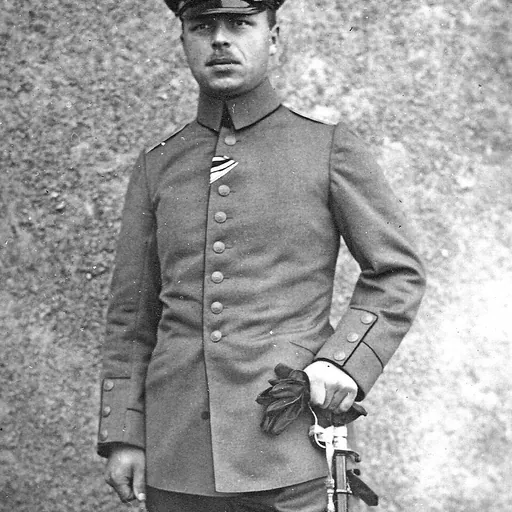
About Franz Dischinger
Lived 1887 – 1953 (aged 65). Franz Dischinger was a German civil engineer and university teacher.
Franz Dischinger (8 October 1887 - 9 January 1953) was a pioneering German civil and structural engineer, responsible for the development of the modern cable-stayed bridge. He was also a pioneer of the use of prestressed concrete, patenting the technique of external prestressing (where the prestressing bars or tendons are not encased in the concrete) in 1934.
After completing Gymnasium in Karlsruhe, Germany, Dischinger went to the Technische Hoschschule Karlsruhe (now Karlsruhe Institute of Technology) where he studied and received a degree in building engineering. After getting his degree in 1913, he then started working for Dyckerhoff & Widmann A.G., an engineering firm in Germany. In 1928 Dischinger went back to school to receive his doctorate at the Technische Hoschschule Dresden (now TU Dresden), Germany.
In 1922, he designed the Zeiss Planetarium in Jena with Walther Bauersfeld, using a thin-shell concrete roof in the shape of a hemisphere. Their system was subsequently patented, and Dischinger published a paper on the relevant mathematics in 1928.
Since the previous stay and cable bridges in Dischinger's opinion were both flawed technically and disturbing looking, he decided to publish his own cable stayed bridge. This design has been used ever since, more than 100 of these cable stayed bridges have been built.
For the 1938 design of a rail suspension bridge (not built), he had studied historical bridges incorporating inclined stay elements, such as those by Ferdinand Arnodin and John Roebling. He went on to design the 183 m span Strömsund Bridge in Sweden, completed in 1955 and generally considered the first of the modern tradition of cable-stayed bridges, although there had been many isolated examples of the bridge form before then. This employed a steel deck and cables, with large spacings between the stays typical of the early designs. It appears in Strömsund's coat of arms.
Other key works include:
Großmarkthalle, Basel, Switzerland, 1929 (dome roof) Market Hall, Leipzig, Germany, 1930 (polygonal dome roofs) Koblenz bridge, Germany, 1935 (three arch concrete bridge) Aue bridge, Germany, 1936 Cologne Rodenkirchen Bridge, Cologne, Germany, 1954 (with others, including Fritz Leonhardt)
Don’t just read it —
keep it.
Full-length biographies made to live with: read them, listen on the way to work, watch them tonight.
- E-book
- Audio
- Video
Instant download · yours to keep · every purchase keeps this site free
Important facts
People in Franz Dischinger's life
Named in this biography and alive at the same time



Related people
Same field, nearest in time




Contemporaries
People whose lives overlapped Franz Dischinger's




Frequently asked questions
Who was Franz Dischinger?
German civil engineer (1887–1953)
When was Franz Dischinger born?
Franz Dischinger was born on 8 October 1887 in Heidelberg.
When did Franz Dischinger die?
Franz Dischinger died on 9 January 1953 in Berlin.
What was Franz Dischinger's occupation?
Franz Dischinger was a civil engineer and university teacher.
What nationality was Franz Dischinger?
Franz Dischinger was German.
Sources & further reading
Cite this page
APA: Biography.guide. (2026). Franz Dischinger. https://biography.guide/franz-dischinger/
MLA: "Franz Dischinger." Biography.guide, https://biography.guide/franz-dischinger/.
Chicago: "Franz Dischinger." Biography.guide. https://biography.guide/franz-dischinger/.
Data last updated: 2026-09-23 · Spot an error? Report a correction.
Portrait: Wikimedia Commons · author & licence
Page generated 2026-09-27 05:05 UTC