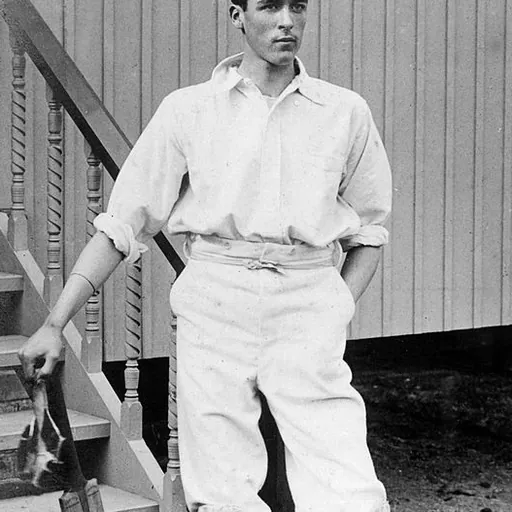
About Frank Woolley
Lived 1887 – 1978 (aged 91). Frank Woolley was a British cricketer.
Frank Edward Woolley (27 May 1887 – 18 October 1978) was an English professional cricketer who is widely regarded as one of the greatest all-rounders in the sport's history. He played for Kent County Cricket Club from 1906 to 1938, and represented England in 64 Test matches.
Woolley was a left-handed batsman and left-arm bowler who varied his pace and style between medium pace and slow left-arm orthodox. He was an outstanding close-in fielder, and remains the only non-wicket-keeper to have held more than 1,000 catches in a first-class career. Woolley was named Wisden Cricketer of the Year in 1911 and was inducted into the ICC Cricket Hall of Fame in 2009.
Early life Woolley was born in Tonbridge, Kent, in 1887, the youngest of four brothers. He was born in the family home at 72 High Street that also included his father Charles's workshop and showroom. Having inherited a cleaning and dyeing business from his own father, Charles developed Woolley's Cycle and Engine Works, which made and repaired bicycles and, later, motor cars. Charles had originally trained as an engineer at a railway works in Ashford, where he met and married his wife, Louise Lewis, the daughter of the work's owner.
The family business was located close to the Angel Ground, the home of Tonbridge Cricket Club and a venue used annually by Kent County Cricket Club for festival matches. In 1899, the ground became the base for the Tonbridge Nursery, a training centre established to develop young professional cricketers for Kent. Players trained at the Nursery formed the core of Kent's four County Championship-winning teams during the early years of Woolley's career.
Woolley developed an interest in cricket at an early age. He played informally with his brothers behind his father's workshop and watched matches at the Angel Ground from a tree overlooking the field. He was also a keen association footballer, playing for Tonbridge and later signing for Tunbridge Wells Rangers F.C. in 1906. By the time Woolley reached his teenage years, his father's business had been developed into a motor vehicle garage and was prospering, allowing Woolley the opportunity to attend the fee-paying Tonbridge School.
His cricketing ability attracted attention as he assisted as a fielder during practice matches at the Angel Ground. This led to him being invited to play in a match to make up numbers by Tom Pawley, Kent's manager. Woolley did not regard himself as academically inclined and declined a place at Tonbridge School, instead leaving formal education at the age of 14.
Cricket career Engaged by Kent
In 1903, when he was 16, Woolley was formally engaged as a young professional by Kent, and trained full time at the Tonbridge Nursery under William McCanlis during the cricket season. His brother Claud, who went on to play for Northamptonshire, joined the Nursery around the same time. Woolley soon impressed McCanlis and the other Nursery coaches.
Wartime service HMS King George V at anchor on the Firth of Forth in 1917. Woolley was attached to the ship in 1918 at North Queensferry. After the outbreak of World War I in August 1914, the English cricket season continued, although public interest declined and the social aspects of the game were reduced. Woolley married in September 1914, shortly after the outbreak of war. His three brothers all joined the Kent Fortress Royal Engineers in 1914, but when Woolley attempted to join them he failed his medical examination. Instead, he went to work in his father's workshop, which had been converted to the manufacture of munitions.
Woolley was subsequently recruited by Jack Hobbs, who was also employed in the munitions industry, to play for Keighley Cricket Club in the Bradford Cricket League. He also made several appearances in exhibition matches, on one occasion scoring a century for a Lancashire XI against a Yorkshire XI in 1916.
Later in 1916, Woolley was accepted for service with the Royal Naval Air Service (RNAS). He began training in November and was posted to Dover in March 1917, where he was attached to a motor boat section. He was promoted to aircraftman first class and in February 1918 was transferred to Felixstowe, serving as the coxswain of a rescue launch.
In April 1918, the RNAS merged with the Royal Flying Corps to form the Royal Air Force (RAF), and Woolley was transferred to the new service. He was posted to North Queensferry, Scotland, where he worked under Admiral Sir John de Robeck. A keen cricketer, Robeck attached Woolley to his flagship, HMS King George V. Robeck arranged a number of cricket matches, including games held at the home of Lord Rosebery, a former captain of Surrey. During the summer of 1918, Woolley played in several more exhibition matches, including appearances for England against a Dominions XI and for teams organised by Pelham Warner.
Woolley was transferred to the RAF Reserve in January 1919 and was formally discharged in 1920. In 1922, he played a single first-class match for the Royal Air Force cricket team.
Later life and family
Woolley married Sybil Fordham, the daughter of a veterinary surgeon from Ashford, in 1914. The couple had three children: one son and two daughters. Prior to his retirement from professional cricket, Woolley purchased a bungalow in Hildenborough, on land sufficiently large to allow him to establish a cricket school. He coached cricket at The King's School, Canterbury, but following the outbreak of the Second World War the school was evacuated to Cornwall. Woolley subsequently moved to Cliftonville, where he joined the Local Defence Volunteers.
Woolley's only son, Richard, was killed while serving as a merchant seaman on board SS Beaverford during Convoy HX 84 in November 1940. After the war, he moved to Tunbridge Wells, where he continued to coach at The King's School for a further ten years. In the early 1950s, he also spent a summer coaching cricket at Butlin's holiday camp. Woolley played twice for Old England teams, was elected a life member of both Kent County Cricket Club and Marylebone Cricket Club (MCC), and was an inaugural member of the ICC Cricket Hall of Fame when it was established in 2009.
Don’t just read it —
keep it.
Full-length biographies made to live with: read them, listen on the way to work, watch them tonight.
- E-book
- Audio
- Video
Instant download · yours to keep · every purchase keeps this site free
Important facts
People in Frank Woolley's life
Named in this biography and alive at the same time




Related people
Same field, nearest in time




Contemporaries
People whose lives overlapped Frank Woolley's



Frequently asked questions
Who was Frank Woolley?
Cricket player of England. (1887-1978)
When was Frank Woolley born?
Frank Woolley was born on 27 May 1887 in Tonbridge.
When did Frank Woolley die?
Frank Woolley died on 18 October 1978 in Chester.
What was Frank Woolley's occupation?
Frank Woolley was a cricketer.
What nationality was Frank Woolley?
Frank Woolley was British.
Sources & further reading
Cite this page
APA: Biography.guide. (2026). Frank Woolley. https://biography.guide/frank-woolley/
MLA: "Frank Woolley." Biography.guide, https://biography.guide/frank-woolley/.
Chicago: "Frank Woolley." Biography.guide. https://biography.guide/frank-woolley/.
Data last updated: 2026-09-24 · Spot an error? Report a correction.
Portrait: Wikimedia Commons · author & licence
Page generated 2026-09-27 05:09 UTC