
Frank Marshall Davis
United States writer, political and labor movement activist
About Frank Marshall Davis
Lived 1905 – 1987 (aged 81). Frank Marshall Davis was an American journalist and poet.
Frank Marshall Davis (December 31, 1905 – July 26, 1987) was an American writer, poet, political and labor activist and businessman.
Davis began his career writing for African American newspapers in Chicago. He moved to Atlanta, where he became the editor of the paper he turned into the Atlanta Daily World. He later returned to Chicago. During this time, he was outspoken about political and social issues, while also covering topics that ranged from sports to music. His poetry was sponsored by the Works Progress Administration (WPA) under President Franklin D. Roosevelt's New Deal programs. He also played a role in the South Side Writers Group in Chicago, and is considered among the writers of the Black Chicago Renaissance. His parents divorced, and Davis grew up living with his mother and stepfather, and with his maternal grandparents. he graduated from Arkansas City High School (Kansas). In 1923, at age 17, he attended Friends University. From 1924 to 1927, and again in 1929, he attended Kansas State Agricultural College, now Kansas State University.
When Davis entered Kansas State, twenty-five other African-American students were enrolled. Kansas was segregated by custom, if not by law. Davis studied industrial journalism. He began to write poems as the result of a class assignment, and was encouraged by an English literature instructor to continue his poetry writing.
Early career
In 1927, Davis moved to Chicago, a destination of tens of thousands of African Americans during the Great Migration. He worked variously for the Chicago Evening Bulletin, the Chicago Whip, and the Gary American, all African American newspapers. He also wrote free-lance articles and short stories for African American magazines. During this time Davis began to write poetry seriously, including his first long poem, entitled Chicago's Congo, Sonata for an Orchestra.
In 1931, Davis moved to Atlanta to become an editor of a twice-weekly paper. Later that year he became the paper's managing editor. In 1932 the paper, renamed as the Atlanta Daily World became the nation's first successful black daily newspaper. a news service founded in 1919 for black newspapers. Eventually, Davis became executive editor of the ANP. He held the position until 1947. While in Chicago, Davis also started a photography club, worked for numerous political parties, and participated in the League of American Writers. Davis was an avid photographer, and inspired writer Richard Wright's interest in the field.
Davis wrote that his photography consisted in large part of nudes because "the female body fascinates me, both aesthetically and emotionally."
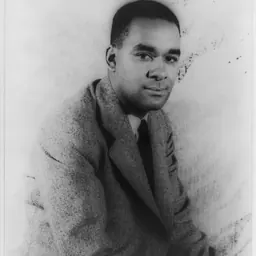
Davis, Richard Wright, Margaret Walker, and others were part of the South Side Writers Group, which met regularly beginning in 1936 to critique each other's work. They were part of what became known as the Black Chicago Renaissance.
Davis also worked as a sports reporter, in particular covering the rivalry between African-American boxer Joe Louis and the German Max Schmeling. He and other writers portrayed their confrontation as democracy and equality vs. fascism. Davis used his journalism to call for integration of the sports world. He believed that sports was a field in which men could break the color bar, and was a way to reach out to a working class.
He began to work on community organizing, starting a Chicago labor newspaper, The Star, toward the end of World War II. The paper's goal was to "promote a policy of cooperation and unity between Russia and the United States" seeking to "[avoid] the red-baiting tendencies of the mainstream press." After World War II, Americans became suspicious of the Soviet Union, a former ally, after it extended its control over Eastern Europe, and fears were raised about the influence of Communism in the US.
In 1945, Davis taught one of the first jazz history courses in the United States, at the Abraham Lincoln School in Chicago. In 1948, with the encouragement of authors such as Richard Wright and Margaret Walker, Davis published a collection of poems, entitled 47th Street: Poems. The collection chronicled the varied life of African Americans on Chicago's South Side.
Davis promoted the ideal of a "raceless" society, based on his belief that race as a biological or social construct was illogical and a fallacy. Davis was a member of the Civil Rights Congress in 1947–1948,
In Livin' the Blues, Davis wrote of the period 1935 to 1948, "I worked with all kinds of groups. I made no distinction between those labeled Communist, Socialist or merely liberal. My sole criterion was this: Are you with me in my determination to wipe out white supremacy?" Some libraries removed his books, and he was the subject of FBI investigations in the 1940s and 1950s.
Career in Hawaii
In 1948, Davis and his second wife, whom he had married in 1946, moved to Honolulu, Hawaii. In a 1974 interview with Black World/Negro Digest, Davis said they had been attracted to the place because of a magazine article his wife had read. In Hawaii, Davis wrote a weekly column, called "Frank-ly Speaking," for the Honolulu Record, a labor paper published by the International Longshore and Warehouse Union (ILWU). Davis's early columns covered labor issues, but he broadened his scope to write about cultural and political issues, especially racism. He also explored the history of blues and jazz in his columns. Davis published little poetry between 1948 and 1978, when his final volume, Awakening, and Other Poems, was published.
In 1968, Davis wrote a pornographic novel, titled Sex Rebel: Black, publishing it under the pseudonym Bob Greene. Three works were published posthumously: Livin' the Blues: Memories of a Black Journalist and Poet (1992), Black Moods: Collected Poems (2002), and Writings of Frank Marshall Davis: A Voice of the Black Press (2007).
Personal life
Davis was married to Thelma Boyd, his first wife, for 13 years. For a time, while Davis worked in Chicago, Thelma lived and worked in Atlanta Davis had a son, Mark, and four daughters: Lynn, Beth, Jeanne, and Jill.
Analysis of literary work
Davis said he was captivated by "the new revolutionary style called free verse. Sonnets and, in fact, all rhyme held little interest for" him. Stacy I. Morgan states that in his work, Davis "delighted in contradicting reader expectations".
Legacy and impact
Kathryn Waddell Takara said of Davis's political and literary legacy:
Davis has been cited as being an influence on poet and publisher Dudley Randall. Through exposure provided by Randall, Stephen Henderson and Margaret Taylor Goss Burroughs, Davis influenced the Black Arts Movement. In 2018, he was inducted into the Chicago Literary Hall of Fame.
In Barack Obama's memoir Dreams from My Father (1995), Davis is referred to as a friend in Hawaii of Obama's maternal grandfather Stanley Dunham; Obama later identified the man as Davis. Obama said Davis recounted that he and Stanley Dunham had grown up 50 miles apart in Kansas, near Wichita, although they did not meet until living in Hawaii. Davis described the way Kansas race relations were back then, including Jim Crow restrictions, and his belief that there had been little progress since then. As Obama remembered, "It made me smile, thinking back on Frank and his old Black Power, dashiki self. In some ways he was as incurable as my mother, as certain in his faith, living in the same sixties time warp that Hawaii had created." Obama also remembered Frank Davis later in life after taking a job in South Chicago as a community organizer. One day Obama visited areas where Davis had lived, writing, "I imagined Frank in a baggy suit and wide lapels, standing in front of the old Regal Theatre, waiting to see Duke or Ella emerge from a gig."
Works Selected works Black Man's Verse; Black Cat, (Chicago, IL), 1935. I Am the American Negro, Black Cat, (Chicago, IL), 1937, Through Sepia Eyes; Black Cat, (Chicago, IL), 1938. 47th Street: Poems; Decker (Prairie City, IL), 1948. Black Man's Verse; Black Cat (Skokie, IL), 1961. Sex Rebel: Black (Memoirs of a Gash Gourmet), (written under pseudonym "Bob Greene"); Greenleaf Publishing Company (Evanston, IL), 1968. Jazz Interludes: Seven Musical Poems; Black Cat (Skokie, IL), 1977. Awakening and Other Poems; Black Cat (Skokie, IL), 1978. Livin' the Blues: Memoirs of a Black Journalist and Poet, ed. John Edgar Tidwell; University of Wisconsin Press, 1992, Black Moods: Collected Poems, ed. John Edgar Tidwell; University of Illinois Press, 2002, Writings of Frank Marshall Davis: A Voice of the Black Press, ed. by John Edgar Tidwell; University Press of Mississippi, 2007. ;
Don’t just read it —
keep it.
Full-length biographies made to live with: read them, listen on the way to work, watch them tonight.
- E-book
- Audio
- Video
Instant download · yours to keep · every purchase keeps this site free
Important facts
People in Frank Marshall Davis's life
Named in this biography and alive at the same time




Related people
Same field, nearest in time



Contemporaries
People whose lives overlapped Frank Marshall Davis's





Frequently asked questions
Who was Frank Marshall Davis?
United States writer, political and labor movement activist (1905–1987)
When was Frank Marshall Davis born?
Frank Marshall Davis was born on 31 December 1905 in Arkansas City.
When did Frank Marshall Davis die?
Frank Marshall Davis died on 26 July 1987 in Honolulu.
What was Frank Marshall Davis's occupation?
Frank Marshall Davis was a journalist and poet.
What nationality was Frank Marshall Davis?
Frank Marshall Davis was American.
Sources & further reading
· Wikipedia: Frank Marshall Davis
· DBpedia: Frank Marshall Davis
Cite this page
APA: Biography.guide. (2026). Frank Marshall Davis. https://biography.guide/frank-marshall-davis/
MLA: "Frank Marshall Davis." Biography.guide, https://biography.guide/frank-marshall-davis/.
Chicago: "Frank Marshall Davis." Biography.guide. https://biography.guide/frank-marshall-davis/.
Data last updated: 2026-09-20 · Spot an error? Report a correction.
Page generated 2026-09-27 05:02 UTC