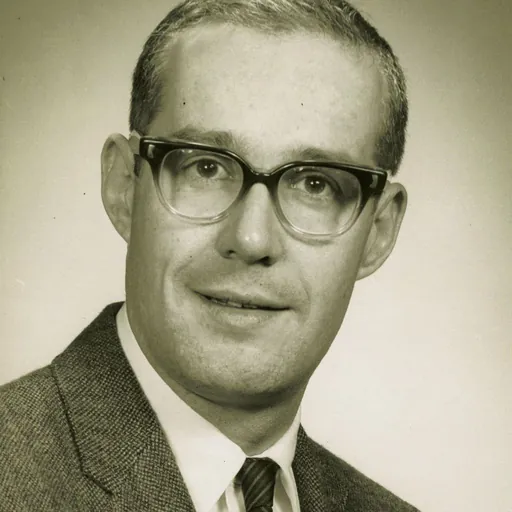
About Frank Hole
Born 1931. Frank Hole is an American archaeologist, prehistorian, anthropologist and university teacher.
Frank Hole (born 1931) is an American Near Eastern archaeologist known for his work on the prehistory of Iran, the origins of food production, and the archaeology of pastoral nomadism. He is C. J. MacCurdy Professor Emeritus of Anthropology at Yale University.
Education and career Hole studied at Cornell College (BA, 1953), Harvard University (1957–58), and the University of Chicago (MA, 1958; PhD, 1961). He worked at Rice University from 1961 to 1980, and was a full professor from 1968. In 1980, he moved to Yale University, where he served as the C. J. MacCurdy Professor of Anthropology (1996–2005) and the head of the division of anthropology at the Peabody Museum (1996–2005). He retired in 2005 and was appointed a senior research scientist and professor emeritus. He has held visiting professorships at the University of Colorado (1971), Yale (1972–1973), and Masaryk University.
Hole was elected a Fellow of the American Association for the Advancement of Science in 1966, and a member of the Connecticut Academy of Science and Engineering in 1983. and a Farabi International Award in 2011.
Research on Iranian prehistory At Chicago, Hole studied under Robert Braidwood, who was investigating the origins of food production in Southwest Asia. In 1959, when political instability prevented him from returning to his excavations at Jarmo in Iraqi Kurdistan, Braidwood began working across the border in the Iranian part of the Zagros Mountains. Hole joined Braidwood's team, which in 1959 conducted the first systematic surveys of early prehistory in Iran, in the region of Kermanshah, and the following year conducted excavations at Asiab, Sarab, and Warwasi.
Between 1961 and 1965, Hole and Flannery conducted a number of surveys in Lurestan and Khuzestan, and excavated at Gar Arjeneh, Yafteh, Pasangar, Ghamari, Kunji Cave, Ali Kosh, and (with James Neely) Tepe Sabz. These sites produced what was, at the time, some of the earliest evidence for the plant and animal domestication in the world.
He is also known for his pioneering work on the archaeology of pastoral nomads in the Near East, in particular his ethnoarchaeology of Luri pastoralists in western Iran.
Don’t just read it —
keep it.
Full-length biographies made to live with: read them, listen on the way to work, watch them tonight.
- E-book
- Audio
- Video
Instant download · yours to keep · every purchase keeps this site free
Important facts
Related people
Same field, nearest in time

Contemporaries
People whose lives overlapped Frank Hole's

Frequently asked questions
Who is Frank Hole?
American archaeologist and prehistorian (1931-)
When was Frank Hole born?
Frank Hole was born on 13 November 1931 in Oak Park.
What is Frank Hole's occupation?
Frank Hole is an archaeologist, prehistorian, anthropologist and university teacher.
What nationality is Frank Hole?
Frank Hole is American.
Sources & further reading
Cite this page
APA: Biography.guide. (2026). Frank Hole. https://biography.guide/frank-hole/
MLA: "Frank Hole." Biography.guide, https://biography.guide/frank-hole/.
Chicago: "Frank Hole." Biography.guide. https://biography.guide/frank-hole/.
Data last updated: 2026-09-20 · Spot an error? Report a correction.
Page generated 2026-09-27 05:10 UTC