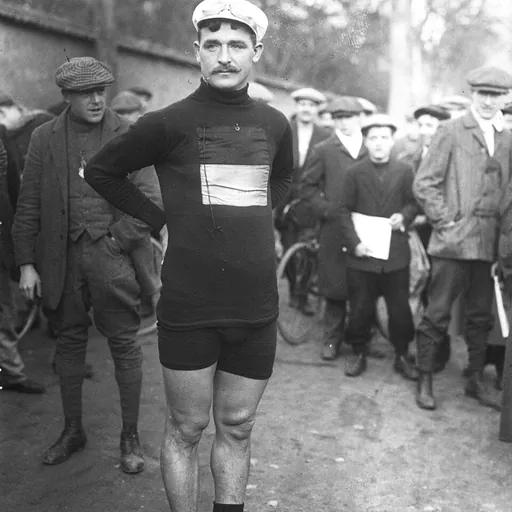
About François Faber
Lived 1887 – 1915 (aged 28). François Faber was a Luxembourgish and French sport cyclist.
François Faber (; 26 January 1887 – 9 May 1915) was a Luxembourgish racing cyclist. He was born in France. He was the first foreigner to win the Tour de France in 1909, and his record of winning 5 consecutive stages still stands. Faber was known for his long solos; he is the only rider in Tour de France history to lead solo more than 1000 km.
Origins Faber's father, Jean-François, was born in Wiltz, Luxembourg, which gave his son Luxembourgish nationality. His mother, Marie-Paule, was born in Lorraine. François Faber had a Luxembourgish passport but lived in France and considered himself French. His half-brother was another cyclist, Ernest Paul.
Faber worked as a furniture-remover and as a docker when he raced as an amateur.
Racing career Faber was a professional from 1906 to 1914. He won 27 races. His size— and —and his suburb of Paris gave him the nickname The Giant of Colombes. He rode for Labor in 1906 and 1907, moved to Peugeot in 1908, then Alcyon from 1909 to 1911. He joined Automoto for 1912 before returning to Peugeot in 1913 and 1914.
He rode the Tour de France for the first time in 1906 but didn't finish and the next year, he came seventh. In 1908 as part of the all-conquering Peugeot team, he finished second, winning four stages.
He dominated the 1909 Tour de France, winning five consecutive stages, which is still a record. The 1909 Tour had the worst weather the race had seen. Fifty riders dropped out in six days when rain, snow, thick mud, frost and deeply rutted, unsurfaced roads dogged the race from 7 to 13 July. The worse things got, the better Faber rode. He led the race alone for 200 km to win the 398 km stage from Roubaix to Metz on the second day.
The third day started at three degrees above freezing and the weather became even worse. The race set off for Belfort and again Faber broke clear going over the Ballon d'Alsace and, after leading alone for 110 km, he finished covered in mud with his main challenger, Gustave Garrigou, 33 minutes behind.
Still the weather got worse as the next stage left at 2am to ride to Lyon. Faber's riding attracted a crowd of 3,000 to see him leave and what was said to be 20,000 to see him finish. He won again after riding the last 62 km alone after a day of potholes and knee-high water. He climbed the Col de Porte in a wind that twice blew him off his bike and being knocked down by a horse. His chain broke on the approach to Lyon and he ran a kilometre to the finish, pushing his bike. He won all five stages from Metz to Nice, all of them by himself,
Lucien Petit-Breton said of him: quote|I told you he'd be head and shoulders better. Not only did he show I was right but he let his pals Garrigou, Alavoine, Duboc and van Hauwaert take the first six places. And he went even further [il a même forcé la note] in giving seventh place to his half-brother! I can still recall when he started, in 1906, with the isolés. He set off from the start with his handlebars up high and he stayed at the back of the group all the time, riding on the wheel of the best riders. He was young, with no confidence in himself. His only wish was to be the last of the isolés to stay with the champions. Sometimes he stopped at a bar and ate his sandwiches as he waited for his 'colleagues', to finish the day in their company, because he didn't like being alone. After last year's Tour, I hadn't any doubts about his immense possibilities. Paris–Brussels, Bordeaux–Paris, Sedan-Brussels, Paris–Tours twice, Paris–Roubaix and the Giro di Lombardia.
Death Faber joined the French Foreign Legion when the First World War broke out. He was assigned to the 2nd Marching Regiment of the 1st Foreign Regiment, at Bayonne on 22 August 1914. He was promoted to corporal. On 9 May 1915, the first day of the Battle of Artois at Carency near Arras he received a telegram saying his wife had given birth to a daughter. One story says that, cheering, he jumped out of the trench and was killed by a German bullet. Another, more commonly accepted, is that he was shot while carrying an injured colleague back from no-man's land during fighting between Carency and Mont-Saint-Éloi. His regiment lost 1,950 of 2,900 in their attack. Faber was posthumously awarded the Médaille militaire.
The GP François Faber, a small race in Luxembourg, is named after him.
There is a plaque in his memory in the church of Notre Dame de Lorette in the French national war cemetery near Arras.
On 28 March 2015, a new plaque in his memory was unveiled in Mont-Saint-Éloi, close to where he died. It was unveiled by Faber's grandson, Jacques Pallut and the town's mayor, Jean-Pierre Bavière.
Career achievements Major results
1908 1st Giro di Lombardia 2nd Overall Tour de France 1st Stages 3, 4, 8 & 12 1909
1st Stages 2, 3, 4, 5, 6, & 10 1st Paris–Tours 1st Paris–Brussels 1st Sedan-Brussels 1910 1st Paris–Tours 2nd Overall Tour de France 1st Stages 2, 4 & 7 1911 1st Bordeaux–Paris Tour de France 1st Stages 3 & 6 1913 1st Paris–Roubaix Tour de France 1st Stages 10 & 13 1st Stage 2 Tour of Belgium 1914 Tour de France 1st Stages 13 & 14
Grand Tour general classification results timeline
Don’t just read it —
keep it.
Full-length biographies made to live with: read them, listen on the way to work, watch them tonight.
- E-book
- Audio
- Video
Instant download · yours to keep · every purchase keeps this site free
Important facts
People in François Faber's life
Named in this biography and alive at the same time

Related people
Same field, nearest in time




Contemporaries
People whose lives overlapped François Faber's




Frequently asked questions
Who was François Faber?
Luxembourgian racing cyclist (1887–1915)
When was François Faber born?
François Faber was born on 26 January 1887 in Aulnay-sur-Iton.
When did François Faber die?
François Faber died on 9 May 1915 in Carency, Mont-Saint-Éloi.
What was François Faber's occupation?
François Faber was a sport cyclist.
What nationality was François Faber?
François Faber was Luxembourgish and French.
Sources & further reading
Cite this page
APA: Biography.guide. (2026). François Faber. https://biography.guide/francois-faber/
MLA: "François Faber." Biography.guide, https://biography.guide/francois-faber/.
Chicago: "François Faber." Biography.guide. https://biography.guide/francois-faber/.
Data last updated: 2026-09-20 · Spot an error? Report a correction.
Portrait: Wikimedia Commons · author & licence
Page generated 2026-09-27 04:58 UTC