
François d'Aguilon
Architect, mathematician, physicist
About François d'Aguilon
Lived 1567 – 1617 (aged 50). François d'Aguilon was a mathematician, catholic priest, architect and physicist.
François d'Aguilon (; also d'Aguillon or in Latin Franciscus Aguilonius) (4 January 1567 – 20 March 1617) was a Jesuit, mathematician, physicist, and architect from the Spanish Netherlands.
D'Aguilon was born in Brussels; his father was a secretary to Philip II of Spain. The notable geometers educated at this school included Jean-Charles della Faille, André Tacquet, and Theodorus Moretus. It included one of the first studies of binocular vision. It also gave the names we now use to stereographic projection and orthographic projection, although the projections themselves were likely known to Hipparchus. This book inspired the works of Desargues and Christiaan Huygens.
He died in Antwerp, aged 50.
Six Books of Optics Francois d'Aguilon's Six Books of Optics concerns geometrical optics, which at the time in the Jesuit school was a subcategory of geometry. He taught logic, syntax, and theology while being charged with organizing the teaching of geometry and science which would be useful for geography, navigation, architecture and the military arts in Belgium. His superiors wanted him to synthesize the work of Euclid, Alhazen, Vitello, Roger Bacon and others. Although he died before completing the book, it still consists of six in-depth books, called Opticorum Libri Sex.
Perception and the horopter D'Aguilon extensively studied stereographic projection, which he wanted to use a means to aid architects, cosmographers, navigators and artists. For centuries, artists and architects had sought formal laws of projection to place objects on a screen. Aguilon's Opticorum libri sex successfully treated projections and the errors in perception. D'Aguillon adopted Alhazen's theory that only light rays orthogonal to the cornea and lens surface are clearly registered. Aguilon was the first to use the term horopter, which is the line drawn through the focal point of both eyes and parallel to the line between the eyes. In other words, it describes how only objects on the horopter are seen in their true location. He then built an instrument to measure the spacing of double images in the horopter as he saw fit.
D'Aguilon expanded on the horopter by saying in his book:
At first glance, it seems that Aguillon discovered the geometrical horopter more than 200 years before Prevost and Vieth and Muller. The horopter was then used by architect Girard Desargues, who in 1639 published a remarkable treatise on the conic sections, emphasizing the idea of projection.
Similarity to other theorists In Aguilon's book there are elements of perspectivities as well as the stereographic projections of Ptolemy and Hipparchus. Unaware that Johannes Kepler had already published optical theories years before him, Aguilon decided to share his insights on geometric optics. At the age of 20, the Dutch poet Constantijn Huygens read Aguilon's and was enthralled by it. He later said that it was the best book he had ever read in geometrical optics, and he thought that Aguilon should be compared to Plato, Eudoxus and Archimedes. In fact the title of Constantijn Huygens' first publication imitated Aguilon's title (omitting letters p and c): Otiorum Libri Sex (1625).
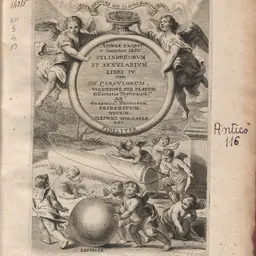
Accompanying art In Aguilon's book the beginning of each section had works of the Flemish Baroque painter, Peter Paul Rubens. The frontispiece at the beginning of the book shows an eagle, referring to Aguilon's name and a variety of optical and geometrical images. On either side of the title stands Mercury holding the head of Argus with a hundred eyes, and Minerva holding a shield reflecting the head of Medusa. Then, at the beginning of each of six sections are Rubens' drawings describing Aguilon's experiments, one of which is the first known picture of a photometer This is one of six experiments drawn by Rubens and shows how intensity of light varies with the square of distance from the source. The experiment was later taken up by Mersenne and another Jesuit, Claude de Chales, and eventually led to Bouguer's more famous photometer. It is evident, from the detail that he put into his drawings, how enthused Rubens was about the subject matter, perspective geometry and optical rules.
Don’t just read it —
keep it.
Full-length biographies made to live with: read them, listen on the way to work, watch them tonight.
- E-book
- Audio
- Video
Instant download · yours to keep · every purchase keeps this site free
Important facts
more
Franciscus Aguilonius, Franciscus de AguilonPeople in François d'Aguilon's life
Named in this biography and alive at the same time



Related people
Same field, nearest in time




Contemporaries
People whose lives overlapped François d'Aguilon's


Frequently asked questions
Who was François d'Aguilon?
architect, mathematician, physicist (1567-1617)
When was François d'Aguilon born?
François d'Aguilon was born on 4 January 1567 in Brussels metropolitan area.
When did François d'Aguilon die?
François d'Aguilon died on 20 March 1617 in Antwerp.
What was François d'Aguilon's occupation?
François d'Aguilon was a mathematician, catholic priest, architect and physicist.
What nationality was François d'Aguilon?
François d'Aguilon's recorded nationality: Flanders.
Sources & further reading
· Wikipedia: François d'Aguilon
Cite this page
APA: Biography.guide. (2026). François d'Aguilon. https://biography.guide/francois-d-aguilon/
MLA: "François d'Aguilon." Biography.guide, https://biography.guide/francois-d-aguilon/.
Chicago: "François d'Aguilon." Biography.guide. https://biography.guide/francois-d-aguilon/.
Data last updated: 2026-09-20 · Spot an error? Report a correction.
Page generated 2026-09-27 05:20 UTC