
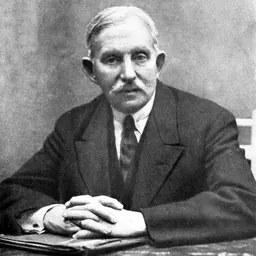
Franco Rasetti
Italian nuclear physicist, paleontologist, and university teacher
About Franco Rasetti
Lived 1901 – 2001 (aged 100). Franco Rasetti was an Italian botanist, physicist, paleontologist, nuclear physicist, university teacher and geologist.
Life and career Rasetti was born in Castiglione del Lago, Italy. He earned a Laurea in physics at the University of Pisa in 1923, and Fermi invited him to join his research group at the University of Rome.
Enrico Fermi and his research group (the Via Panisperna boys) in the courtyard of Rome University's Physics Institute in Via Panisperna, about 1934. Franco Rasetti is the second from right
In 1928-1929 during a stay at the California Institute of Technology (Caltech), he carried out experiments on the Raman effect. He measured a spectrum of dinitrogen in 1929 which provided the first experimental evidence that the atomic nucleus is not composed of protons and electrons, as was incorrectly believed at the time.
In 1930, he was appointed to the chair in spectroscopy at the Physics Institute of the University of Rome, at that time still located in Via Panisperna. His colleagues included Oscar D'Agostino, Emilio Segrè, Edoardo Amaldi, Ettore Majorana and Enrico Fermi, as well as the institute's director Orso Mario Corbino. Rasetti remained in this position until 1938.
Rasetti was one of Fermi's main collaborators in the study of neutrons and neutron-induced radioactivity. In 1934, he participated in the discovery of the artificial radioactivity of fluorine and aluminium which would be critical in the development of the atomic bomb.
In 1939 the advance of fascism and the deteriorating Italian political situation led him to leave Italy, following the example of his colleagues Fermi, Segré and Bruno Pontecorvo. With Fermi he had discovered the key to nuclear fission, but unlike many of his colleagues, he refused for moral reasons to work on the Manhattan Project.
From 1939 to 1947, he taught at Laval University in Quebec City (Canada), where he was founding chairman of the physics department. He devoted himself to geology, paleontology, entomology, and botany, becoming one of the most authoritative scholars of the Cambrian geological era.
He died in Waremme, Belgium at the age of 100. The Nature obituary noted that Rasetti was one of the most prolific generalists whose work and writing are noted for the elegance, simplicity and beauty.
Raman spectroscopy and the model of the atomic nucleus After the discovery of Raman scattering by organic liquids, Rasetti decided to study the same phenomenon in gases at high pressure during his stay at Caltech in 1928–29. The spectra showed vibrational transitions with rotational fine structure. In the homonuclear diatomic molecules H2, N2 and O2, Rasetti found an alternation of strong and weak lines. This alternation was explained by Gerhard Herzberg and Walter Heitler as a consequence of nuclear spin isomerism.
For dihydrogen, each nucleus is a proton of spin 1/2, so that it can be shown using quantum mechanics and the Pauli exclusion principle that the odd rotational levels are more populated than the even levels. The transitions originating from odd levels are therefore more intense as observed by Rasetti. In dinitrogen, however, Rasetti observed that the lines originating from even levels are more intense.
This result was difficult to understand at the time, however, because the neutron had not yet been discovered, and it was thought that the 14N nucleus contains 14 protons and 7 electrons, or an odd number (21) of particles in total which would correspond to a half-integral spin.
Awards In 1952 he was awarded the Charles Doolittle Walcott Medal by the National Academy of Sciences for his contributions to Cambrian paleontology.
Don’t just read it —
keep it.
Full-length biographies made to live with: read them, listen on the way to work, watch them tonight.
- E-book
- Audio
- Video
Instant download · yours to keep · every purchase keeps this site free
Important facts
People in Franco Rasetti's life
Named in this biography and alive at the same time


Related people
Same field, nearest in time


Contemporaries
People whose lives overlapped Franco Rasetti's


Frequently asked questions
Who was Franco Rasetti?
Italian nuclear physicist, paleontologist, and university teacher (1901–2001)
When was Franco Rasetti born?
Franco Rasetti was born on 10 August 1901 in Castiglione del Lago.
When did Franco Rasetti die?
Franco Rasetti died on 5 December 2001 in Waremme.
What was Franco Rasetti's occupation?
Franco Rasetti was a botanist, physicist, paleontologist, nuclear physicist, university teacher and geologist.
What nationality was Franco Rasetti?
Franco Rasetti was Italian.
Sources & further reading
Cite this page
APA: Biography.guide. (2026). Franco Rasetti. https://biography.guide/franco-rasetti/
MLA: "Franco Rasetti." Biography.guide, https://biography.guide/franco-rasetti/.
Chicago: "Franco Rasetti." Biography.guide. https://biography.guide/franco-rasetti/.
Data last updated: 2026-09-20 · Spot an error? Report a correction.
Page generated 2026-09-27 05:32 UTC