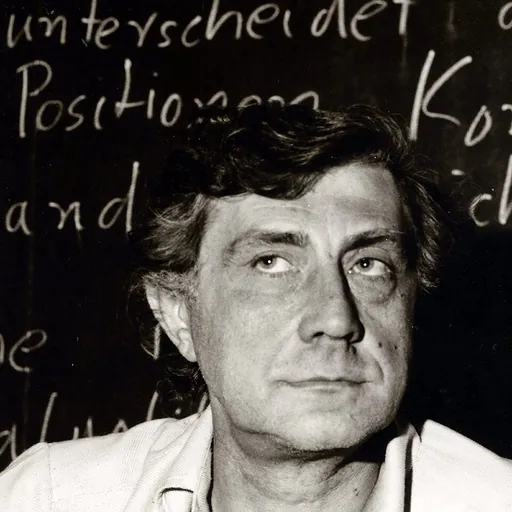
Franco Basaglia
Italian psychiatrist and neurologist
About Franco Basaglia
Lived 1924 – 1980 (aged 56). Franco Basaglia was an Italian psychiatrist, neurologist, anthropologist, existential therapist and writer, known for Basaglia Law, Democratic Psychiatry and Italian psychiatric reform.
Franco Basaglia (; 11 March 1924 29 August 1980) was an Italian psychiatrist, neurologist, professor, and disability advocate who proposed the dismantling of psychiatric hospitals, pioneer of the modern concept of mental health, Italian psychiatry reformer, figurehead and founder of Democratic Psychiatry, architect, and principal proponent of Law 180, which abolished mental hospitals in Italy. He is considered to be the most influential Italian psychiatrist of the 20th century.
He died in Venice.
Views According to Renato Piccione, the intellectual legacy of Franco Basaglia can be divided into three periods: university period which initiated the process of criticizing psychiatry as "science" that ought to cure and liberate a person but, in fact, oppresses them; institutional negation which coincides with experience in Gorizia (1962–1968); deinstitutionalization which coincides with direction of experience in Trieste (1971–1979).
When Basaglia arrived at Gorizia, he was revolted by what he observed as the conventional regime of institutional 'care': locked doors only partly successful in muffling the weeping and screams of the patients, many of them lying nude and powerless in their excrement. And Basaglia observed the institutional response to human suffering: physical abuse, straitjackets, ice packs, bed ties, ECT and insulin-coma shock therapies to 'quiet' the melancholy and the terrified, and to strike terror in the agitated and the difficult.
Basaglia insisted that much in the inveterate stereotypes of madness was actually the consequence of institutional conditions, but not a real danger which the walls of a mental hospital had been required to contain. He considered psychiatric hospital as an oppressive, locked and total institution in which prison-like, punitive rules are applied, in order to gradually eliminate its own contents; and patients, doctors and nurses are all subjected (at different levels) to the same process of institutionalism.
Basaglia recognized that many of the characteristics of his patients which were believed to be inherent in their mental illness, such as the vacant stares and the repetitive gestures and movements, appeared to dissolve as the patients left the confines of the asylum.
Basaglia and his followers believed that psychiatry was used as the provider to the establishment of scientific support for social control. In this report Basaglia stated that "the psychiatrist of today seems to have discovered, suddenly, that the first step towards the cure of the patient is his return to liberty of which, until now, the psychiatrist himself had deprived him" and that "it is true that the discovery of liberty is the most obvious that Psychiatry could reach." In conclusion, Basaglia tried to fix some points in an attempt to form a lever for discovering liberty: ('The Institution Denied'), edited by Franco Basaglia, was published. Widely read all over Italy, this book not only documented and analyzed the changes at Gorizia but also carried anti-institutional debate into other areas: factories, universities and schools.
Giovanna Russo and Francesco Carelli state that back in 1978 the Basaglia reform perhaps could not be fully implemented because society was unprepared for such an avant-garde and innovative concept of mental health.
British clinical psychologist Richard Bentall argues that after Franco Basaglia had persuaded the Italian government to pass Law 180, which made new hospitalizations to large mental hospitals illegal, the results were controversial. In the following decade many Italian doctors complained that the prisons had become depositories for the seriously mentally ill, and that they found themselves "in a state psychiatric-therapeutic impotence when faced with the uncontrollable paranoid schizophrenic, the agitated-meddlesome maniac, or the catatonic". These complaints were seized upon psychiatrists elsewhere, eager to exhibit the foolishness of abandoning conventional ways. This reform was introduced amongst great enthusiasm and bitter criticism, hostility and perplexity, critical and sometimes unconditional support.
Francine Saillant and Serge Genest assert that Basaglia's reform of psychiatry in Italy, a renewed vision of Italian society, and radical critique of public institutions made him one of Italy's greatest, most progressive intellectuals and a leading figure of the second half of the 20th century.
Don’t just read it —
keep it.
Full-length biographies made to live with: read them, listen on the way to work, watch them tonight.
- E-book
- Audio
- Video
Instant download · yours to keep · every purchase keeps this site free
Important facts
People in Franco Basaglia's life
Named in this biography and alive at the same time


Related people
Same field, nearest in time


Contemporaries
People whose lives overlapped Franco Basaglia's


Frequently asked questions
Who was Franco Basaglia?
Italian psychiatrist and neurologist (1924-1980)
When was Franco Basaglia born?
Franco Basaglia was born on 11 March 1924 in Venice.
When did Franco Basaglia die?
Franco Basaglia died on 29 August 1980 in Venice.
What was Franco Basaglia's occupation?
Franco Basaglia was a psychiatrist, neurologist, anthropologist, existential therapist and writer.
What was Franco Basaglia known for?
Franco Basaglia was known for Basaglia Law, Democratic Psychiatry and Italian psychiatric reform.
What nationality was Franco Basaglia?
Franco Basaglia was Italian.
Sources & further reading
Cite this page
APA: Biography.guide. (2026). Franco Basaglia. https://biography.guide/franco-basaglia/
MLA: "Franco Basaglia." Biography.guide, https://biography.guide/franco-basaglia/.
Chicago: "Franco Basaglia." Biography.guide. https://biography.guide/franco-basaglia/.
Data last updated: 2026-09-22 · Spot an error? Report a correction.
Portrait: Wikimedia Commons · author & licence
Page generated 2026-09-27 05:01 UTC