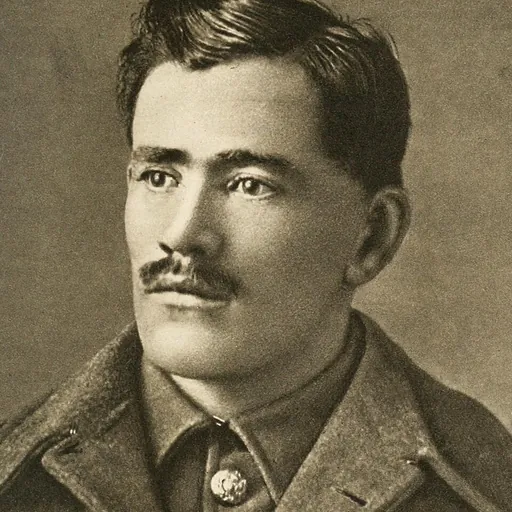
About Francis Ledwidge
Lived 1887 – 1917 (aged 29). Francis Ledwidge was an Irish poet and writer.
Francis Edward Ledwidge (19 August 188731 July 1917) was a 20th-century Irish poet. From Slane, County Meath, and sometimes known as the "poet of the blackbirds", he was later also known as a First World War war poet. He befriended the established writer Lord Dunsany, who helped with the publication of his works. He was killed in action at Ypres in 1917.
Born to a poor family in Slane, County Meath, Ledwidge started writing at an early age and was first published in a local newspaper at the age of 14. Finding work as a labourer and miner, he was also a trade union activist, and a keen patriot and nationalist, associated with Sinn Féin. He became friendly with a local landowner, the writer Lord Dunsany, who gave him a workspace in the library of Dunsany Castle, and introduced him to literary figures including William Butler Yeats, Æ and Katherine Tynan, with whom he had a long-term correspondence. He was elected to a local government post and helped organise the local branch of the Irish Volunteers, while Dunsany edited the first volume of his poetry and helped him secure publication for it.
Despite having sided with the faction of the Irish Volunteers which opposed participation in the war, and against the wishes of Lord Dunsany, he enlisted in the Royal Inniskilling Fusiliers in October 1914 and continued to write poetry on campaign, sending work to Dunsany and to family and other friends. Having been posted to several theatres of the war, he was killed in action in July 1917 during the early phase of the Battle of Passchendaele. At the time of his death, he and Dunsany were in advanced preparation for a second volume of his work, and Dunsany later arranged for a third volume and a collected edition of 122 poems in 1919. Some musical settings of his work were also composed. Further poems, from the archives at Dunsany Castle and some material held by families of relatives and friends, were published by Ledwidge's biographer, Alice Curtayne, in 1974, by enthusiast Hubert Dunn and by the two major Ledwidge memorial groups, in 1997 and 2022 respectively.
A museum of his life and work was opened in his birthplace cottage in 1982 and was the site of multiple events in the decades after; it remains operational as of 2022. Ledwidge was selected as one of twelve prominent war poets - and the only Irish one - for the exhibition Anthem for Doomed Youth at the Imperial War Museum in London in 2002. He has been memorialised at events at the Slane museum, in Ypres and in Inchicore, Dublin, with his official centenary commemoration at Slane in 2017 and his work set to music and performed by Anúna at the former Inchicore barracks the same year. A few Ledwidge manuscripts are held in the National Library of Ireland, and the main surviving collection, including his early works, is in the archives of Dunsany Castle, along with letters. Selections of both handwritten and typed manuscripts have been shown publicly at the Anthem for Doomed Youth exhibition and at a book launch at Slane Castle in 2022, and privately to scholars and members of the Ledwidge Cottage Museum committee.
Early life and work Francis Ledwidge, known to his family as "Frank", was born at Janeville (Baile Sinead) on the eastern edge of Slane, in County Meath, Ireland, the eighth of nine children in a poverty-stricken family. His parents, Patrick Ledwidge and his wife Anne Lynch (1853–1926), believed in giving their children the best education they could afford; however, when Francis was only five, his father Patrick died, which forced his wife and the children out to work at an early age.
Francis left the local national school aged thirteen, and while he continued to educate himself, he worked at what work he could find. Employment included work as a farm hand, road surface mender and supervisor of roadwork, copper miner at Beaupark Mine near Slane (from which post he was sacked for organising a strike for better mining conditions, three years before the general 1913 strike, having been a trade union activist since 1906) and, briefly, a shop assistant in Dublin.
Appointed secretary of the Slane branch of the Meath Labour Union (1913–14) he had aspirations towards permanent white-collar work. He was known for his connections with Sinn Féin. Dunsany later prepared his first collection of poetry Songs of the Fields, which successfully appealed to the expectations of the Irish Literary Revival and its social taste for rural poetry.
Later poetry and war Ledwidge seems to have fitted into Army life well, and rapidly achieved promotion to lance corporal. In 1915, he saw action in the Landing at Suvla Bay during the Gallipoli Campaign, where he suffered severe rheumatism. Having survived huge losses sustained by his company, Ledwidge became ill after a back injury gained during the Battle of Kosturino in Serbia (December 1915), a locale which inspired a number of poems.
Ledwidge was dismayed by the news of the Easter Rising, writing a lament for his friend Thomas MacDonagh, one of the Rising's leaders who was executed in May 1916.
A Roman Catholic military chaplain, Father Devas, was the first on the scene. That night, Father Devas wrote in his diary, "Crowds at Holy Communion. Arranged for service but washed out by rain and fatigues. Walk in rain with dogs. Ledwidge killed, blown to bits; at Confession yesterday and Mass and Holy Communion this morning. R.I.P."
Folklore According to a local folktale, the ghostly apparition of Ledwidge appeared in Navan at the same time he died on the Western front. His ghost greeted a friend before fading away.
Legacy and archives Memorials A stone tablet commemorates Ledwidge in the Island of Ireland Peace Park, Messines, Belgium. His work as "peasant poet" and "soldier poet", once a standard part of the Irish school curriculum, faded from view for several decades of the 20th century. Its intensity, coupled with a revived interest in his period, has restored it to life.
The Flanders Fields memorial in Dublin's Peace Park is engraved with poetry from Ledwidge.
Interest groups A local committee opened the Ledwidge Cottage Museum in the poet's childhood home at Janeville, Slane, in June 1982, and is now run by the founding committee's successor and their dedicated non-profit company, Francis Ledwidge Museum and War Memorial Centre CLG. The cottage museum contains displays of his life and work; it charges a small fee for admission.
The Inchicore Ledwidge Society was founded in 1995.
Commemorative events The centenary of his birth was marked with events and a booklet published by a committee in 1987.
On the 81st anniversary of his death in 1998, a simple non-militaristic monument was unveiled by the poet's nephew, Joe Ledwidge, and the writer Dermot Bolger, on the exact spot where he was killed - the location having been unearthed by Piet Chielens, the director of the In Flanders Fields Museum. The monument consists of a portrait of Ledwidge on glass over yellow Ieper brick, with the text of his poem "Soliloquy" printed in English and in Dutch.
In 2002, Ledwidge was selected as one of twelve representative World War I soldier poets by the Imperial War Museum, the only Irish poet chosen. Personal and written material connected to him was included in their Anthem for Doomed Youth exhibition, which ran into 2003. His family and Dunsany Castle's archives lent original materials, and he and images of these were featured on the museum's website, and in a chapter in the exhibition book of the same title.
In a 2016 episode of the BBC Radio 3 series Minds at War Belfast academic Gerald Dawe contributed a commentary entitled "Francis Ledwidge's poem 'O'Connell Street'".
Centenary of death The official national commemoration for Ledwidge was held at the birthplace cottage at the edge of Slane on 24 June 2017, with Ireland represented by Minister for European Affairs, Helen McEntee, joined by four members of Ledwidge's family, an Irish Army Brigadier General, a Garda Assistant Commissioner, various politicians, the Belgian ambassador, the UK defence attache, and many locals. There were also events at Ieper (Ypres) in Belgium, where the Irish poet Dermot Bolger gave an oration at his grave, and in the former Richmond Barracks in Inchicore Dublin on July 30, where there was a musical memorial event featuring the musical group Anúna, including some of Ledwidge's poetry set to music.
Publications and reception Poetry Ledwidge Cottage Museum, Slane, County Meath where Francis lived and grew up as a young poet. Ledwidge was writing poetry from childhood, and from age 14, he would routinely send poetry to a number of newspapers in Ireland. Selected items were published, notably between 1909 and 1914; later some UK publication was added. The newspaper publications were largely unpaid, though the Irish Weekly Independent would pay a small reward to the first-printed poem each week.
The only work published in book form during Ledwidge's lifetime was the original volume Songs of the Fields (1915), containing fifty poems, which was very well received. The poems in this volume were reviewed by Lord Dunsany, and selected by Dunsany and Ledwidge working together. Dunsany helped Lediwdge secure a publisher, Herbert Jenkins. The critic Edward Marsh printed three of the poems in the Georgian Poetry series, and remained a correspondent for the remainder of Ledwidge's life.
A second volume, Songs of Peace, had its 39 poems selected and was fully drafted when Ledwidge died; patron and friend Lord Dunsany wrote the introduction while both were in Derry in September 1916 and arranged for its publication in September 1917, with an additional foreword. Following the war, Dunsany arranged for more of Ledwidge's work to be published, selecting 33 poems for a third and final volume, Last Songs. The 122 poems from the three volumes were assembled into a collection, The Complete Poems of Francis Ledwidge, released in 1919, which went through at least three editions.
Dunsany commented on the work with words such as: "[I was] astonished by the brilliance of that eye and that had looked at the fields of Meath and seen there all the simple birds and flowers, with a vividness which made those pages like a magnifying glass, through which one looked at familiar things for the first time."
Posthumous publication In 1974, Alice Curtayne assembled a new collection of Ledwidge's poems, Francis Ledwidge : Complete Poems adding 44 pieces from various sources, many of the newly-collected items having had newspaper appearances. Curtayne organised the poems into thematic groups. The collection was reprinted. In mid-1997, Liam O'Meara and the Inchicore Ledwidge Society published a new collection, Francis Ledwidge : The Poems Complete, with 66 poems added to the Curtayne selection, many found in the archives at Dunsany Castle; around 20 of the poems had not previously been published.
A Ledwidge enthusiast, retired British judge Hubert Dunn, who had spoken of Ledwidge at commemorative events, and had contact with the Ledwidge and Dunsany families, and interest groups, secured permission to review some materials at Dunsany Castle. Working with the literary curator at Dunsany, Dunn located some unpublished poems, and in 2006, he released a narrative of Ledwidge's life and influences, with dozens of poems incorporated, including a small number of previously unpublished works.
The Ledwidge Cottage Museum and the Gallery Press of Loughcrew, County Meath, led by Peter Fallon, with support from Randal, the 21st Lord Dunsany, and the Dunsany archivist, Joe Doyle, jointly issued a new collection, Poems, in 2022. Containing 140 works, one not previously seen, the book was launched at an event at Slane Castle on 7 August 2022. The launch, in the castle’s famous Georgian ballroom, was attended by local activists, politicians, librarians, the 21st Lord Dunsany and the Dunsany literary curator, among many others.
Prose and drama
Ledwidge's submissions to the Drogheda Independent in 1913 were done with the eventual aim of publishing a book: Legends and Stories of the Boyne Side. The book was unfinished, having reached the entry for Slane, but some material was drafted, typeset, and some copies of this partial work printed, but it was then "shelved", and the early print material was dumped in the 1970s, except for one set, which was recovered, and published as Legends and Stories of the Boyne Side. A further edition, expanded to include some short stories, a war record, and the full text of an autobiographical letter to Lewis Chase, was released in 2006: Legends of the Boyne and Selected Prose. Researched and edited by Liam O'Meara, it was launched by Senator David Norris at Liberty Hall in 2006.
Ledwidge also wrote of working on a play, The Crock of Gold, but no Ledwidge drama has yet been published or performed. There are also references to other writing, but none has been published.
Don’t just read it —
keep it.
Full-length biographies made to live with: read them, listen on the way to work, watch them tonight.
- E-book
- Audio
- Video
Instant download · yours to keep · every purchase keeps this site free
Important facts
People in Francis Ledwidge's life
Named in this biography and alive at the same time






Related people
Same field, nearest in time
Contemporaries
People whose lives overlapped Francis Ledwidge's



Frequently asked questions
Who was Francis Ledwidge?
Irish poet (1887-1917)
When was Francis Ledwidge born?
Francis Ledwidge was born on 19 August 1887 in Slane.
When did Francis Ledwidge die?
Francis Ledwidge died on 31 July 1917 in Boezinge.
What was Francis Ledwidge's occupation?
Francis Ledwidge was a poet and writer.
What nationality was Francis Ledwidge?
Francis Ledwidge was Irish.
Sources & further reading
Cite this page
APA: Biography.guide. (2026). Francis Ledwidge. https://biography.guide/francis-ledwidge/
MLA: "Francis Ledwidge." Biography.guide, https://biography.guide/francis-ledwidge/.
Chicago: "Francis Ledwidge." Biography.guide. https://biography.guide/francis-ledwidge/.
Data last updated: 2026-09-21 · Spot an error? Report a correction.
Portrait: Wikimedia Commons · author & licence
Page generated 2026-09-27 05:00 UTC