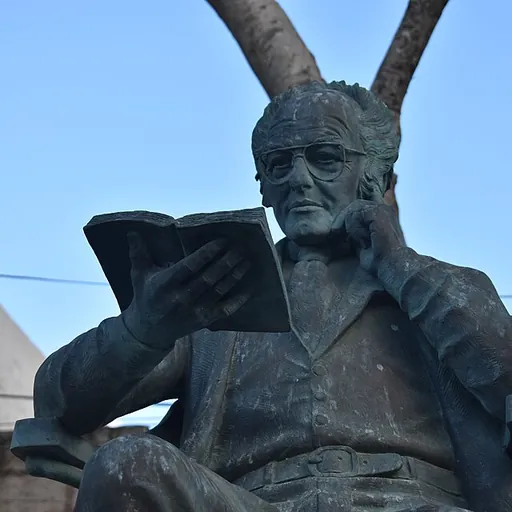
About Francis Ebejer
Lived 1925 – 1993 (aged 67). Francis Ebejer was a Maltese writer, poet, playwright and novelist.
Francis Ebejer (28 August 1925, Dingli — 10 June 1993, St Julian's) was a Maltese dramatist, novelist and playwright. He is regarded as one of the most influential writers in Maltese history, inspiring generations of writers beyond his death. Some of his most notable works include Il-Vaganzi tas-Sajf, Boulevard (1964), Menz (1967), Requiem For A Malta Fascist (1980), Il-Ħadd fuq il-Bejt (1964).
Biography Ebejer studied medicine at the University of Malta between 1942 and 1943 before abandoning the course to work as an English-Italian interpreter with the 8th Army of the British Forces in Tripolitania, North Africa (1943–44). After the war he became a teacher in England. Upon completion of St Mary's Training College, Strawberry Hill, Twickenham (1948–50), he was appointed a primary school headmaster in Malta, a post he held till 1977.
Ebejer wrote seven full-length novels in English, and another one in Maltese, all published. His final novel, The Maltese Baron and I Lucian was published in 2002, nine years after the author's death. Other novels by Ebejer include A Wreath of Maltese Innocents (1958), Wild Spell of Summer (1968), In the Eye of the Sun (1969), Come Again in Spring: Requiem for a Malta Fascist (1980), and Leap of Malta Dolphins (1982). He wrote the Maltese rumanzett entitled Il-Ħarsa ta' Rużann. Several university students have written their theses for laureateships and doctorates in English on his works.
Ebejer was the leading Maltese dramatist of the second half of the 20th century, having written over fifty plays, the majority in Maltese, for the stage, television and radio, several of them recipients of literary and dramatic awards. In the 1950s he wrote mostly for the radio, the sixties and the seventies saw the more mature Ebejer producing most of his stage plays for Malta's National Theatre, the Manoel Theatre in Valletta.
Ebejer had three children: Frank, Mary Jane and, later, Damian. Damian went on to become an artistic and a poet. Frank died in a road accident in Hampshire in 1972 at the age of twenty-two. Around this time he wrote Vum-Barala-Zungaré (1973), a play often noted for its critical view of divine providence, although Ebejer consistently rejected claims that he had lost his faith. In later years, after visiting his brother, a bishop in Brazil, he returned to a practising Catholic. He subsequently contributed weekly articles to a local newspaper, in which he argued for the authenticity of the Turin Shroud.
On 10 June 1993, Francis Ebejer died at the age of 67. He passed away at his home in Swieqi. His funeral in Ħad-Dingli was attended by members of Parliament, actors, theatre producers and publishers. He is buried in the Ħad-Dingli cemetery.
Ebejer’s plays introduced themes of introspection concerning Maltese society, expressed through a stylistic approach noted for its linguistic precision. His stage direction, along with his writing, adopted techniques that were new to Maltese theatre at the time. His plays Vaganzi tas-Sajf (1962), Boulevard (1964) and Menz (1967) achieved notable success and marked a shift toward drama with a more intellectual focus in the Maltese theatrical landscape. His work Id-Dar tas-Soru was later adapted into a series for Maltese television; while regarded by some viewers as demanding, it nonetheless attracted a wide audience.
His work explored universal themes. Although he expressed an interest in Maltese identity, he avoided presenting it in generalised terms, instead acknowledging the complexity and contradictions inherent in human experience. By addressing issues that extend beyond cultural contexts specific to a certain point in time, his writing has maintained a broad cultural relevance . When reflecting upon Francis Ebejer's work, Prof. Arthur Pollard (University of Hull) said, "Ebejer never suggests the merely occasional; he seeks to endow the local reality with universal significance."
Ebejer encountered many personal mishaps and sufferings in his life, which some scholars feel were an inspiration for his works. He was known to be a very private person, even to his closest friends. However, in 1992 and one year before his death, he uncharacteristically allowed a TV camera into his home for the filming of a failed foreign docudrama. The unique footage taken of Ebejer was kept unused for a number of years until it was utilised in "A Gentleman from Malta."
This documentary examined his personal life and how it influenced his philosophy in approaching his work. They interviewed many of contemporaries including Karmen Azzopardi, Dr Paul Xuereb, Charles Thake and Josephine Zammit Cordina, as well as his friends and son, Damian Ebejer.
In 1998, it won the Best Documentary of the Year in the MBA Programme Awards.
Don’t just read it —
keep it.
Full-length biographies made to live with: read them, listen on the way to work, watch them tonight.
- E-book
- Audio
- Video
Instant download · yours to keep · every purchase keeps this site free
Important facts
People in Francis Ebejer's life
Named in this biography and alive at the same time

Related people
Same field, nearest in time



Contemporaries
People whose lives overlapped Francis Ebejer's



Frequently asked questions
Who was Francis Ebejer?
Maltese writer (1925-1993)
When was Francis Ebejer born?
Francis Ebejer was born on 28 August 1925 in Dingli.
When did Francis Ebejer die?
Francis Ebejer died on 10 June 1993 in Swieqi.
What was Francis Ebejer's occupation?
Francis Ebejer was a writer, poet, playwright and novelist.
What nationality was Francis Ebejer?
Francis Ebejer was Maltese.
Sources & further reading
Cite this page
APA: Biography.guide. (2026). Francis Ebejer. https://biography.guide/francis-ebejer/
MLA: "Francis Ebejer." Biography.guide, https://biography.guide/francis-ebejer/.
Chicago: "Francis Ebejer." Biography.guide. https://biography.guide/francis-ebejer/.
Data last updated: 2026-09-20 · Spot an error? Report a correction.
Page generated 2026-09-27 05:09 UTC