
About Francis Andersen
Lived 1925 – 2020 (aged 94). Francis Andersen was an Australian linguist, biblical scholar and theologian.
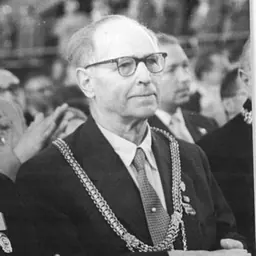
Francis Ian Andersen (28 July 1925 – 13 May 2020) was an Australian scholar in the fields of biblical studies and Hebrew. Together with A. Dean Forbes (full name Alfred Dean Forbes, born 1941), he pioneered the use of computers for the analysis of biblical Hebrew syntax. He taught Old Testament, History, and Religious Studies at various institutions in Australia and the United States, including Macquarie University, the University of Queensland, and Fuller Theological Seminary. His published works include the Tyndale commentary on Job, and Anchor Bible commentaries on Hosea, Amos, Habakkuk and Micah, and over 90 papers (some as co-author).
Biography Francis Ian Andersen was born in Warwick, Queensland, Australia. In his final high school examinations in 1942, he topped the state of Queensland, winning an Open Scholarship to the University of Queensland. He received a Bachelor of Science from the University of Queensland in Chemistry in 1947. He accepted a position as Demonstrator in Chemistry at the University of Melbourne, where he taught until 1953. He received a Master of Science in Physical Chemistry in 1951, and a Bachelor of Arts in Russian in 1955, both from the University of Melbourne.
In 1952 he married Lois Garrett, a medical doctor. They had five children: John (born 1954), David (born 1956), Martin (born 1958), Nedra (born 1961), and Kathryn (born 1965).
While he was undertaking a postgraduate degree in chemistry at the University of Melbourne, he was attracted into the field of biblical studies by Stuart Barton Babbage, the principal of Ridley College, an Anglican theological college in Melbourne, who persuaded him to join the staff there. In 1957 he received a Fulbright Scholarship to study at Johns Hopkins University in Baltimore, United States under William F. Albright. He received a PhD with a dissertation entitled "Studies in Hebrew Syntax".
In 1960 he returned to Ridley College as Vice-Principal. In 1963 he accepted an appointment as Professor of Old Testament at the Church Divinity School of the Pacific, in Berkeley, California. In 1973 he became Warden of the College of Saint John the Evangelist in Auckland, New Zealand. A year later, he returned to Australia. From 1974 to 1975 he was Exchange Professor at the Department of Near Eastern Studies at the University of Michigan in Ann Arbor, Michigan. In 1975 he became Associate Professor of History at Macquarie University, in North Ryde, New South Wales, where he taught until 1980. In 1981 he became Professor of Studies in Religion at the University of Queensland, in St Lucia, Queensland. He later lived in Melbourne, Australia.
His wife Lois died in 2010. In 2015 he married Margaret Johnson nee Beazley. He died on 13 May 2020 at the age of 94.
Work Andersen had a wide range of research interests, and has been described as a polymath. As can be seen from his bibliography, he published research in such diverse fields as archaeology, biblical studies, chemistry, computational linguistics, Hebrew orthography, morphology, and syntax, pseudepigrapha, Semitic languages, sociology, and theology.
Much of his most significant work was the result of two academic partnerships he formed when he was teaching at the Church Divinity School of the Pacific in Berkeley, California in the 1960s. The first was with David Noel Freedman, who was teaching at the San Francisco Theological Seminary. They teamed up commencing in 1965 to write three commentaries on the minor prophets in the Anchor Bible series, which was edited by Freedman. Andersen wrote a fourth commentary on Habakkuk by himself.
The other research partnership was with A. Dean Forbes, who was Project Manager for Computer Speech Recognition Research at Hewlett-Packard Laboratories in Palo Alto, California. Over a period of more than thirty-five years, Andersen and Forbes carried out research in the field of computer-assisted corpus linguistics, developing a computer database of all the clauses in the Hebrew Bible.
This database enabled Andersen and Forbes to produce a series of computer generated keyword-in-context concordances, as well as analyses of the vocabulary of the Old Testament (see bibliography on computational linguistics). Their database has been licensed to Logos Bible Software and provided with a syntax search engine. (see bibliography on Pseudepigrapha). He made a number of trips to the Soviet Union, including a visit in January 1989 under an exchange agreement between the University of Queensland and the USSR Academy of Sciences. He spent much time examining ancient manuscripts in various libraries in Leningrad (now Saint Petersburg), including the Russian National Library (Saltykor-Shchedrin), He was able to shed light on a number of important manuscripts hitherto little accessed by Western scholars. One of these was the Karasu-Bazar Codex(Codex by Krymchaks) of the Latter Prophets, which may be the oldest extant biblical codex in Hebrew. Another was manuscript A, representing the shorter recension of 2 Enoch, the very existence of which had previously escaped the attention of Western scholars. He also made a visit to Bulgaria in 1986 and published an article on Pseudepigrapha studies there.
Partial bibliography For a more comprehensive bibliography up to 1985, see For a current bibliography of works on computational linguistics, see Andersen-Forbes Resources
Archaeology
Biblical studies
(This commentary is, according to Tremper Longman, "one of the best on any biblical book." )
Chemistry
Computational linguistics
Hebrew morphology
Hebrew orthography
Hebrew syntax
Pseudepigrapha
Semitic languages
Sociology
Theology
Don’t just read it —
keep it.
Full-length biographies made to live with: read them, listen on the way to work, watch them tonight.
- E-book
- Audio
- Video
Instant download · yours to keep · every purchase keeps this site free
Important facts
People in Francis Andersen's life
Named in this biography and alive at the same time





Related people
Same field, nearest in time



Contemporaries
People whose lives overlapped Francis Andersen's



Frequently asked questions
Who was Francis Andersen?
Australian linguist (1925-2020)
When was Francis Andersen born?
Francis Andersen was born on 28 July 1925 in Warwick.
When did Francis Andersen die?
Francis Andersen died on 13 May 2020.
What was Francis Andersen's occupation?
Francis Andersen was a linguist, biblical scholar and theologian.
What nationality was Francis Andersen?
Francis Andersen was Australian.
Sources & further reading
Cite this page
APA: Biography.guide. (2026). Francis Andersen. https://biography.guide/francis-andersen/
MLA: "Francis Andersen." Biography.guide, https://biography.guide/francis-andersen/.
Chicago: "Francis Andersen." Biography.guide. https://biography.guide/francis-andersen/.
Data last updated: 2026-09-20 · Spot an error? Report a correction.
Page generated 2026-09-27 05:33 UTC