
About Francesco Morone
Lived 1471 – 1529 (aged 57–58). Francesco Morone was an Italian painter.
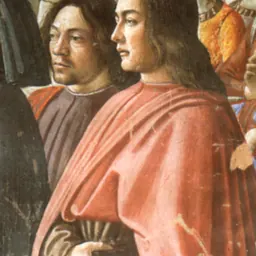
Presumed self-portrait of Francesco Morone. Detail of the Washing of the Feet, first half of the 1510s, Castelvecchio Museum, Verona
Francesco Morone (1471 – 16 May 1529) was an Italian painter, active in his native city of Verona in a Renaissance style.
He learned the art of painting in his father Domenico Morone's workshop, where he met Girolamo dai Libri, with whom he formed a lasting friendship and collaborated on several occasions. After working for a long time as his father's assistant, in 1498 he signed his first independent work: a Crucifixion for the Avanzi Chapel of the Church of San Bernardino in his native city. This first work marked the beginning of his artistic separation from his father's figure, a process of emancipation that was completed around 1502–1504 with the creation of the canvas Madonna enthroned with Child between Saints Zeno and Nicholas, considered one of his finest works. His successful period continued with the fresco decoration of the sacristy of the Church of Santa Maria in Organo in Verona, unanimously regarded as among his masterpieces.
Around 1517 he signed the Stigmata of Saint Francis. also a canvas of fine workmanship=In his later works, one can discern the influence of his pupil Paolo Morando, who in the meantime had surpassed his master in adapting to new stylistic trends. In the last years of his life, he drew even closer to religion, which probably influenced his artistic production, thereafter characterized by "sweet and melancholy Madonnas". He died in 1529 and his remains were placed in San Bernardino, where many of his most important works are still preserved.
Biography Birth and training
Francesco Morone was born around 1471 in the district of San Vitale in Verona, the third of seven children of Cecilia and Domenico, himself also a renowned painter. He learned the art of painting in his father's workshop, together with his younger brother Antonio (born around 1474), and collaborated for a long time with his father on various commissions. From the documents in our possession, we know that he continued to live in San Vitale even after marrying Lucia and having some children with her, always working in the Veronese territory.
From his father Domenico he inherited the influences of Mantuan Mantegnism, though he was able to broaden his artistic horizons when he came into contact with the trends of the Venetian environment. He probably stayed in the lagoon, where he encountered the Venetian school of Vittore Carpaccio, Bartolomeo Montagna, Cima da Conegliano, Giovanni Bellini, and Antonello da Messina. The influence of these artists is evident in Francesco's works, which are distinguished by a different approach compared to his father, who remained faithful to the Mantegna school.
Maturity
Between 1505 and 1507 Francesco Morone, assisted by some collaborators, executed the frescoes in the sacristy of the Church of Santa Maria in Organo in Verona, unanimously considered among his masterpieces, so much so that Vasari described it as "the most beautiful... that there was in all Italy". In the upper part of the wall he painted portraits of popes and other illustrious figures linked to the Benedictine order, including some doges of the Republic of Venice. Vasari praised and minutely described the pictorial cycle, suggesting that he had the opportunity to admire it in person. The work has been appreciated by numerous art historians, among them Jacob Burckhardt who, in the 19th century, was still able to underline "the beauty of the Saviour surrounded by angels in glory frescoed on the ceiling" of Mantegna-inspired derivation, today almost illegible.
In the same years Francesco welcomed as a pupil Paolo Morando, nicknamed Cavazzola. Together, in 1509, they worked as "compagni depentori" on the fresco of the Pentecost for the conch of the Miniscalchi chapel in the Basilica of Sant'Anastasia. According to the analysis of Luciano Cuppini, in this work Francesco's hand is especially evident in "the alabaster-like luminosity of the Virgin and some of the Apostles, the reflection of the dazzling light of the sky brightened by the Holy Spirit". Cavazzola's apprenticeship did not last long, since he soon emancipated himself from his master, developing a personal style which, in turn, influenced Francesco himself.
In 1508 he collaborated with the painter Michele da Verona for the frescoed façade of the chapel of the Madonna in the Church of Santa Chiara in Verona. To Francesco are attributed the figures of God the Father, Saint Matthew, Saint Mark and Joshua on the external façade, and Christ in the roundel on the internal vault. The following year he painted a Madonna and Child, now preserved in the Accademia Carrara in Bergamo.
Around the same years he may have painted the so-called Madonna Moscardo in which, in the clearly northern-style background landscape, the artist reproduces on the left Albrecht Dürer’s engraving Sea Monster. This represents the only known literary quotation of the German master in Francesco Morone's oeuvre, whereas it recurs frequently in the works of his friend Girolamo dai Libri.
From the Olivetan monks of Santa Maria in Organo, in 1515 Francesco Morone also received the commission to decorate the doors of the ancient organ, in collaboration with the painter and miniaturist Girolamo dai Libri. Vasari recounts the long friendship already linking the two artists, probably both trained in Domenico Morone's workshop=The contract signed on 12 November 1515 between Abbot Cipriani and the two artists stipulated that the two doors should appear "beautiful and praised by those who understand the art", reflecting the monks' desire to embellish their church after the tragic events of the War of the League of Cambrai which had shaken Verona.
The attribution of individual contributions in the work is debated: Vasari assigns to Francesco the realization of Saint Benedict and Saint John the Evangelist, while to Girolamo the flowers and the background; art historian Carlo Del Bravo has substantially proposed the opposite. Others still suppose that each artist painted one door. Contemporary criticism tends not to distinguish sharply between their contributions, supporting instead that both, bound by deep friendship, worked on the doors in perfect harmony, dividing the task equally and influencing each other. The work was completed in 1516 and placed in a chapel built by the Olivetans specifically to house the instrument. Later, probably on the occasion of the Baroque renovation of the organ, the doors passed to the Dal Pozzo family until, at the beginning of the 19th century, Count Bartolomeo donated them to the parish church of Marcellise (today in the municipality of San Martino Buon Albergo), where they still remain.
The collaboration between the two and Santa Maria in Organo must have continued with other works, however now lost.
Style and criticism
As mentioned, Francesco was trained in his father's workshop, whom he soon surpassed in skill, as Vasari recounts. In the following centuries, however, critics reassessed the works of Domenico Morone, considered one of the main protagonists of the transition of the Veronese school of painting towards the Renaissance after a period of creative crisis, assigning to the son a less incisive role, given his late emancipation from his father's style. In any case, Francesco fully belongs among the protagonists of the second generation of Renaissance painters in Verona, who were able to combine the Mantegnesque experience learned in the workshop with currents coming from the flourishing Venetian artistic scene.
Although at first he showed himself strongly tied to his father's schemes, in adulthood he managed to elaborate a personal style characterized by meticulous attention to naturalistic details (an aspect he shared with his friend Girolamo dai Libri) and by a careful study of perspective and lighting, aimed at giving depth and realism to his compositions. To achieve this, he often placed the protagonists of his works within architectural scenographies, in the manner of Mantegna’s teaching. Variegated draperies, sumptuous garments and naturalistic landscapes are further recurring elements in his production.
In the last years of his life, his painting failed to evolve in step with the rapid transformations that were renewing the Veronese scene, enlivened by the innovative solutions introduced by Giovanni Francesco Caroto and by his pupil Paolo Morando. His last works reflect a further deepening of his religious sentiment, as evident from the marked mysticism that permeates them.
Works Virgin and Child, Pinacoteca di Brera, Milan Virgin and Child, National Gallery, London Samson and Delilah, Museo Poldi Pezzoli, Milan Frescos at Santa Chiara Church, Verona
Don’t just read it —
keep it.
Full-length biographies made to live with: read them, listen on the way to work, watch them tonight.
- E-book
- Audio
- Video
Instant download · yours to keep · every purchase keeps this site free
Important facts
People in Francesco Morone's life
Named in this biography and alive at the same time


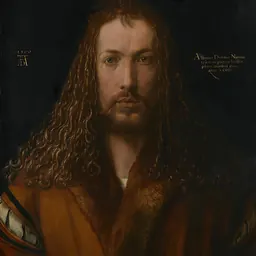
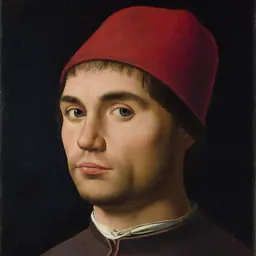

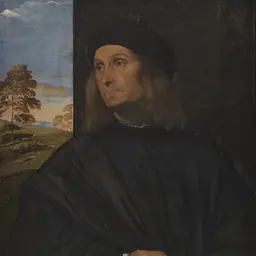
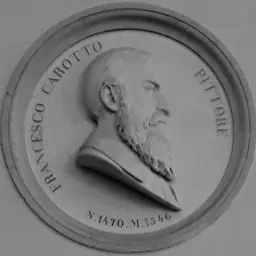

Related people
Same field, nearest in time



Contemporaries
People whose lives overlapped Francesco Morone's


Frequently asked questions
Who was Francesco Morone?
Italian painter (1471-1529)
When was Francesco Morone born?
Francesco Morone was born in 1471 in Verona.
When did Francesco Morone die?
Francesco Morone died on 26 May 1529 in Verona.
What was Francesco Morone's occupation?
Francesco Morone was a painter.
What nationality was Francesco Morone?
Francesco Morone was Italian.
Sources & further reading
Cite this page
APA: Biography.guide. (2026). Francesco Morone. https://biography.guide/francesco-morone/
MLA: "Francesco Morone." Biography.guide, https://biography.guide/francesco-morone/.
Chicago: "Francesco Morone." Biography.guide. https://biography.guide/francesco-morone/.
Data last updated: 2026-09-20 · Spot an error? Report a correction.
Page generated 2026-09-27 05:26 UTC